Sunday, February 17, 2008

All Summer in a Day

One of the most asked-about Bradbury stories is "All Summer in a Day". Barely a day goes by without someone posting to the Bradbury message boards enquiring about their vague memory of a short film they were once shown at school.

I was quite amused to discover this web page from the Chicago Tribune about "seasonal affective disorder," which refers to Bradbury's story. The page also has a direct link to the full text of the story.

As for the film, it occasionally appears on YouTube and elsewhere, no doubt without permission of the copyright holders. Its latest appearance is here.

In case you were wondering, the image on the left is the cover of the March 1954 issue of The Magazine of Fantasy & Science Fiction which contained the first appearance of "All Summer in a Day".

Monday, February 11, 2008

Fahrenheit 451 - Moscow style. Herman Melville - Bradbury style.

The Moscow Times has published a review of a new Russian stage adaptation of Bradbury's Fahrenheit 451. It's not clear whether this is a translation of Bradbury's own play, or a completely new adaptation. Read John Freedman's review here.

Subterranean Press, which has produced some excellent limited edition versions of Bradbury books, has announced the first book publication of Moby Dick - Ray Bradbury's original screenplay for the 1956 feature film directed by John Huston. This is an important publication, since it finally gives us a chance to see what Bradbury brought to the adaptation, without the distortions imposed by Huston, Huston's friends, and others such as Orson Welles.

Why does it matter? For at least three reasons. First, Huston grabbed co-script credit from Bradbury, and somehow managed to overturn a Writer's Guild of America ruling on script credit which had gone in Bradbury's favour. Second, because the innovations in Bradbury's version of Moby Dick are so powerful that many of them have been carried over into more recent adaptations of Melville's novel, as if Bradbury's text were superior to Melville's. Third, because (as I have argued elsewhere) Bradbury's experience on the Moby Dick project had a major influence on the next fifty years of his development as a writer: through his Irish stories and plays, his endless wrestling with the Melville tribute Leviathan '99, his novel Green Shadow, White Whale, and much else.

Wednesday, January 09, 2008

More decline and decay...

Further to my previous blog mentioning the remains of the Fahrenheit 451 monorail, some more ruins to ponder. This time, the remains of Venice, California, which have had a considerable impact on Ray Bradbury.

As far I am aware, the first declared influence was on Bradbury's short story "The Fog Horn", the 1951 tale of a lighthouse destroyed by a lonely dinosaur. The story was the basis of the 1950s monster movie The Beast From 20,000 Fathoms. So where is the Venice influence? The dinosaur itself! In a frequently recounted anecdote, Bradbury tells how he saw the remains of the Venice Pier rollecrcoaster, and imagined it to be the skeletal remains of a dinosaur. Freewheeling from there, he asked what would lure such a creature to such a place. A lighthouse, of course!

But Venice has had more than one story's worth of influence on Bradbury. Much of the carnival imagery of his early stories is likely to have been influenced by the carnival-like Venice, California, which Bradbury probably first visited in the late 1930s when he was in his teens.

Later in life, Bradbury makes explicit use of Venice, its pier and derelict canals in his 1985 novel Death is a Lonely Business. Indeed, his depiction of the town influenced the cover art of several editions of the novel - there are some examples here.

There are more images of Venice in its prime and in decline in the online photo collection of the Los Angeles Public library. Click here to see a selection.

Saturday, January 05, 2008

New Findings: Old Stuff

I've been making new finds of old stuff on the web, most of them thanks to Google Alerts. Here are some curios that have just come to my attention.

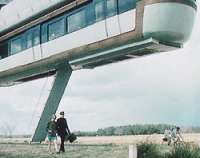
Ever wondered what happened to the monorail Montag used to get home in Truffaut's film of Fahrenheit 451? It was a real monorail in France, built as a protoype, and Truffaut chose it because of its futuristic appearance.

The monorail is no longer in existence, but a few years ago some monorail enthusiasts tracked down what remains of the system, including the vandalised car and some sections of track. Find out more by visiting Randy Lambertus's page from 1999.

Going back to 1993, we find Ray Bradbury being interviewed about his alleged total recall. This unlikely gift is what allows him to remember the moment of his own birth. No one really believes this claim, but his belief in it led him to write one of his classic short stories, "The Small Assassin". Bradbury has discussed this in many interviews, but this one from YouTube is one I hadn't seen before. It's from a Canadian TV show called Prisoners of Gravity.

Friday, December 14, 2007

Exclusive! Preview of the new journal

Courtesy of William Touponce, director of the Center for Ray Bradbury Studies at Indiana University, comes this exclusive sneak preview of the forthcoming new journal The New Ray Bradbury Review:


The cover artwork (click on it to enlarge) is by Bradbury himself. Inside is a collection of articles by various Bradbury scholars, most focusing on this issue's topic of "adaptation". Here's the table of contents:

Among the contributors (click to enlarge) you may notice Profs Eller and Touponce (co-authors of Ray Bradbury: The Life of Fiction), David Mogen (author of Ray Bradbury), Terry Pace (who has long been associated with Bradbury's work in theatre), and film scholar John C. Tibbetts. Oh, and yours truly has managed to sneak in there with some material on Bradbury's work in the audio media.

The eagle-eyed reader may notice that, although this is a brand new journal, the cover indicates it as "Volume 2". This, says Bill Touponce, is a nod to William F.Nolan, who published the pioneering original Ray Bradbury Review some years ago, and who contributes the preface to this new journal.

As yet, there is no information on how to obtain the journal. As soon as this is decided, I will post the information here.

Saturday, December 01, 2007

Exclusive! New Movie in Production

Urban Archipelago Films, producers of 2005's short film A Piece of Wood, have announced their new feature film, Ray Bradbury's Chrysalis. Producer Roger Lay Jr kindly supplied this behind-the-scenes photo (click to enlarge) from the first days of shooting. It tantalisingly gives a glimpse of the special effects which will be key to the concept of the movie. To the right of the photo is director Tony Baez Milan, with producer Lay next to him.

Roger recently spent some time with Ray Bradbury, showing him the work on the movie so far. Both Roger and Ray seem pleased with the movie thus far:


"Chrysalis" was first published in Amazing Stories in 1946, and has appeared in only one of Bradbury's books to date, S is for Space (1966). Back in '46, the story didn't even make the cover of Amazing Stories...


...and it must be one of Bradbury's least re-printed stories. It's pleasing to see a lesser-known piece being filmed, instead of further attempts to film already familiar tales.

Urban Archipelago have a web site for documenting Chrysalis, which you can view here. The most interesting content on the site so far is the conceptual art by D. Hirajeta (click on "gallery" to view).

Here is what Urban Archipelago have to say about the new production in their official press release:

A compelling thriller that transcends both time and space, RAY BRADBURY’S CHRYSALIS is based on the short story written by BRADBURY, the acclaimed writer of such literary classics as FAHRENHEIT 451, THE MARTIAN CHRONICLES and THE ILUSTRATED MAN. The short story was originally published in 1966 as part of the science fiction anthology titled S IS FOR SPACE.

It is precisely Mr. Bradbury's legendary body of work and his numerous contributions to the literary and film industries that solidifies the world-wide appeal for this project.

The script for CHRYSALIS has been developed under the master's guidance and it is the second collaboration between Urban Archipelago Films and this legendary author.

The first product to come out of the filmmakers and Bradbury's joint forces was the critically acclaimed short film A PIECE OF WOOD. The short film has been playing in film festivals nation wide since its Premiere in November of 2005 and is currently available ON DEMAND through AT&T Digital Cable via ILLUSION TV.

About The Film

In the great tradition of past works of literature from one of America’s most revered storytellers, CHRYSALIS presents a compelling exploration into human nature.

In the future: The world is ravaged, a third world war has left our planet in a state of decay. In a research facility a handful of scientists research ways to sustain plant life. Scientist Benjamin Rockwell has been called to this decaying research facility. One of the scientists there, Smith, apparently has died. Smith lies on a table, his body transformed, his eyes and mouth grown shut. After getting over the shock, and completing an examination, Rockwell realizes that there is still a pulse within Smith...

His body continues changing...a Chrysalis has grown around Smith in order to protect him.

Now in earth’s darkest hours these scientists must figure out what mysteries lay inside the CHRYSALIS.

CHRYSALIS is a thriller with a science fictional background and glimmers of hope from the beginning. There is action, as the characters turn against each other’s beliefs at the edge of a world that slowly disappears before they can discover ways to stop or prolong the planet’s demise. Are they struggling hopelessly, trying to reach goals that may be unattainable?

The debate of science vs. faith is explored as the characters struggle with their beliefs, their doubts, their dreams, and their fears. Can human beings change the course of nature? Could nature intervene as the world is effectively destroyed? Is the world worthwhile? In the darkest hours, would humans deserve another chance?

RAY BRADBURY’S CHRYSALIS features an impressive cast including John Klemantaski (VIVA), Darren Kendrick (DISORDER), Corey Landis (THAT 70’S SHOW), Elina Madison (BROTHERS AND SISTERS), Glen Vaughan (JESSE JAMES: LEGEND, OUTLAW, TERRORIST), and Larry Dirk (DR. QUINN, MEDICINE WOMAN)

The film is produced by Roger Lay, Jr. and directed by Tony Báez Milán. Cheyenne Pesko is the editor and post-production supervisor. Gabriel Diniz serves as director of photography with production design by Gladys Rodriguez. Music is composed and conducted by Brandon Moore

The film features special creature effects by Romaire Studios, the Emmy Award winning FX facility founded by Lee Romaire.

Some of Romaire's recent credits include the TNT series NIGHTMARES AND DREAMSCAPES, based on the short stories of Stephen King as well as the HBO hit Drama series SIX FEET UNDER, for which the team was awarded an Emmy award for outstanding make up effects (prosthethics).

Principal photography on RAY BRADBURY’S CHRYSALIS is set to take place on multiple sets at the Broadcast Production Services Stages in Hollywood with second unit photography in the northern California dessert and the rainforest of El Yunque in Puerto Rico.

Tuesday, October 16, 2007

Something Wicked This Way Comes

I finally found time to finish my review of the new audio production of Something Wicked This Way Comes. This new CD set is available to buy online from the likes of Amazon and Blackstone.

To read the review - and find out what Mr Halloway, Will, Jim and Mr Dark really look like - click here.

Saturday, October 13, 2007

Russian Bradbury

Ray Bradbury's work seems to be quite well known in Russia (and the rest of the former Soviet Union). Several Russian-language films have been based on his works, often without his permission: Vel'd (1987), Trinadtsatyj Apostol (1988), Vino Iz Oduvanchikov (1997).

Two of the short animated films have recently popped up on YouTube. The most interesting of these is There Will Come Soft Rains (1984). In some ways more bleak than the Bradbury original, this film also seems to make some comment on religion, or Christianity, or western values. You can view the film, with English subtitles, here.

Less interesting, and rather primitive in its animation, is Here There Be Tygers. I know very little about this film, except that it is based on the story of the same name (which has been adapted once for live action, in the Ray Bradbury Theater series; Bradbury also wrote a teleplay of the story for the original Twilight Zone series in the 1960s, but it was never filmed). You can view the animated film, with English subtitles, here. Until this version appeared on YouTube, I had never seen a subtitled version; it's nice to be able to understand what's going on in the film!

Thursday, September 27, 2007

Colonial's Latest: Something Wicked

Look out! Just in time for Halloween, Colonial Radio Theatre's production of SOMETHING WICKED THIS WAY COMES is just about to be released!

It's available to pre-order from Blackstone, here, and should be available from other sources such as Amazon and Borders fairly soon. The official release date is 1st October.

Colonial very kindly supplied me with a review copy, and I can report that this is a rollercoaster of a production, and a worthy successor to their previous release, the award-winning Dandelion Wine. The script is by Bradbury himself - it is essentially his stage play version of SWTWC, ever so slightly modified for radio/audio.

Unlike Dandelion Wine, the SWTWC play is a direct adaptation of the novel, but with many of the introspective chapters (revealing characters' inner thoughts) eliminated. This means the story rolls by at a slick pace. I think those of you who use SWTWC in the classroom will find the audio production to be a useful study aid.

I hope to post a detailed review of the production soon, but for now I'll just say that I found the music and post-production to be lavish, if at times overpowering. The performances are a mixed bag, but Mr Dark and Mr Halloway come across well. The production perhaps lacks some of the intimacy of the later parts of Dandelion Wine, and Bradbury's removal of introspection - desirable for stage, but arguably not so desirable for radio - makes for a less rounded narrative. But this may be outweighed by the gain in pace, which the Colonial team have made the most of.

Colonial have also announced that they are working on another Bradbury piece: The Halloween Tree.

My thanks to Jerry Robbins of Colonial (who plays Mr Halloway, by the way) for the information and sneak preview of the CD cover art.

Friday, September 14, 2007

When Genres Collide

Publishing is quite a slow business. It's over a year since I presented a paper about Bradbury's Leviathan '99 at the Science Fiction Research Association conference in New York... but the book of the conference has only just come out.

When Genres Collide: Selected essays from the 37th annual meeting of the Science Fiction Research Association, edited by Tom Morrissey and Oscar De Los Santos, includes a diverse array of papers on various aspects of science fiction. My paper appears in a section alongside papers on Philip K. Dick and Norman Spinrad. Other delights include Lincoln Geraghty on 1980s Hollywood science fiction, and Adam Frisch on the Byronic hero in science fiction.

The book is now available from Amazon (direct link here) and other fine bookstores.