Wednesday, April 03, 2019

Another Fine Mess


 https://i.pinimg.com/originals/c9/39/ba/c939ba784f8ccd3216e9bd38797bcd21.jpg

Twenty-four years ago, in April 1995, The Magazine of Fantasy and Science Fiction debuted a new Ray Bradbury short story. "Another Fine Mess" is one of Bradbury's tributes to Laurel and Hardy, and another of his laments for the old Hollywood of his childhood.

Bella Winters, newly moved into a house near Effie Street in Los Angeles, awakens one night and hears voices outside. And what sounds like a piano being hit. She becomes convinced that she is hearing, in the darkness outside, Laurel and Hardy attempting to get a piano up the steep concrete steps. She calls her friend Zelda, a silent film fanatic, and Zelda too becomes convinced that Stan and Ollie are somehow haunting the steps. Perhaps, Bella suggests, they have returned because no one has ever told them how much they are loved...

The piano reference is, of course, to Laurel and Hardy's classic, Oscar-winning short film The Music Box (1932), in which the comic duo repeatedly attempt to get a boxed upright piano up an impossibly long flight of stairs.

As a longtime resident of Los Angeles, and a lifelong fan of Laurel and Hardy, Bradbury knew and loved the old Hollywood. Bella and Zelda represent aspects of himself, both characters being around his own age, and speaking of seeing Laurel and Hardy films in their early childhood. The old Hollywood may be gone, but vestiges of its geography survive even today, and Bradbury's story is partly a celebration of this. Bradbury had previously returned to old Hollywood in his 1990 novel A Graveyard for Lunatics, a fictionalised account of his own adventures in 1950s Tinseltown.

Oddly, for all his Angeleno knowledge and familiarity with Hollywood, Bradbury doesn't place "Another Fine Mess" at the real location used in The Music Box. The steps seen in the film are located in the Silver Lake area of Los Angeles, and run between Vendome Street and Descanso Drive. For some reason, though, Bradbury sets his story on nearby Effie Street. It's a similarly hilly place, and does indeed have some long concrete steps. But it has nowhere quite like the real Music Box steps. Of course, the story is a fantasy - Bella Winters' waking dream - so has no obligation to reflect reality. But it makes me wonder if Ray was basing the story's location on a particular house that he knew.

Laurel and Hardy purists might further object to Bradbury's Ollie repeatedly saying "Another fine mess" - when the real Hardy tended to say "Another nice mess". However, I'm going to give Ray a pass on this, since there is a Laurel and Hardy short called Another Fine Mess (1930). If Laurel and Hardy are allowed to misquote, then so is Ray!

Bradbury refers to The Music Box in another of his short stories, "The Laurel and Hardy Love Affair" (1987), and he put "the boys" into yet another story, "The Laurel and Hardy Alpha Centauri Farewell Tour", in 2000. And he famously saw Laurel and Hardy live on stage in Dublin in the 1950s, when he was in Ireland to write the film version of Moby Dick (1956). The love for Stan and Ollie declared by Bella and Zelda is heartfelt, and undoubtedly reflects Bradbury's own love for Laurel and Hardy.

Today, you can find "Another Fine Mess" in two of Ray's books: Quicker Than The Eye and Bradbury Stories: 100 of His Most Celebrated Tales.

And you can learn how the once-lost Music Box steps were "re-discovered" here: http://www.laurel-and-hardy.com/films/talkies/music-location.html


Tuesday, March 26, 2019

Fifty Years Beyond Apollo

If you didn't already know it, you will soon. This year is the fiftieth anniversary of the first Moon landing, and you can be sure there will be all sorts of celebrations and commemorations all over the world. Of course, it's not the first time Apollo 11 has been commemorated. Just one decade after Neil Armstrong's one small step, it was celebrated in a TV documentary presented and co-written by Ray Bradbury.

Infinite Horizons: Space Beyond Apollo seems to have begun life as an undated Bradbury script titled Beyond 1984, probably written in 1978. The documentary's presenter, called "Interlocutor" in the script, looks back on the Moon landing and asks philosophically what it was all about, whether it was worthwhile, if there is any hope, and what happens next. The tone of the script reflects Ray's frustration at humankind's greatest achievement - escaping the Earth and setting foot on another world - being cast aside and forgotten.

Ray's view was reflected in his other writings of that era. While at the peak of the US Moon preparations he had written eagerly about Houston Mission Control for Life magazine ("An Impatient Gulliver Above Our Roofs", 1967), a few years after Apollo he wrote a poem called "Abandon In Place", inspired by the now-deserted rocket pads of Apollo at the Kennedy Space Centre.

Ray developed his Beyond 1984 script through various drafts and titles - "Remembrance of Things Future" (March 1979) being one of them. By this draft, the "Interlocutor" was to interact with such futurist luminaries as Isaac Asimov and Alvin Toffler. The final version of the script, now titled Infinite Horizons: Space Beyond Apollo was written jointly by Ray and his producer-director, Malcolm Clarke. In this version - as in the finished documentary - Ray Bradbury is clearly identified as the presenter, stepping into the interlocutor role.

Malcolm Clarke would go on to an illustrious career as a film-maker. He received Oscars for best short documentary in 1989 and 2014 (You Don't Have to Die and The Lady in No. 6 respectively), and his other awards include those from the Writers Guild of America, the Directors Guild of America, Cable ACE - and an Emmy.

Incidentally, this wasn't the first time a Bradbury script had cast him as a presenter. In 1966, he drafted a TV science special called Tomorrow is Now where he would have shown the viewer a history of science from the Ancient Greeks to the present day. And in 1970 he wrote Death Warmed Over, another TV special with himself as host, this time on the subject of horror. Neither of these specials was produced as far as I know, although Death Warmed Over re-surfaced as an essay in a magazine.

Infinite Horizons: Space Beyond Apollo first aired on 17th July 1979 on ABC-TV, ten years and a day after the launch of Armstrong, Aldrin and Collins on Apollo 11. The final page of the script talks of humankind taking to the stars in solar-powered ships, like giant kites flying in formation, and like Christopher Columbus' ships heading out into uncharted waters. (Bradbury was never afraid of mixing his metaphors.) Ray's final lines echo Tsiolkovsky: "For Earth is only our birthplace after all. It needn't be our home forever."

A cut-down version of Infinite Horizons: Space Beyond Apollo can be viewed on Archive.org, here: https://archive.org/details/infinitehorizonsspacebeyondapollo_201505

My thanks to the Center for Ray Bradbury Studies for providing access to Bradbury's papers, which include the various draft scripts referred to above.

Monday, March 11, 2019

Repairs complete!

Following the migration of Bradburymedia to a new web host, repairs are now complete!

There are probably still some broken links around the place - particularly links to other websites, which I haven't had time to systematically check - but everything should now be back to the way it was before the migration. If you spot anything that looks wrong, please post a comment below and I'll check it out.

In case you're wondering what else is here, other than the blog posts, here's a selection of pages which you may find interesting:

My review of the classic feature film It Came from Outer Space (original screen story by Ray Bradbury): http://www.bradburymedia.co.uk/films/it_came/it_came.htm

My review of episodes of The Alfred Hitchcock Hour (scripted by Bradbury and adapted from Bradbury stories): http://www.bradburymedia.co.uk/films/hitchcock/hitchcockhour.htm

My overview of the classic radio series Bradbury Thirteen (based on Bradbury stories): http://www.bradburymedia.co.uk/audio/bradbury13/bradbury13.htm

Thanks for your patience during the refurb - and check back soon for some new content! 

Tuesday, March 05, 2019

My Scribblings

While Bradburymedia undergoes much needed maintenance, perhaps you'd like to peruse some of my more academic writing? I've collected many of my conference papers, journal articles and books chapters in two places, so take your pick:

Phil's writings at Researchgate: https://www.researchgate.net/profile/Phil_Nichols2

Phil's writings at Academia: https://wlv.academia.edu/PhilNichols

Maintenance continues...

I'm still doing repairs to Bradburymedia following its migration to a new web host. Most pages still work, but there will be dead links a-plenty.

Once the basic mechanical stuff is fixed, I'll begin posting new material. ("At last!" I hear you cry...)

Monday, February 11, 2019

Under maintenance...

Image result for roadworks sign


I'm doing some behind-the-scenes maintenance work on Bradburymedia, so don't be surprised if there are some glitches.

Normal service will be resumed as soon as possible!

Tuesday, December 25, 2018

Ray Bradbury's Christmas Gift


This is actually a re-post from 2013, but it's a perennial favourite - and seasonally appropriate to boot!


Seasons greetings, everyone!

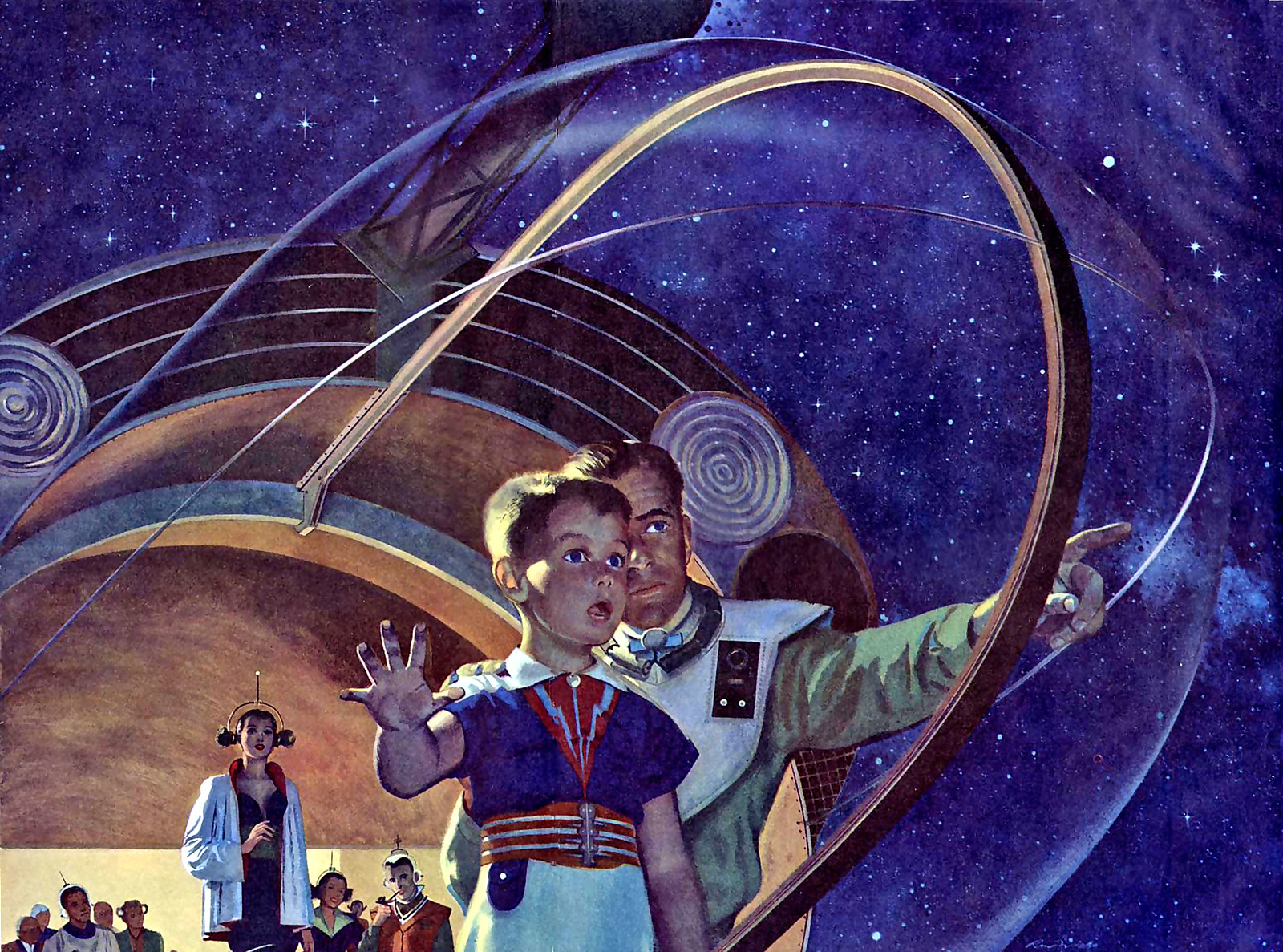
I've noted previously that Ray Bradbury wrote very few Christmas-themed stories, but one of his best-known is "The Gift". It was first published in Esquire magazine in 1952. The artwork above (click to embiggen) is by Ren Wickes, and in the child's face beautifully captures the good old "sense of wonder" people used to talk about in science fiction stories.

To find out why the child is so astonished, read "The Gift" here.

Thursday, August 30, 2018

A Challenge to Scholars!


I was commissioned by an American publisher to provide a short annotated bibliography of the best critical writing about Ray Bradbury's short stories. This meant ploughing through a list of about a hundred candidate essays looking for a dozen or so worthy of comment. And I discovered something rather interesting.

The essays tend to divide into two major groups: those written in the 1980s, and those written in the 2000s. In itself, nothing new. Not to me, at least. I've long been aware that Bradbury was a popular study in American high schools from the 1980s onwards, and that this had prompted a mini-industry of books about his work. Some of the best studies date from this period, including Wayne L. Johnson's book Ray Bradbury and Greenberg & Olander's essay anthology Ray Bradbury. (You'd think publishers would be able to come up with more distinctive titles.

And then, of course, Ray's death in 2012 provided the impetus for some re-evaluation, and hence we get new critical essay collections such as McGiveron's Critical Insights: Ray Bradbury and Critical Insights: Fahrenheit 451, and Gloria McMillan's Orbiting Ray Bradbury's Mars.

Now here's the really interesting thing. These newer collections of essays - and most of the individual essays on Ray published between 1980 and the present - stick to the same old stories. Fahrenheit 451 gets a lot of attention, and rightly so. The Martian Chronicles and the individual stories it comprises also get a lot of attention. But I can count on the fingers of... well, on one finger how many essays consider stories in any of the books shown at the top of this blog post.

Perhaps you recognise those books?

They are the seven new collections of Bradbury short stories published between 1980 and today. Seven collections, covering about thirty years. That's an awful lot of fiction, covering one-third of Bradbury's life. Nearly half of his professional career.

Which leads me to this challenge to scholars:

Enough of your re-assessments of "And The Moon Be Still As Bright" and applying a new "critical lens" to "The Veldt". How about picking something from that seven-volume, thirty-year range of short stories which no one else has considered?

Wednesday, August 22, 2018

Ninety-Eight Years of Ray Bradbury

It's hard to believe that Ray Bradbury was born nearly a century ago, but it's true. Today would have been his 98th birthday.

How to celebrate?

Well, if you're in Indianapolis, you could attend the fifth annual Ray Bradbury Memorial Lecture at the city library: Jon Eller of the Center for Ray Bradbury Studies will be giving an illustrated talk about Bradbury and art. Details are here.

Or if you're in the Los Angeles area, you could attend a free exhibition in Pasadena entitled Dreaming the Universe: The Intersection of Science, Fiction, & Southern California.

But if you're elsewhere in the universe - like me -  you'll have to make your own entertainment. I will spend the day reviewing my notes and documents relating to The Ray Bradbury Theater, because next month I will be presenting a conference paper on Ray's authorship of the sixty-five episode series which took up more than seven years of his professional life. After the conference, I will be submitting an extended version of the paper to an academic journal, and after that it will be expanded further into a book on the series. As with my PhD thesis (which examined Ray's screenwriting), I'll be presenting my findings as something of an archaeological dig into Ray's archives, trying to establish to what extent Bradbury the screenwriter can be seen as the "author" of his TV series. The answer is not as straightforward as you might think.

Happy Bradbury Day - and here's looking forward to the Bradbury Centenary in two years' time.

Sunday, August 05, 2018

Bahrani Looks Back on Fahrenheit 451 (2018)

A new interview has appeared on the HBO film of Fahrenheit 451 (2018) in which writer-director Ramin Bahrani looks back on his film. All previous articles presenting his views were part of the promotional push when the film was released.

Seeing his comments here, it is unfortunately obvious that the weaknesses of the film come largely from a flawed approach to the adaptation. Bahrani points out that he had never adapted a novel before; that he had never made a film with such a big budget; and that he had never made an action film before.
 
It shows.

He says he wanted to make a film that would work for teenagers. Hence all that nonsense jargon, all the reliance on emojis, and almost forgetting that F451 is about book-burning.

He says it's supposed to be set in a parallel present, rather than in the future - but there isn't a single indication of this in the film itself, and I don't recall any of the reviews picking up on this.

And he attributes the negative response to the film as coming from hardcore fans of the book.
 
Er... no, sorry: 25% on Rotten Tomatoes suggests a WIDESPREAD rejection of the film, not hostility from a narrow audience of Bradbury readers.

I remain a defender of the film, which isn't nearly as bad as that 25% rating would suggest. But nor is the film worthy of the Emmy Award it has been shortlisted for.