
In these posts, I cover each of Ray Bradbury's books, say something about the contents, then pick the best stories and adaptations.
Lockdown Choice #8: Dandelion Wine
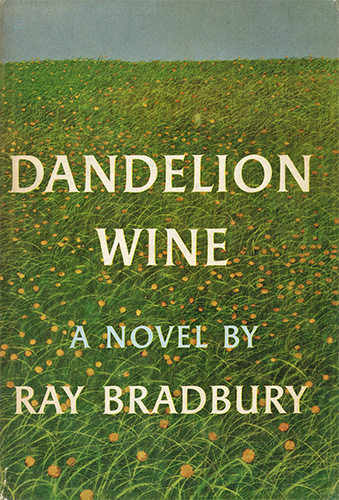 |
| First edition, Doubleday 1957. Cover design by Robert Vickrey. |
The Book
Dandelion Wine was Ray Bradbury's first book for Doubleday in four years, the last being 1953's The Golden Apples of the Sun. In the interim, he had published a children's book through a specialist publisher and two books with Ballantine. Although it may look like he had gone away from Doubleday and then come back, in reality it was a case of Dandelion Wine being delayed because he was having trouble finishing it.Bradbury's original concept for what became Dandelion Wine dates back to the mid-1940s. He drafted various brief outlines - often just a list of short story titles - called The Small Assassins, The Wind of Time, The Blue Remembered Hills and Summer Morning, Summer Night. The project evolved from being a set of stories about children and childhood, to including a conflict between children and the elderly. As with The Martian Chronicles, various short stories would be written and published first, as the book gradually came together as another of Bradbury's "composite novels" or "novelised story-cycles. (See my blog post on The Martian Chronicles for more on this concept.) The end result is a partly-biographical story of one summer in the life of young Douglas Spaulding.
By the 1950s, Bradbury had published a number of the short stories, but still had very little of the linking material that could tie everything together into anything resembling an overall narrative. We can only assume that, once again, he was being driven to create a "proper" novel either from his sense of what consititutes the true output of an author, or that he was being steered to the novel form by his editor. That editor, Walter Bradbury (no relation), was in fact convinced that Summer Morning, Summer Night would be a breakthrough book for Ray, his big opportunity to escape from the genre ghetto(es) that had both started and restricted his career.
 |
| Since the Dandelion Wine stories were mainly "realist" (rather than science fiction or fantasy), Bradbury was able to place them in all kinds of magazines. The short story called "Dandelion Wine" appeared first in this issue of Gourmet: the Magazine of Good Living! |
Through all this time Bradbury referred to his novel-in-progress, with its fluctuating title, as "the Illinois novel", a shorthand reference to the setting of this semi-autobiographical work. The specific setting was, of course, the fictitious Green Town, a thinly disguised portrayal of Ray's real hometown of Waukegan.
By 1954, Ray had a mass of story material, with way too many characters and plot threads for a single novel. Where he been able to get away with this in The Martian Chronicles because of the enormous spatial and temporal dimensions of that book (it tells the story of two whole planets over a span of thirty years), it would just be confusing with only the small scale of Green Town and one summer as a setting.
Things began to focus in a New York meeting between Ray, Walter Bradbury, and Ray's agent Don Congdon. The three discussed various ways forward, with a proposed three-pronged assault on the overlong text: Ray should trim out some of the characters (and merge some others); he should make the book less episodic, by spreading some of the stories out throughout the book; and he should develop and enrich the secondary child characters, the ones who the central characters Tom and Doug interact with. But even with these three resolutions, Ray struggled to make the book work.
 |
| "Summer in the Air" first appeared in Saturday Evening Post in February 1956. Artwork by Amos Sewell. |
 |
| Reader responses to "Summer in the Air". Bradbury's little story of buying new sneakers clearly struck a chord with Post readers. |
The breakthrough came when both Bradburys - Ray and Walter - came to the realisation that there might actually be two books here. There was the beautifully developing narrative of Douglas Spaulding during the year that he realised "I'm alive!" - and there was a set of sketches of the town and the people of Green Town. Ray wasted no time in rearranging the contents, arriving quite rapidly at Dandelion Wine as we now know it, and the set of other stories which would many decades later finally emerge as Farewell Summer (2006).
Oh yes, when you see Farewell Summer advertised as a "sequel" to Dandelion Wine, you are being slightly misled. They genuinely were conceived as two parts of a single work.
Tracking the exact development of the contents of Dandelion Wine as it evolved is far too complex for me to attempt here. Fortunately, however, those super-scholars Eller and Touponce have already done it. In their 2004 book Ray Bradbury: the Life of Fiction they include the following table which shows three stages of development. And since Dandelion Wine is usually published without chapter titles or chapter numbers, this table is also a handy indicator of which parts were originally short stories and which parts were written as bridging material.
 |
| Three stages in Ray's development of Dandelion Wine, from Eller & Touponce's Ray Bradbury: the Life of Fiction, p. 231 (Kent State University Press, 2004). Click to embiggen. |
Incidentally, there is a Bradbury book called Summer Morning, Summer Night - but this is one of those instances of Bradbury re-deploying a title. The 2008 book with that title is a rag-bag collection of left-overs from the Dandelion Wine/Farewell Summer project.
The Stories
Dandelion Wine is a bit tricky to navigate. Although the bulk of the content is made up of short stories which were originally published separately, there are no chapter headings. If I refer you to "Statues", could you find it in the book?Unfortunately, there's no way to deal with this issue, so I'll have to leave you to find the stories within the book for yourself...
"Illumination" - OK, this is the easy one. It's the introductory passage. We are introduced to Douglas Spaulding, who introduces his world to us. In fact, he magics the world to life, or at least he thinks he does. Given that Doug is really Ray Bradbury fictionalised, it seems appropriate that Doug is able to awaken the town so that it can play out his story:
He stood at the open window in the dark, took a deep breath and exhaled.
The street lights, like candles on a black cake, went out. He exhaled again and again and the stars began to vanish.
Douglas smiled. He pointed a finger.
There, and there. Now over here, and here . . .
Yellow squares were cut in the dim morning earth as houselights winked slowly on. A sprinkle of windows came suddenly alight miles off in dawn country.
"Everyone yawn. Everyone up."
"The Happiness Machine" - the one about Leo Auffman, inventor, who wants to make a machine that will bring, well, happiness. Eventually, he discovers that such a machine already exists. He takes Doug and Tom to the side of the house to look at the machine. It's nothing more nor less than - a window, through which he can see his family, going about their business. What I find curious about this story is that it represents one of the few moments in the book which has any resemblance at all to Ray's science fiction stories. Of course, here the story denies technology, relying instead on a shift of perspective, a dawning moment for Leo. But then again, isn't all of Bradbury's technology, in all of his stories, just a form of magic?
 |
| "The Happiness Machine", Saturday Evening Post, September 1957. Artwork by Fritz Willis. |
"Statues" - the one about John Huff leaving town. The whole of Dandelion Wine is about change, discovery and learning - all during what we imagine to be one long, hot summer. One of the things I like about the book is how it captures that childhood feeling that everything goes on forever. Summer holidays did used to last forever, didn't they? But now that you're all grown up, they're over in the blink of an eye. When John Huff, Doug's friend, announces that his family are leaving town, it comes as a devastating blow to Doug, who declares, "You been here in Green Town all my life. You don't just pick up and leave!" I wouldn't exactly say that this is a plotted story - it's more a collection of moments, a series of emotional beats. But that's what makes it ring true.
"The Whole Town's Sleeping" - the one about The Lonely One and the Ravine. If one story sums up Bradbury's fictional Green Town, it's this one. We go with Lavinia Nebbs across town to the theatre, and we travel back with her as she takes a short cut aross the ravine. Which she knows she shouldn't do. And we know it, too. It's a classic tale of suspense. Even if you only ever read one story from Dandelion Wine, please make sure it's this one. Sure, the tone of the story is very different from much of the rest of the book, but it's the fear factor in this story that makes the sugary-sweetness of the rest of the book bearable.
"Good-by, Grandma" - spoiler alert: as the title suggests, this one is about the death of Doug's grandmother. The family can't let her go because, well, who will fix the roof next spring? Although grandma is "just" an old woman, she is clearly the centre of the family's life, depended on for everything. But she wants to go on her terms, not on anybody else's:
"I don't want any Halloween parties here tomorrow. Don't want anyone saying anything sweet about me; I said it all in my time and my pride. I've tasted every victual and danced every dance; now there's one last tart I haven't bit on, one tune I haven't whistled. But I'm not afraid. I'm truly curious. Death won't get a crumb by my mouth I won't keep and savour. So don't you worry over me. Now, all of you go, and let me find my sleep..."
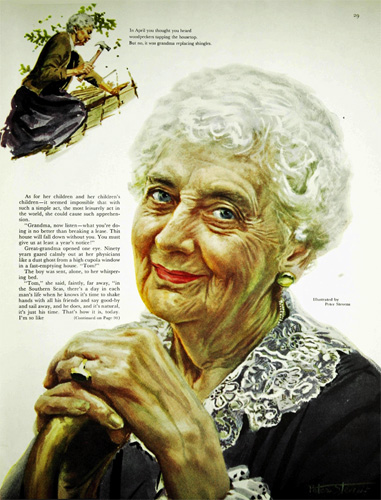 | |
| "Good-by, Grandma" in its first appearance. Saturday Evening Post, May 1957. Artwork by Peter Stevens. |
The Adaptations
Dandelion Wine is the only one of Bradbury's "classic period" novels to remain unfilmed - in English, that is. There was a Russian adaptation in 1997 which, as far as I can tell as a non-Russian-speaker, looks like it was pretty good. Over the years, there have been several announcements about an English-language film, but nothing has ever come of them. I suspect that, like The Martian Chronicles, there isn't enough of an overarching story for the book to be directly filmable. Although, like Chronicles, it might be suitable for a TV miniseries.Bradbury himself adapted Dandelion Wine for the stage, in a version which has been presented as straight drama and as a musical. But even he had to invent a whole new storyline to tie everything together: it centers on the mystery of Bill Forrester, a man who returns to Green Town after many years. Bradbury's theatrical script was used for the full-cast audio production of Dandelion Wine made by Colonial Radio Theatre.
A number of stories from the book have been adapted on their own. The out-and-out winner here has to be "The Whole Town's Sleeping", which pre-dates the book by nearly a decade. In fact, the very first public outing of the story was on radio, a good two years before the story ever saw print.
Back in 1948, Ray submitted the story to the radio series Suspense, where it was aired under the title "Summer Night". The story appeared in print in 1950 (in McCall's), then appeared on TV (Suspense, 1952, again as "Summer Night"), and then saw a whole series of repeat radio dramatisations on Suspense and ABC Radio Workshop. The story is also one of Bradbury's most anthologised stories, having appeared in dozens of books and textbooks.
For his TV series The Ray Bradbury Theater, Ray dramatised "The Happiness Machine", "Exorcism" and "The Whole Town's Sleeping".
Find Out More...
- Read about the Russian film of Dandelion Wine on my page for the film, here.
- Read about the real-life Lonely One, in my blog post about this petty criminal, here.
- Compare the fictional Green Town to the real-life Waukegan in my blog post, here.
- Read about Ray's stage play version of Dandelion Wine, which was also the basis for the Colonial Radio Theatre audio production, in my review here.
Read...
You can read "Illumination" as it originally appeared in The Reporter, here.
And you can read "Summer in the Air" as it originally appeared in Saturday Evening Post, here.


