Thursday, March 08, 2012

The Smile

The summer of 1952 saw the first issue of a fiction magazine called Fantastic, which boasted a star-studded line-up: not only Ray Bradbury, but Raymond Chandler, Walter M. Miller Jr, Kris Neville, Isaac Asimov and Horace L. Gold.

The magazine was a sister publication to Amazing Stories: Amazing concentrated on the science fiction end of the market, while Fantastic concentrated on fantasy. It would prove to be a successful and durable publication, as it containued to appear right up until 1980.

Bradbury's contribution to this first issue was his short story "The Smile", which made its first appearance here. The story is one of his most collected: you can find it in the following Bradbury books: A Medicine for Melancholy, Bradbury Stories: 100 of His Most Celebrated Tales, S is for Space, The Day it Rained Forever, Twice 22, and Match to Flame.

"The Smile" is one of Bradbury's after-the-apocalypse tales, set in a non-specific future and a non-specific location.The people in the story gather to ritually abuse all the remnants of the civilisation they have lost. One character stands apart, however, a young boy who manages to rescue a piece of the spat-upon Mona Lisa, which he hurries away with. Ostensibly a bleak story, in that it shows a collapsed world full of disgust for the causes of collapse, it becomes one of Bradbury's feel-good stories because of the element of hope represented by the smile that the boy manages to rescue. It's an example of what I like to think of as a muted renaissance. Not a true re-birth, but the first glimmer of hope that there might be a re-birth. The Bradbury of the 1950s excelled at this kind of thing. Fahrenheit 451 does something similar, but on a grander scale.

Writing at the time, the editors of Fantastic had this to say about Bradbury:

Few readers are neutral where Ray Bradbury is concerned: he's been called everything from a "chromium-age Thoreau" to a "hyperbole-happy hater of humanity". Both quotes seem more precious than pertinent - but the fact remains that almost as much has been written about Bradbury as by him. His work has appeared in smooth-paper magazines, in the pulps, on radio and television, as well as in numerous anthologies and pocket editions.
We offer "The Smile" as typical Bradbury: a sensitive and significant theme against a background filled with the gritty desolation of a lost world too many of us may help to make.

Illustration by L.Sterne Stevens, Fantastic, Summer 1952


Sunday, March 04, 2012

Author Bio

In the June-July 1953 issue, Fantastic Universe carried a brand new Bradbury short story called "Time In Thy Flight", which received top billing on the cover. The strap line for the story was "The circus, Hallowe'en, the Glorious Fourth may go - yet eternal is their pull on a child's heart."

(Or, we may add, on Bradbury's heart!)

The story also has a cute little biography of Bradbury:

Most Ray Bradbury readers seem to think of him as a sort of Charles Addams character sprung to life. Actually he is a handsome, cheerful and enthusiastic trnasplanted Californian with wife (1) and children (2), who looks far more at home over a broiled steak than a dish of pickled owl's eyes. Yet few living authors have vast sweep of fantasy or chill brush of horror. We're proud to offer his newest story.

Thursday, March 01, 2012

To Fairyland By Rocket

Eric Rabkin once wrote an essay on Bradbury called "To Fairyland By Rocket". In that title alone, Rabkin encapsulates something fundamental about Bradbury's writing: the collision or co-existence of fantasy and science fiction.

Bradbury is quite clear on what he considers to be science fiction. Fahrenheit 451, he tells us, is SF precisely because it is possible. It is a warning about the future, extrapolating from the technologies and the culture prevalent at the time of writing the novel.

The Martian Chronicles, on the other hand, is in Bradbury's view pure fantasy. The reason? It is impossible. No way it could ever happen. Yes, it has allegorical properties, and in its re-casting of the American experience of the frontier it unveils some profound truths. But it isn't an extrapolation of a possible future, merely a fanciful presentation of a world that never was.

It is The Martian Chronicles above all which gives Rabkin the fuel for his discussion of how Bradbury uses off-the-shelf imagery from SF and places it in a world - all crystal pillars, masks and flame birds - which is straight out of a fairy story.

Another story which I have always considered to be part of this approach is "Here There Be Tygers", about an expedition to a planet which turns out to be a paradise that seems to grant any wish. Bradbury doesn't refer to wishes, instead presenting the story in terms of a planet that can somehow read thought, but a wish-fulfilment fantasy is what is at the heart of the story.

The "fairyland by rocket" aspect of the story is captured neatly in the artwork accompanying the story when it was reprinted in Amazing Stories in April-May 1953. The illustration by Tom O'Sullivan (below - click on image to enlarge) captures a facnciful moment of flight - probably the most memorable sequence of the story - while in the background is the standard 1950s SF rocket.


(The amusing blurb in the magazine more or less apologises for re-printing a story, which was due to the expected new Bradbury story not arriving in time.)

"Here There Be Tygers" was first published in an anthology called New Tales of Space and Time in 1951. It was later collected in two Bradbury volumes: R is for Rocket and the UK Day it Rained Forever.


Monday, February 27, 2012

Imported Wine

In these days of globalisation, it is easy to assume that British and American culture are in sync, and that they always have been. A book published in the States is often published simultaneously in the UK. It therefore always comes of something of a surprise to me to find British references to Bradbury from the 1950s, 1960s and 1970s which seem out of step with American references.

I was reminded of this when I caught sight of a 1965 edition of New Worlds magazine. This used to be the UK's leading science fiction magazine, edited first by Ted Carnell and later by Michael Moorcock. The issue of December 1965 - a quite ordinary, run of the mill issue really - carries the name of Langdon Jones on the cover, because his short story "Transient" is contained within. But Jones makes a second appearance in this issue, as a reviewer of the first British paperback edition of Bradbury's Dandelion Wine.

What surprised me here was that the first UK paperback edition took until 1965 to come into print... of a book first published (in the US) in 1957!

Jones' comments on the book are quite insightful, and he puts up a spirited defence of Bradbury. The book is sentimental, says Jones; it is nostalgic; it is escapist. But, he says, these are not bad things in themselves, and in case, he says, "the world of Green Town, Illinois, is not a place of smug sweetness. There is horror here too, the horror of the Lonely One [...]; the horror of losing touch with close friends; the horror of being old and of suddenly losing the whole of one's youth."


My favourite section, though, is where Jones clearly marks out who should and should not read this book:

There are, as I have discovered, some very, very literal people in this world. Those who would rather spend their time crabbily counting up the halfpennies of logic whilst ignoring the fluttering riches of meaning, I advise to keep well away from this book and this author. Those who would prefer the transparent but sweaty engineer working frantically on his logical machinery while blue-scaled Venusian lizards batter down the papier-mache door will not feel at home in Green Town with its solid, but distorted perspectives.

Langdon Jones seems to have retired from writing - his website tells us that he "used to be" a writer. He used to be a very good one, and I wish he wrote more.

Friday, February 24, 2012

Bug Jack Barron

Alongside my interest in Ray Bradbury's screen career, I have been a longtime follower of other fantasists who practice(d) the art of screenwriting. These include Harlan Ellison, Norman Spinrad, Robert Bloch, Theodore Sturgeon, Richard Matheson, Charles Beaumont... to name just six.

One of Spinrad's best novels is Bug Jack Barron, a work whose style and politics place it firmly in the late 1960s, but whose depiction of media manipulation is remarkably prescient - in some ways paralleling what Bradbury achieved in Fahrenheit 451.

Bug Jack Barron first appeared in Britain's leading science fiction magazine New Worlds, at that time edited by Michael Moorcock. Moorcock has written an excellent article about Spinrad and the novel.

Spinrad was keen to see Bug Jack Barron turned into a film, and wrote a screenplay adaptation of his novel in 1970. This week, for the first time, he has published his screenplay: it is now available as an e-book in the Kindle format. At the time of writing, it is a FREE download. Click here for the US download/purchase page, or click here for the UK page.

(Don't have a Kindle? No problem. You can download a free Kindle read for the PC: details here.)

I once spoke very briefly to Norman about the film, and there was obvious frustration in his voice as he told me of how the film's rights were tied up at Universal Pictures. On his own blog, he has given a bit more detail of how things developed and how he hopes that publishing the screenplay just might help get the property out of Universal's grip.

In the 1980s, Harlan Ellison was at work on another adaptation of the novel, for award-winning director Costa-Gavras. I remember eagerly awaiting the production of this film, which Ellison had spoken of in a number of articles and interviews. Unfortunately, the film was never made.

After I posted about Bug Jack Barron on the Ellison message board (the Art Deco Dining Pavilion), Harlan dropped in to report that his screenplay - described as an original work suggested by Spinrad's novel - will soon be published, from Publishing 180. The Ellison screenplay is entitled None of the Above, and should make fascinating reading, as well as being an excellent companion to Ellison's Brain Movies series of books collecting his best screenplays and teleplays.

Thursday, February 23, 2012

Point of View

 Bradbury is known as much for his style as for his plots. One of the things that makes his short stories interesting is his willingness to try out new stylistic ideas and techniques.

While most of Bradbury's stories are written in the third person ("he did this", "she did that"), Bradbury quite often adopts the third person, writing as "I". Perhaps his most sustained writing in this mode is in the trilogy of mytery novels starting with Death is a Lonely Business (1985), whose narrator appears to be modelled closely on Bradbury himself.

Among Bradbury's stranger forays into the first person are those stories with a less familiar or less likely narrator. A Mermory of Murder (1984) includes a story narrated by a dead man.

And "I, Rocket" (1944) is narrated by a rocket ship.

Yes, a rocket ship.

Oddly, the story has never been collected in a Bradbury short story collection, although it has made the odd anthology appearance. Its first publication was in the pulp Amazing Stories in May 1944, where it was accompanied by an illustration by the artist Brody (below - click on the picture to enlarge).


The narrator of this story sees everything in terms that would make sense to a rocket ship, and will thank Metal where we might thank God. So much is straightforward and probably no better than you or I would come up with if asked to write a tale from the point of view of a machine.

What is more remarkable is Bradbury's adoption of numerous biological metaphors throughout the story. There is talk of the ship being built, but not really coming alive until "the slap on the back to give me strength and directed purpose," and reference to its birth period when "I was integrated, skeleton, skin and innards." Then there are people, who are variously referred to as blood cells and microbes:
The microbes within my body were in a small dosage; but virulent because they moved free, unchecked, unsuspected. Their names were Anton Larion and Leigh Belloc. I refer to them as bacteria simply because, like microscopic forms in a large body, their function was to poison and destroy me.
Not many writers can make you feel sympathy for a war-ravaged space hulk the way Bradbury does here.

Monday, February 20, 2012

Ray Bradbury Award Shortlist

The Science Fiction Writers of America have just announced the shortlist for the 2011 Nebula Awards, which includes the Ray Bradbury Award for Outstanding Dramatic Presentation.

The Bradbury nominees are as follows:

  • Attack the Block, Joe Cornish (writer/director) (Optimum Releasing; Screen Gems)
  • Captain America: The First Avenger, Christopher Markus, Stephen McFeely (writers), Joe Johnston (director) (Paramount)
  • Doctor Who: “The Doctor’s Wife,” Neil Gaiman (writer), Richard Clark (director) (BBC Wales)
  • Hugo, John Logan (writer), Martin Scorsese (director) (Paramount)
  • Midnight in Paris, Woody Allen (writer/director) (Sony)
  • Source Code, Ben Ripley (writer), Duncan Jones (director) (Summit)
  • The Adjustment Bureau, George Nolfi (writer/director) (Universal)
I confess to only having seen a few of these, although I know of most of them. I personally found "The Doctor's Wife" disappointing, and have a feeling that it is the novelty of Neil Gaiman writing for Dr Who that drew attention to it, rather than the quality of the work itself. (We saw a similar phenomenon when Richard Curtis wrote an episode of Dr Who, which was neither the best Who episode of its season nor the best TV writing Curtis had ever done.)

I don't for one minute think that this award should in any way reflect what Bradbury would like, but suspect that either Hugo or Midnight in Paris would be more his cup of tea.

Full details of the Nebula nominees can be found on the SFWA website. Previous winners are listed here.

-------------------------------------------------

Today I have discovered a whole pile of comments that people have submitted to various blog posts I made over the last year. For some bizarre reason, I hadn't been notified of these comments, and so I was unaware that they were awaiting moderation. If you have posted a comment but never seen it appear, I offer you my sincere apologies.

I think I have now fixed the problem (which seems to be due to Blogger "forgetting" my email address, even though it clearly hasn't forgotten it), so comments and responses should appear more swiftly in the future.

Meanwhile, if you'd care to scan through the old posts, you might well find that old comments have now appeared and been responded to.

Saturday, February 11, 2012

Old Wine in Old Bottles

Browsing eBay the other day, I discovered some Bradbury media releases that I hadn't previously been aware of. Not DVDs. Not VHS tapes. Not even Betamaxes.

Laserdiscs!

Just to clarify, I was fully aware of the Laserdisc format. The history of video technology is one of my specialist subjects, and I've been teaching it off and on for twenty years.

I was even aware of the occasional  Bradbury movie making it onto the twelve-inch shiny discs. Something Wicked This Way Comes was one such, and it came with a very good commentary track by Bradbury and several others involved in the production. (Unlike the DVD, which comes with no extras worth having.)

What was new to me was the appearance of selected episodes of Ray Bradbury Theater on this now obsolete format, released on the Image Entertainment label. I wonder what the quality is like - better than the rather dreadful transfers seen on the DVD box set, I would imagine.

I don't usually recommend eBay as a research source, but from the images on there I have identified that there were at least three volumes of the The Best of  the Ray Bradbury Theater on Laserdisc:

  • Volume 1/Volume 2 - Gotcha!, Skeleton, The Emissary, The Fruit at the Bottom of the Bowl
  • Volume 2 - Punishment Without Crime, On the Orient North, The Coffin, The Small Assassin
  • Volume 3 (pictured above) - And So Died Riabouchinska, The Man Upstairs, There Was An Old Woman, Tyrannosaurus Rex

The image of "Volume 1/Volume 2" is not clear on eBay, but there is a clearer image on Laserdisc Database (from where we also learn that this disc was released in 1988, while Ray Bradbury Theater was still in production). What is confusing is that there is a different "Volume 2",  which is a separate disc. There is a possibility here that there is more than one series/release represented here. The "Volume 1/Volume 2" disc also has different graphics on the packaging, which also suggests that it is from a different release.

If anyone knows more about these discs, please get in touch.

By the time you read this, the eBay auctions may all be over, but the complete list of Bradbury Laserdiscs currently on sale is here!

Thursday, February 09, 2012

Locus Award Ballot

It's that time of year: Locus magazine has opened to the poll for the Locus Awards. These awards honour the best published works in the science fiction and fantasy fields. The ballot is open to all, and can be accessed here:

http://www.locusmag.com/Magazine/2012/PollAndSurvey.html

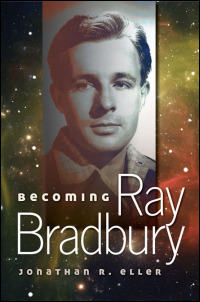
I'm not directly familiar with many of the works listed - life's too short! - but I would draw your attention to Jon Eller's excellent biographical work Becoming Ray Bradbury. This gives a detailed, thorough account of how Bradbury became the author he is, through an examination of the influences that acted on him during his early career. It will be getting my vote.

Incidentally, Jon tells me that he is two-thirds of the way through writing the sequel to Becoming Ray Bradbury, a volume which will cover the period 1953-1972. This is the stage of Bradbury's career where he goes off to Ireland to write Moby Dick for John Huston, and comes back a changed man: a screenwriter, playwright, poet and (shortly afterwards, as the space age gets going) media ambassador for the science fiction field which he had all but left behind. This second volume will appear on a future Locus ballot paper...

Tuesday, February 07, 2012

Father Electrico

Further to my earlier post about the Christopher Slatoff sculpture Father Electrico, here are two videos about it. The first shows the bronze casting process, and the second shows the sculpture and gathered crowds on the night of the unveiling.


Bronze Pour @ La Fonderie from Nathan K on Vimeo.


Fr. Electrico By Christopher Slatoff from Nathan K on Vimeo.


And if you want to see more, John Sasser has a gallery of images on Facebook.