My next few blog posts will be simply images - pictures of items of memorabilia, theatre tickets, posters, newspaper ads etc. Most of them will speak for themselves.
To start, here's a British magazine ad from fifty-five years ago. From the list of book titles on the right, and the quotations from famous writers and critics, it should be clear that by the end of the 1950s Bradbury's reputation was well and truly established.
(Click on the picture to enlarge.)
Wednesday, February 05, 2014
Wednesday, January 29, 2014
In a Season of Calm Weather...
In January 1957, Playboy magazine premiered Ray Bradbury's short story "In a Season of Calm Weather". The narrator wanders on a beach and sees a man drawing patterns in the sand with a stick. It turns out to be Pablo Picasso. The tide comes in, and Picasso's masterpiece of sand art is washed away, as if it had never been there.
Some years later, Bradbury wrote a screenplay version of the story under the title The Picasso Summer - and under the pseudonym "Douglas Spaulding". He withdrew his name from the project because of the mess the film-makers had made of his simple tale. The only redeeming feature of the bizarre international co-production is a short sequence of animation inspired by Picasso (who was not involved with the film at all).
Today you can find the original short story in a couple of Bradbury books: A Medicine for Melancholy, The Day it Rained Forever and Twice 22 collect it under its original title; while The Stories of Ray Bradbury reprints it as "The Picasso Summer".
The reason I am blogging about "In a Season of Calm Weather" today is the remarkable sand art of Andres Amador. Below is just one of his pieces of ephemera - and there is plenty more, including videos and discussion of his techniques and collaborations on Andres' own blog, here.
Tuesday, January 14, 2014
To The Future!
A supposedly newly discovered video has been published of Ray Bradbury giving his view of the future - from twenty years ago. Incongruously* titled "Success in Cyberspace", the ten-minute piece has Ray in his office talking (apparently off-the-cuff) directly to camera with specific reference to his short story "The Toynbee Convector".
While much of what he says will already be familiar from countless interviews and speeches, this re-telling of "Toynbee" is relatively rare. Ray makes a specific point of using the time-traveller of the story as a metaphor for his own optimistic view of the future.
The background story of what this video was made for, and how it came into existence (and was subsequently "lost") is all told on this page from Information Age, which hosts the video in its entirety. It is claimed to be from an early use of high-definition video, but the quality of the clip itself looks decidedly sub-VHS to me.
*Why incongruous? This is the man who would later tell us we have "too many internets".
Wednesday, December 25, 2013
Ray Bradbury's Christmas Gift
Seasons greetings, everyone!
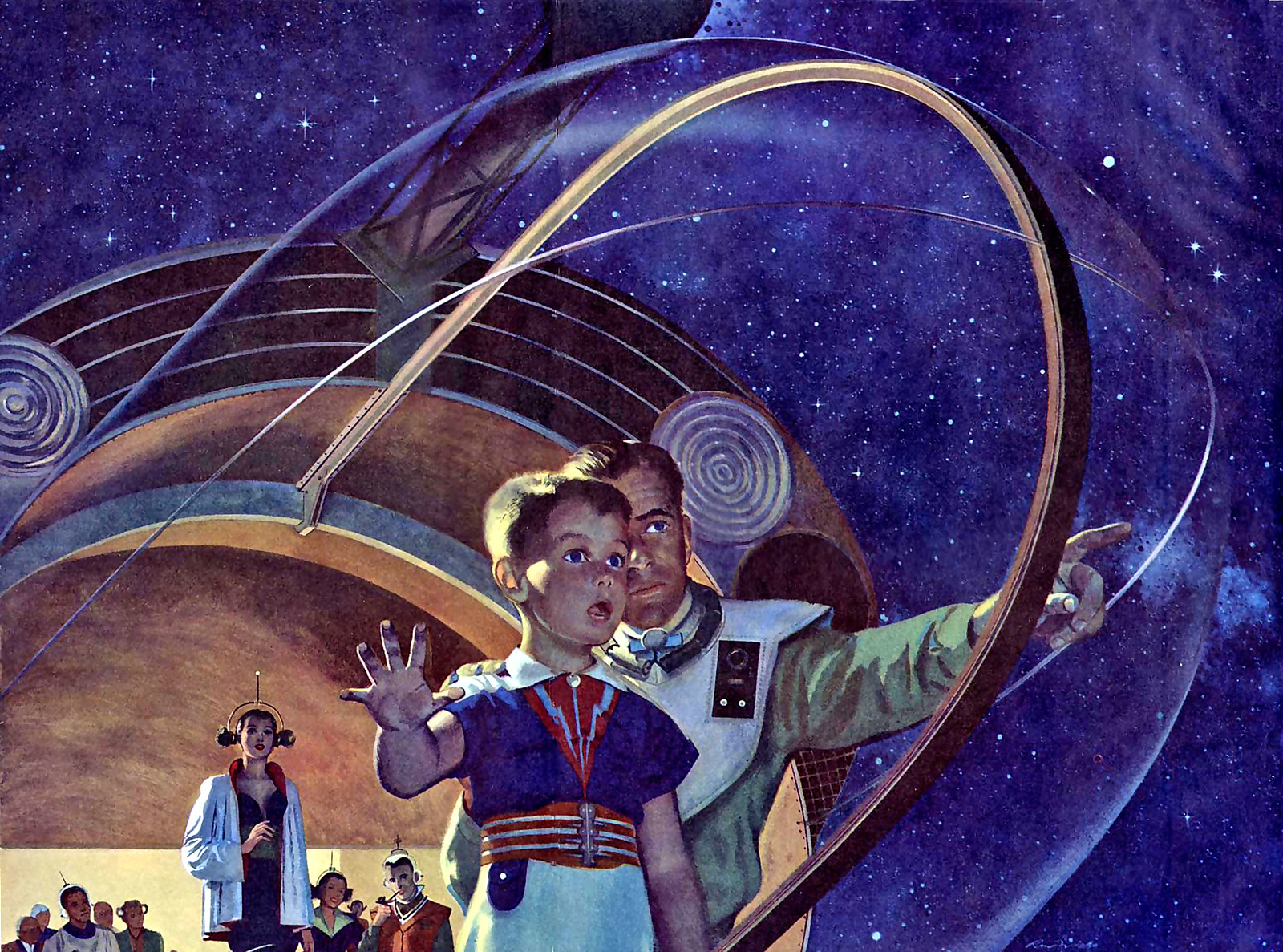
I've noted previously that Ray Bradbury wrote very few Christmas-themed stories, but one of his best-known is "The Gift". It was first published in Esquire magazine in 1952. The artwork above (click to embiggen) is by Ren Wickes, and in the child's face beautifully captures the good old "sense of wonder" people used to talk about in science fiction stories.
To find out why the child is so astonished, read "The Gift" here.
Subscribe to:
Posts (Atom)