Many people are familiar with Ray Bradbury's The Illustrated Man - but not so many know of "The Illustrated Woman". It's a short story which first appeared in Playboy in March 1961, and concerns a woman who is covered with tattoos... or is she?
Today, you can find the story in the Bradbury collections The Machineries of Joy and The Stories of Ray Bradbury, but here is how she looked in magazine publication. (Click to make her even more immense!)
Showing posts with label Playboy. Show all posts
Sunday, April 13, 2014
Wednesday, January 29, 2014
In a Season of Calm Weather...
In January 1957, Playboy magazine premiered Ray Bradbury's short story "In a Season of Calm Weather". The narrator wanders on a beach and sees a man drawing patterns in the sand with a stick. It turns out to be Pablo Picasso. The tide comes in, and Picasso's masterpiece of sand art is washed away, as if it had never been there.
Some years later, Bradbury wrote a screenplay version of the story under the title The Picasso Summer - and under the pseudonym "Douglas Spaulding". He withdrew his name from the project because of the mess the film-makers had made of his simple tale. The only redeeming feature of the bizarre international co-production is a short sequence of animation inspired by Picasso (who was not involved with the film at all).
Today you can find the original short story in a couple of Bradbury books: A Medicine for Melancholy, The Day it Rained Forever and Twice 22 collect it under its original title; while The Stories of Ray Bradbury reprints it as "The Picasso Summer".
The reason I am blogging about "In a Season of Calm Weather" today is the remarkable sand art of Andres Amador. Below is just one of his pieces of ephemera - and there is plenty more, including videos and discussion of his techniques and collaborations on Andres' own blog, here.
Tuesday, March 15, 2011
Bradbury Oddity
Bradbury's work has appeared in almost all media. One of the oddest items, though, is a short story which appeared in a magazine with an advertisement attached. "The Hour of Ghosts" was first published in Saturday Review on October 25 1969, and has not yet been collected in any of Bradbury's books, although it was anthologised in Peter Haining's Ghost Tour in 1991.In December 1969, the story was reprinted in Playboy - as a centrefold, no less! This time, the story appeared with an advertising strapline:
In the science fiction of today lie the bits and pieces of tomorrow's reality. A reality that all of us in the Bell system are planning for today. Bell AT&T.
This version of the story can be viewed on Flickr, thanks to Sizemore who uploaded it: part one here, part two here.
Sunday, February 06, 2011
Found on the Web
The blog Panel Patter has an interesting short review of the comic book collection series Ray Bradbury Chronicles. These are largely re-collected and re-assembled adaptations of Bradbury stories from the Topps comics, which in turn were a mixture of new material from comic artists such as Richard Corben, and old material taken from the 1950s EC Comics.
The blog Book Aunt reviews the Leo & Diane Dillon-illustrated edition of Bradbury's Switch on the Night, along with other illustrated children's books that might be considered "thoughtful".It's not often that I would bother to post a link to a religious website, but ironicschmozzer's weblog has an interesting sermon built around Dandelion Wine!
Bradbury is listed at number 3 in this top ten of writers who have published fiction in Playboy.
Finally, Canadian-Armenian actor Garen Boyajian, best known for a role in Ararat, has announced that he is developing a film based on Bradbury's Death is a Lonely Business.
Friday, December 31, 2010
F451: the Playboy Connection
Fahrenheit 451 was originally serialised in the earliest issues of Playboy magazine in the 1950s. Ray Bradbury's short stories also found a home in the magazine from the 1950s onwards. Given Bradbury's somewhat wholesome image - this is the man whose stories are taught in schools all across the US, after all - it may be surprising that he should be associated with the Hefner empire. However, Bradbury and Hefner have been good friends for decades.
Earlier this year, Bradbury and Hefner appeared together and talked about the F451-Playboy connection for the Writer's Guild of America, West. Here is the video of their discussion.
Thursday, May 21, 2009
F451 Graphic Novel
News on a new graphic adaptation of Fahrenheit 451: artist Tim Hamilton has, with Bradbury's approval, been preparing this new version which will get its debut in Playboy, of all places. This isn't such a bizarre place, though; Bradbury's original book-burning tale first saw print in Hefner's adult magazine, as the short story "The Fireman".Read about the publishing plans in this Publishers Weekly story, and read more in this profile of Tim Hamilton.
Wednesday, August 06, 2008
Farewell Summer and other news
In fact, I found the book a brisk read, with some interesting elements, but not exactly a classic. Click here to read my review.
However, friend Eric has seen this book, and he has confirmed that "Affluence of Despair" is not a short story. It is, in fact, an essay. The very same essay is to be found in Bradbury's essay collection Bradbury Speaks.
I have also updated the links to the magazine covers in the Short Story Finder. These point to external websites, in some cases to commercial sites that sell back issues. All the Playboy cover links are now fixed, and I have added cover links for Dime Mystery and The Saturday Evening Post. CAUTION: Those of a delicate disposition should avoid clicking on the Playboy links, as the external site I link to carries random ads of an adult nature. You have been warned!
Sunday, January 07, 2007
Iconic images
A question on the official Ray Bradbury Message Board got me looking at illustrations of the short story "A Sound of Thunder" (1952). This, you may recall, is Bradbury's classic dinosaur-hunting tale: travel back in time and enjoy the thrill of hunting T.Rex. (Image is by Richard Corben, from The Ray Bradbury Chronicles.)This is a compelling fantasy. So much so that other writers have trodden the same ground, most famously L. Sprague de Camp in "A Gun for Dinosaur".
Bradbury makes the tale slightly different, by bringing in one of those time paradoxes that the true science fiction fan will happily spend hours debating. Bradbury's twist is that one of the time-travellers steps on a butterfly and screws up the subsequent course of evolution.
Now many have criticised the story for its logical flaws - most famously the editors of Fantasy and Science Fiction who rejected the story on those grounds. (Bradbury didn't care - he sold the story to a 'slick' magazine instead, and made a whole lot more money.) However, defenders of the story, myself included, will tell you that the details of the time travel don't matter one jot. It's the symbolism that's important. Bradbury seems to be saying that little things are important: the way he sets the story up, the fate of the dinosaur is trivial; it's the butterfly that really matters.

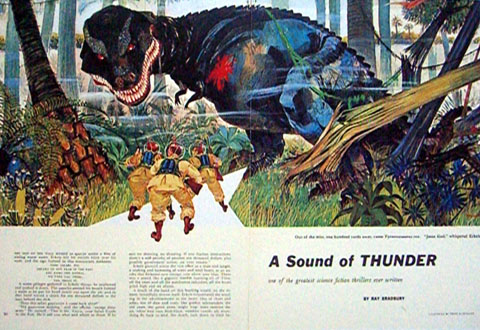
Looking at various visual interpretations of "A Sound of Thunder", I find that most illustrators have gone for the big picture. They show the T.Rex, sometimes dwarfing our time-travellers. That's certainly true of Frederick Siebel, the original illustrator of the Collier's magazine version of the story (June 1952, above). Notice that Siebel gives us the thrill of the hunt. He does also show the all-important pathway which our heroes must stick to - and one of the hunters fatally stepping off the path.

Franz Altschuler, who illustrated the story for Playboy (June 1956, above) follows the same idea, although the chrononauts don't seem quite so concerned in his vision.

Even the Game Boy game (above) bearing the title of Bradbury's story lingers on the hunt.

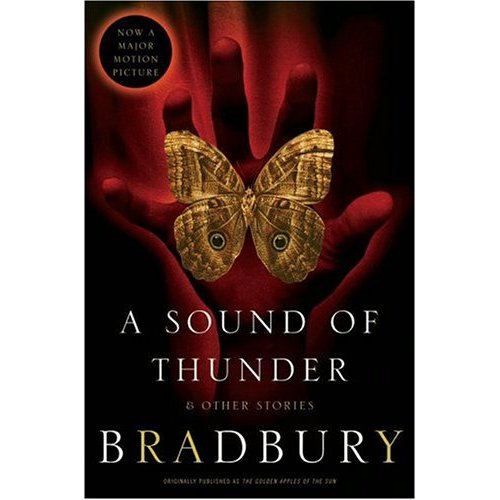
The poster and publicity for the recent film version (not a film I recommend you rush out and see) did get one thing right: emphasising the butterfly. I think this adds to the intrigue of the advertising campaign, especially when the movie trailer hints at sub-Jurassic Park dinosaur CGI. (Image shows the movie poster graphic used on a re-issue of a Bradbury short story collection.)
[For the record, I find the low budget adaptation for TV's Ray Bradbury Theatre to be vastly superior to the Peter Hyams movie. And the radio production for Bradbury 13 is pretty good as well.]

Full marks go to Joe Mugnaini, the quintessential Bradbury illustrator, for achieving such a perfect balance in his line-drawing. Created for The Golden Apples of the Sun, the short story collection that first contained "A Sound of Thunder", his illustration (above) seems to focus on the dino hunt - and his composition uses the pathway as a flourish that frames the tyrannosaur. But look again. See how the butterfly, all translucent wing, dominates the scene.
This, for me, is precisely why Mugnaini worked as Bradbury's best illustrator. He found a way of getting narrative into a single frame, and always gives a new way of looking at a story.
Subscribe to:
Posts (Atom)