Showing posts with label Mugnaini. Show all posts

Saturday, July 31, 2021

Bradbury 100 - new episode

Time for another all-new episode of my audio podcast Bradbury 100. This week I'm joined by filmmaker and visual effects artist Christopher Cooksey to discuss the challenges and joys of bringing Ray's work to life in the visual realm.

Christopher is the co-producer of Bill Oberst Jr's stage production Ray Bradbury - LIVE (Forever). Ostensibly a one-person show, it's really a visual feast. Bill, alone on stage (except for one dance scene), is nevertheless able to walk around Bradbury's world with the aid of visual projections and audio effects. This video, from Christopher's Youtube channel, shows some of the work that went into making the visuals for the show.


To put Bill and Christopher's work in context, in the first part of the podcast I talk about Bradbury's own use of audio-visual elements in his stage plays. You can find Ray's plays in print in a number of books. Dramatic Publishing carries nearly all of them for would-be performers and play producers, and there are some play collections aimed at general readers. The introductions and production notes in these are often as entertaining as the plays.

Find out more about Christopher Cooksey from his extensive Youtube channel and from his website.

And now, enjoy the episode:


Friday, April 15, 2016

Ray Bradbury and the Oscars

Ray Bradbury never won an Oscar, but in 1963 he came close.

The 1962 short film Icarus Montgolfier Wright, which animated hundreds of Joe Mugnaini's paintings, was written for the screen by Ray Bradbury and George Clayton Johnson, and based of course on Ray's short story. It was nominated for an Oscar in the category of Best Short Film, and the award would have gone to producer Jules Engel. But on the night, the award went instead to John and Faith Hubley for The Hole.

Here's the announcement of the nominees and winner, from actor Van Heflin:  https://www.oscars.org/vef/load/575b1f3cc94322f3e3173d907ac0ca12?width=640&height=365


You can watch the Hubleys' film here: https://www.youtube.com/watch?v=PGB3eudJwOU

And you can watch Icarus here: https://www.youtube.com/watch?v=lm5kylavY3Y


Monday, April 30, 2012

Vacation in the Golden Age & New Artwork

I have mentioned before the ambitious blogging project of author Jamie Todd Rubin: to review the classic era of Astounding Science Fiction magazine, issue by issue, starting with the July 1939 edition.

Jamie has now reached July 1942, when Astounding published the first of three Bradbury stories. "Eat, Drink and Be Wary" is a very slender story, which Bradbury submitted for the "Probability Zero" section of the magazine. This section was editor John W. Campbell's place for publishing short-shorts from new writers. I believe there was no payment for appearing in this column; the reward for the writers' efforts was publication!

Jamie's review includes the Bradbury piece, and detailed reviews of all the longer pieces in the magazine, which include efforts from such SF luminaries as A.E. Van Vogt and L. Sprague de Camp.


Patrick Leger is the artist responsible for the artwork on the recent Simon & Schuster editions of Bradbury's The Illustrated Man and The Martian Chronicles. What I hadn't realised was that Leger's design decisions were consciously influenced by Joe Mugnaini. Mugnaini's artwork is inextricably linked to Bradbury's fiction through the iconic cover of Fahrenheit 451 and over books, and through the line drawings he produced for Golden Apples of the Sun.

Leger talks about his new designs in his blog, and includes some of his preliminary sketches.

Sunday, March 16, 2008

The Golden Apples of the Sun

I received my copy of Subterranean Press's new hardcover of The Golden Apples of the Sun recently. At the current dollar/sterling exchange rate, it was quite cheap (as limited editions go).

I was disappointed to discover that Joe Mugnaini's original art is limited to the cover, and isn't continued inside the book. His line drawings have always been synonymous with The Golden Apples of the Sun, and I was hoping to see them in this edition.

The main reason I was persuaded to buy this edition is the inclusion of a couple of bonuses: two plays by Ray, based on stories in the book, and published here for the first time. And while these are good, I would have liked some contextual information.

For example, when were they written? Were they ever performed, in this form or any other? Is "The Fog Horn" a RADIO treatment (because it certainly reads like one)? And why is the play of "En La Noche" so excessive in stage/actor directions? Had Ray never seen a play written down?

At the very least, they should have given an explanation of why "The Fog Horn" is incomplete. (The dust jacket says the book includes two plays, not one play and one fragment of a play.)

So, while it's a handsome enough volume in its own right, it could have been so much better if they had thought it through.

I have since found out that "The Fog Horn" is indeed a radio treatment. However, I remain somewhat mystified about "En La Noche" - it apparently dates from 1960, and while it is one of Bradbury's earliest stage plays, he was certainly an experienced dramatist by this point.

Sunday, January 07, 2007

Iconic images

A question on the official Ray Bradbury Message Board got me looking at illustrations of the short story "A Sound of Thunder" (1952). This, you may recall, is Bradbury's classic dinosaur-hunting tale: travel back in time and enjoy the thrill of hunting T.Rex. (Image is by Richard Corben, from The Ray Bradbury Chronicles.)

This is a compelling fantasy. So much so that other writers have trodden the same ground, most famously L. Sprague de Camp in "A Gun for Dinosaur".

Bradbury makes the tale slightly different, by bringing in one of those time paradoxes that the true science fiction fan will happily spend hours debating. Bradbury's twist is that one of the time-travellers steps on a butterfly and screws up the subsequent course of evolution.

Now many have criticised the story for its logical flaws - most famously the editors of Fantasy and Science Fiction who rejected the story on those grounds. (Bradbury didn't care - he sold the story to a 'slick' magazine instead, and made a whole lot more money.) However, defenders of the story, myself included, will tell you that the details of the time travel don't matter one jot. It's the symbolism that's important. Bradbury seems to be saying that little things are important: the way he sets the story up, the fate of the dinosaur is trivial; it's the butterfly that really matters.
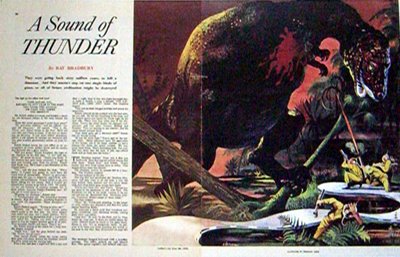

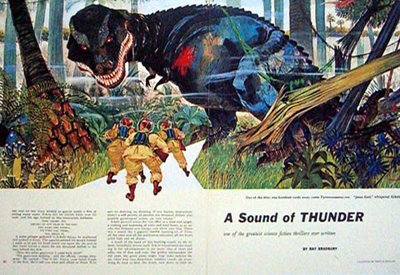
Looking at various visual interpretations of "A Sound of Thunder", I find that most illustrators have gone for the big picture. They show the T.Rex, sometimes dwarfing our time-travellers. That's certainly true of Frederick Siebel, the original illustrator of the Collier's magazine version of the story (June 1952, above). Notice that Siebel gives us the thrill of the hunt. He does also show the all-important pathway which our heroes must stick to - and one of the hunters fatally stepping off the path.


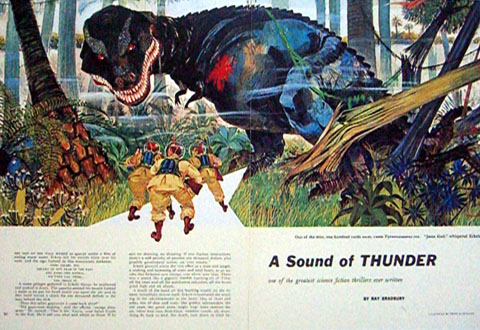
Franz Altschuler, who illustrated the story for Playboy (June 1956, above) follows the same idea, although the chrononauts don't seem quite so concerned in his vision.



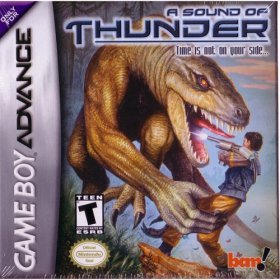
Even the Game Boy game (above) bearing the title of Bradbury's story lingers on the hunt.



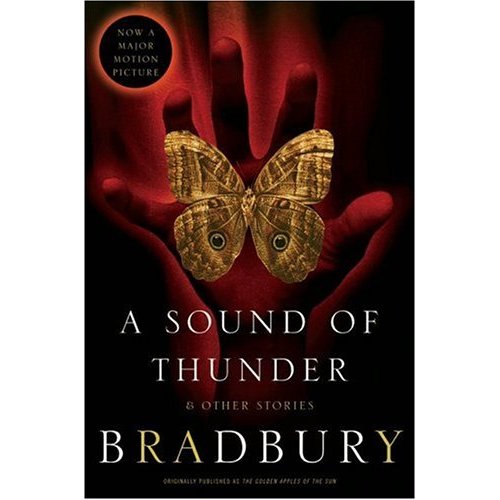
The poster and publicity for the recent film version (not a film I recommend you rush out and see) did get one thing right: emphasising the butterfly. I think this adds to the intrigue of the advertising campaign, especially when the movie trailer hints at sub-Jurassic Park dinosaur CGI. (Image shows the movie poster graphic used on a re-issue of a Bradbury short story collection.)

[For the record, I find the low budget adaptation for TV's Ray Bradbury Theatre to be vastly superior to the Peter Hyams movie. And the radio production for Bradbury 13 is pretty good as well.]
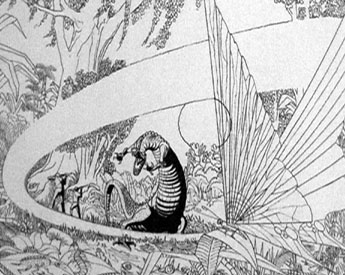


Full marks go to Joe Mugnaini, the quintessential Bradbury illustrator, for achieving such a perfect balance in his line-drawing. Created for The Golden Apples of the Sun, the short story collection that first contained "A Sound of Thunder", his illustration (above) seems to focus on the dino hunt - and his composition uses the pathway as a flourish that frames the tyrannosaur. But look again. See how the butterfly, all translucent wing, dominates the scene.

This, for me, is precisely why Mugnaini worked as Bradbury's best illustrator. He found a way of getting narrative into a single frame, and always gives a new way of looking at a story.

Tuesday, August 08, 2006

Bradbury images

One ongoing strand of my research into Bradbury is looking at Bradbury's imagery, and what happens to it when his stories are translated into other media. My view, generally, is that Bradbury's stories are often sensory explosions that thoroughly engage the reader; it is then almost inevitable that when someone lifts a Bradbury plot and makes a film of it, the film will disappoint. I say almost inevitable because I'm sure a strong visual artist could do much to bring Bradbury to life. If we think of the film-makers who have adapted Bradbury, very few of them have been primarily visual artists. The strongest Bradbury film adaptations have some sense of atmosphere - Something Wicked This Way Comes (in parts), Moby Dick, Fahrenheit 451 (think of the final scenes) - but still don't quite summon up the sensory response you get from reading Bradbury off the page.

I am reminded that the illustrator most closely associated with Bradbury, Joe Mugnaini, was a visual artist who was able to not just visualise what Bradbury had written, but extend it, interpret it, add twists and depth to it. Mugnaini's line illustrations are deceptively simple, and have (in many cases) created a permanent image in the reader's mind, an image which is inseparable from the Bradbury story.

If only there were a film-maker with the vision of a Mugnaini...

There's very little on the web about Mugnaini - lots of references to him, but very few dedicated pages. A Google Images search will turn up lots of his work, however. The best pages on Mugnaini I can find are: