A quick update to yesterday's post: architect Thom Mayne has spoken for the first time on his motivations and plans in buying Ray Bradbury's former house in Los Angeles.
Alex Shephard briefly interviewed Mayne by phone. Read the details here: http://www.mhpbooks.com/why-was-ray-bradburys-home-demolished-an-interview-with-architect-thom-mayne/

Friday, January 16, 2015
Thursday, January 15, 2015
Building Bridges
Reports of the demolition of Ray Bradbury's former home have gone viral over the last day or two, with many news outlets and bloggers picking up on the original reports which appeared on File770. The news reports have resulted in hundreds of comments, some of them motivated by sadness, anger or disbelief. The architect Thom Mayne - reportedly the purchaser of the house on Cheviot Drive, Los Angeles - has been the target of some hostile reactions from Bradbury followers, but to my knowledge has not yet been drawn into commenting on reports of his plans and intentions.
Jon Eller - Bradbury's literary biographer, author of Becoming Ray Bradbury and Ray Bradbury Unbound, editor of The Collected Stories of Ray Bradbury, and director of the Center for Ray Bradbury Studies - has taken a more philosophical view on the demolition. According to KRCW's Design & Architecture blog, Eller believes that both Bradbury and Mayne are futurists, whose view of the transformative power of architecture show parallels. Eller hopes to draw Mayne into dialogue, so that the reported family-home construction planned to replace the Bradbury house will be in some way informed by Bradbury's legacy.
KRCW has recorded an interview with Jon Eller, and is planning to interview Thom Mayne. The Design & Architecture blog promises that these interviews will be heard in an upcoming episode.
Jon Eller - Bradbury's literary biographer, author of Becoming Ray Bradbury and Ray Bradbury Unbound, editor of The Collected Stories of Ray Bradbury, and director of the Center for Ray Bradbury Studies - has taken a more philosophical view on the demolition. According to KRCW's Design & Architecture blog, Eller believes that both Bradbury and Mayne are futurists, whose view of the transformative power of architecture show parallels. Eller hopes to draw Mayne into dialogue, so that the reported family-home construction planned to replace the Bradbury house will be in some way informed by Bradbury's legacy.
KRCW has recorded an interview with Jon Eller, and is planning to interview Thom Mayne. The Design & Architecture blog promises that these interviews will be heard in an upcoming episode.
Tuesday, January 13, 2015
Soft Rains
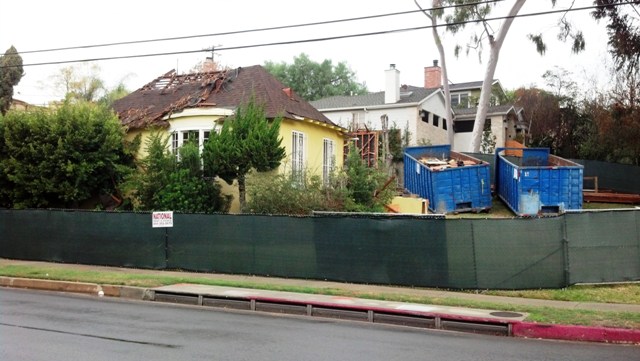
Ray Bradbury's former house, located on Cheviot Drive in Los Angeles, has been recreated along with Ray in a graphic treatment of a Bradburyesque fiction - and in real life has been pulled down.
Ray passed away in 2012, and in 2014 his house was finally put up for sale. It was bought by an architect who, apparently, has the intention of using the land for building a new family home. It was only a matter of time before the Bradbury house, a curious yellow bungalow built into a hillside, would be redeveloped. I don't think anyone close to Bradbury was quite prepared for how devastating this would seem.
Ray and his family moved into the house over fifty years ago, and countless newpaper interviews, magazine profiles, news reports and documentary films have shown the house, so much so that the house and Bradbury became synonymous. His basement office, overloaded with books, toys and exotic masks, was for many years a particular focus of published profiles of Ray; and in the last years of his life, it was his "den" that became the focus, where he would entertain visitors surrounded by sculptures of dinosaurs, an Ice-Cream Suit, Halloween paraphernalia and original artworks.
In 2014, not only was the house sold off, but many of Ray's possessions also went up for auction. And this week, the demolition team moved in. There are pictures of the remains of the house in this report on Mike Glyer's File770 website, accompanying an article written by Ray's longtime friend and helper John King Tarpinian.
By coincidence, this week also saw the publication of the third issue of Shadow Show, the comic book based on the Bradbury tribute book of the same name. Issue 3 includes a graphic adaptation of Bradbury biographer Sam Weller's short story "Live Forever!" - a story which includes Ray as a character, and uses the house as the arena in which this Bradburyesque tale unfolds. Sam tells me that the comic's producers went to great lengths to achieve accuracy in depicting the house. The result is very successful. Here's one page from the comic, and you can see more in this preview.

Note that even the artworks hanging on the walls are reproduced with accuracy in Mark Sexton's comic strip - in the page above, the final frame shows the classic cover art for Bradbury's The Illustrated Man.
It is a great irony that these two events should have coincided: the celebration of Bradbury's house as one source of his literary strength, and the destruction of that same house. Friends of Bradbury who were present around the time of the demolition have reported a further irony. The day they knocked the roof off the Bradbury house, it rained. Not exactly a common occurrence in Los Angeles. Inevitably, it brings to mind Bradbury's classic short story "There Will Come Soft Rains", which poignantly depicts an empty house after a nuclear war:
The house shuddered, oak bone on bone, its bared skeleton cringing from the heat, its wire, its nerves revealed as if a surgeon had torn the skin off to let the red veins and capillaries quiver in the scalded air. [...]
The crash. The attic smashing into kitchen and parlor. The parlor into cellar, cellar into sub-cellar. Deep freeze, armchair, film tapes, circuits, beds, and all like skeletons thrown in a cluttered mound deep under.[...]
Dawn showed faintly in the east. Among the ruins, one wall stood alone. Within the wall, a last voice said, over and over again and again, even as the sun rose to shine upon the heaped rubble and steam:
"Today is August 5, 2026, today is August 5, 2026, today is . . ."
Wednesday, December 31, 2014
Ray Bradbury: From Science to the Supernatural
Ray Bradbury: From Science to the Supernatural is a film screening event taking place in Bloomington, Indiana, from 24th-29th March 2015. For the last few months, I have been working with Indiana University Cinema and the Center for Ray Bradbury Studies on the programme of events, and can now reveal the contents of the screenings.
The images below are taken from the Spring 2015 programme book from IU Cinema. Click on them to enlarge, and you will see the full blurb for each of the events.
All being well, I will be attending all screenings - introducing some of the events, and participating in disussion panels for some of them. Jon Eller, author of Becoming Ray Bradbury and Ray Bradbury Unbound will be co-hosting. Jon and I collaborated on the basic "wishlist" for the screenings, and IU Cinema's Jon Vickers has done the real work in sorting out screening rights and securing prints and recordings of the films and TV shows in the programme. (No mean feat, especially when Jon Eller and I desperately wanted to include the extremely rare "A Sound of Different Drummers".)
According to the IU Cinema catalogue, all screenings in the Bradbury series will be FREE, but you will need tickets to attend (IU Cinema is limited to 260 seats). Details of how to book are included in the images below.


The images below are taken from the Spring 2015 programme book from IU Cinema. Click on them to enlarge, and you will see the full blurb for each of the events.
All being well, I will be attending all screenings - introducing some of the events, and participating in disussion panels for some of them. Jon Eller, author of Becoming Ray Bradbury and Ray Bradbury Unbound will be co-hosting. Jon and I collaborated on the basic "wishlist" for the screenings, and IU Cinema's Jon Vickers has done the real work in sorting out screening rights and securing prints and recordings of the films and TV shows in the programme. (No mean feat, especially when Jon Eller and I desperately wanted to include the extremely rare "A Sound of Different Drummers".)
According to the IU Cinema catalogue, all screenings in the Bradbury series will be FREE, but you will need tickets to attend (IU Cinema is limited to 260 seats). Details of how to book are included in the images below.
Monday, December 01, 2014
Ray Bradbury and THE TWILIGHT ZONE
Marc Scott Zicree, the writer-producer, and author of the excellent Twilight Zone Companion, is working on a book about his ten-year-long friendship with Ray Bradbury. The working title is My Ray Bradbury.
When Zicree was working on The Twilight Zone Companion, he attempted to interview Bradbury about his involvement with that classic Rod Serling TV series. Bradbury wrote just one completed episode of the series, "I Sing The Body Electric," but also wrote a couple of unfilmed episodes. Bradbury also claimed a significant contribution to the very existence of the series: he reportedly introduced Serling to the writers Richard Matheson and Charles Beaumont, each of whom would write many episodes of the series.
Zicree's attempt to draw information out of Bradbury was thwarted back in the 1980s, but the two later became friends. Long after The Twilight Zone Companion was published, Zicree finally heard Bradbury's account of how the relationship between Serling and Bradbury soured. Zicree recounts all of this in his latest "Mr Sci-Fi" video on YouTube.
Zicree slightly overstates things when he claims that none of this has been discussed before. In fact, much of Bradbury's account of events is given in Sam Weller's biography The Bradbury Chronicles. Nevertheless, Zicree's encyclopedic knowledge of Twilight Zone and Serling, and his friendship with Bradbury, make his telling of events fascinating and compelling. You can see the entire 24-minute video below.
There is, in fact, yet more to the Serling-Bradbury conflict. The Zicree video presents the Bradbury interpretation, but I have seen correspondence from the time which suggests an entire other dimension to the argument between the two great writers. Indeed, Jon Eller's new book Ray Bradbury Unbound (chapter 28) reveals much more of the Serling-Bradbury relationship, based on both the surviving correspondence and his own extensive interviews with Bradbury, giving the most detailed and insightful account yet published.
One day, perhaps, a fuller version of the story may emerge - but for now, Zicree's recounting of Bradbury's view is one of the best you will find.
(This blog post has been updated to include the reference to Ray Bradbury Unbound - 7 January 2014.)
When Zicree was working on The Twilight Zone Companion, he attempted to interview Bradbury about his involvement with that classic Rod Serling TV series. Bradbury wrote just one completed episode of the series, "I Sing The Body Electric," but also wrote a couple of unfilmed episodes. Bradbury also claimed a significant contribution to the very existence of the series: he reportedly introduced Serling to the writers Richard Matheson and Charles Beaumont, each of whom would write many episodes of the series.
Zicree's attempt to draw information out of Bradbury was thwarted back in the 1980s, but the two later became friends. Long after The Twilight Zone Companion was published, Zicree finally heard Bradbury's account of how the relationship between Serling and Bradbury soured. Zicree recounts all of this in his latest "Mr Sci-Fi" video on YouTube.
Zicree slightly overstates things when he claims that none of this has been discussed before. In fact, much of Bradbury's account of events is given in Sam Weller's biography The Bradbury Chronicles. Nevertheless, Zicree's encyclopedic knowledge of Twilight Zone and Serling, and his friendship with Bradbury, make his telling of events fascinating and compelling. You can see the entire 24-minute video below.
There is, in fact, yet more to the Serling-Bradbury conflict. The Zicree video presents the Bradbury interpretation, but I have seen correspondence from the time which suggests an entire other dimension to the argument between the two great writers. Indeed, Jon Eller's new book Ray Bradbury Unbound (chapter 28) reveals much more of the Serling-Bradbury relationship, based on both the surviving correspondence and his own extensive interviews with Bradbury, giving the most detailed and insightful account yet published.
One day, perhaps, a fuller version of the story may emerge - but for now, Zicree's recounting of Bradbury's view is one of the best you will find.
(This blog post has been updated to include the reference to Ray Bradbury Unbound - 7 January 2014.)
Friday, November 14, 2014
Bradbury Auction - Round Two
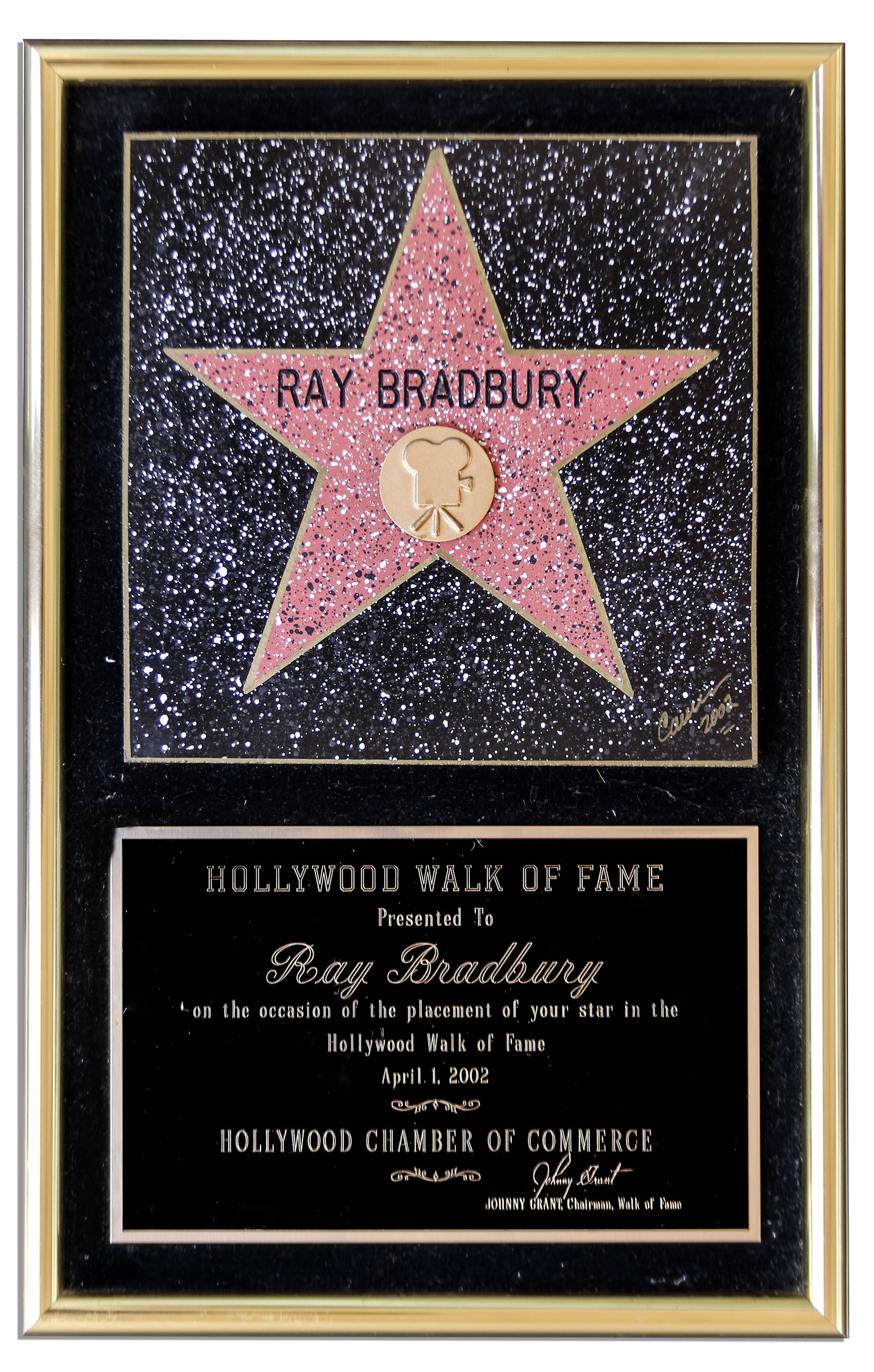
Among the curios still on offer are a genuine Wonderful Ice Cream Suit, from one of the productions of Bradbury's story/play; a herringbone jacket which Ray wore in Ireland while working on Moby Dick for John Huston back in the 1950s; and many items of artwork from Bradbury's personal collection.
Perhaps the standout item is the official commemorative plaque from Ray Bradbury's Hollywood Star, which was presented to him in 2002.
When the first auction was on, I suggested that it would be rather neat if someone would bid-and-donate: to bid on an item and then donate it to the Center for Ray Bradbury Studies. The Center, in Indianapolis, houses the largest collection of Bradbury materials: manuscripts, correspondence, books, pulp magazines, awards and other artefacts - including the furniture from Ray's former basement office. It's primarily a research collection (as the "Studies" in its title implies), but it also has plans for more public outreach and for a visitor reception/exhibition area. While the Center's collection is extensive, the Center isn't exactly awash with funds, and isn't in much of a position to extend its holdings, except by donations.
So, with the round two auction now underway - with just under a week left to run - I would once again like to suggest bidding-to-donate. That Hollywood Star would look quite magnificent in, say, a reconstruction of RayBradbury's basement office...
The Hollywood Star lot is viewable here: http://natedsanders.com/ItemImages/000032/47585h_lg.jpeg
And the entire auction catalogue is online here: http://natedsanders.com/Category/Ray_Bradbury_Estate-66.html
Happy Bidding!
Wednesday, November 05, 2014
RIP: George Slusser (1939-2014)

George wrote one of the earliest studies of Ray Bradbury's work, The Bradbury Chronicles (Borgo Press, 1977). This short study, written in an accessible style, concentrated mainly on Bradbury's early short stories, and drew out the key themes that seemed to be Bradbury's preoccupation in those classic weird tales.
George Slusser was an academic at the University of California Riverside, where he built the J.Lloyd Eaton Collection into the world's largest research collection for science fiction, fantasy and horror. He also organised or helped organise many of the Eaton Conferences, and edited and co-edited many of the books that collected the proceedings of those conferences.
As well as writing about Bradbury, George wrote books on Ursula Le Guin, Arthur C. Clarke, Harlan Ellison, Robert Heinlein and many others. He collaborated frequently with Eric Rabkin, and helped shape the academic study of SF.
In 2008, I submitted a conference paper proposal about Bradbury to the Eaton Conference, and was surprised to get a personal response from George. I was even more surprised when he told me my paper had been accepted - and that Ray Bradbury was to be a guest of honour at the conference. That conference would be my first meeting with both George and Ray.
Both the Eaton collection and the Eaton conference look set to continue in the future. Both are a fitting legacy for George Edgar Slusser.
Wednesday, September 17, 2014
Re-Unite Bradbury's Hugo Award with his Manuscripts!

Ray's Retro-Hugo is currently up for auction, along with more than 400 other artefacts offered by the Bradbury estate. The starting bid was $5000. Unfortunately, this is beyond what the Center for Ray Bradbury Studies, which holds (in original or digitised form) many manuscripts related to Fahrenheit 451, could afford to spend. So I would like to make a simple proposition to put the Hugo back with the manuscripts:
Bid-to-donate.
Is there someone out there who could bid for the Retro-Hugo, and donate it to the Center for Ray Bradbury Studies at Indiana University?
If this idea appeals to you, please visit the web site of Nate D. Sanders Auctions of Los Angeles (link below); or email auction@natedsanders.com; or phone 310 440-2982. The auction instructions and registration pages of the website explain the online, phone, and mail bidding process.
The bidding period runs until 5:00 p.m. PDT on Thursday, September 25th, 2014. The Bradbury Hugo Award is lot number 293 in the Bradbury online auction catalog. Here's a direct link:
http://natedsanders.com/Ray_Bradbury_s_Hugo_Award_for___Fahrenheit_451____-LOT31626.aspx
Saturday, September 13, 2014
Bradbury "Ice Cream Suit" Event in California

The film was scripted by Ray Bradbury, based on his short story and play, and was directed for Disney by Stuart Gordon - a director better known for his work in the horror genre. Gordon will be on the discussion panel, along with two of the film's stars: Joe Mantegna and Edward James Olmos.
And if that weren't enough, the panel will be joined by Bradbury's authorised biographer Sam Weller, and chaired by organiser of Los Angeles' Ray Bradbury Week, Steven Paul Leiva.
Full details of the 12th October event are here.
Saturday, September 06, 2014
Auction for the Ray Bradbury Estate

The full catalogue for the auction is online, and the auction house appears to be open to online bidding. There are hundreds of lots, ranging from rough sketches by Bradbury collaborators such as Joe Mugnaini, through to the commemorative plaque for Ray's Hollywood star. Even if you don't intend to bid on anything, the catalogue is fascinating to browse through, and in most cases includes quite detailed photos of the lots. View the catalogue here.
Subscribe to:
Posts (Atom)