According to The Illuminerdi, a new screen adaptation of Ray Bradbury's The Martian Chronicles is in development. As usual with such announcements, I caution against getting too excited: "in development" just means someone is signed up to write a script or treatment. Whether said script ever goes into production is another matter entirely.
The new, big name atached to the project is James Gunn, filmmaker of considerable talent - and not a little controversy. In 2018 he was fired by Disney when some decade-old tweets came to light which showed poor judgment and poor taste. (He was later re-hired when Gunn apologised and recanted; and when the unearthing of the old tweets was found to be the work of alt-right activists.)
The bigger picture is that The Martian Chronicles spent most of the 1950s, 1960s and 1970s "in development". Back in the 1950s, Ray Bradbury and Kirk Douglas tried to get the Chronicles onto TV and then into film, with scripts and treatments by Ray. Then in the 1960s, he worked with Alan J. Pakula and Robert Mulligan on a film version. None of these came to anything. The Martian Chronicles did eventually get onto the screen in the late 1970s/early 1980s, in the wake of (a) the unexpected global success of Star Wars and (b) the unexpected stage success in Los Angeles of Ray's theatrical production of the Chronicles.
After the critical flop of the 1980 TV miniseries version of The Martian Chronicles, Ray adapted various of the constituent stories of his book as episodes of his TV series The Ray Bradbury Theater. And then attempted, yet again, to get The Martian Chronicles on the big screen, with his own screenplay adaptation. Various attempts were made through the 1990s and early 2000s.
So the latest news is actually nothing new. Once again, a big Hollywood name is attached, but we've seen this all before. Whatever happened to the remakes of The Illustrated Man and Something Wicked This Way Comes? It is Hollywood's way to spend a lot of time (and sometimes money, too) on development, but somehow never quite get to an end product.
I hope things will turn out differently this time. It would be a nice way to celebrate the Bradbury Centenary, and the seventieth anniversary of The Martian Chronicles book. But don't hold your breath!

Monday, February 17, 2020
Thursday, February 13, 2020
The official Ray Bradbury website
In case you haven't visited it recently, please note that the official Ray Bradbury website is now under new management, and the old site has been completely replaced.
The new-look site has some excellent text content, mostly supplied by the Center for Ray Bradbury Studies. There are also some fascinating images, some never published before.
The new site keeps a link to the previous discussion board, which is the only facet of the old site to be retained. And it carries a Centennial page which list all the Bradbury-related events due to take place in 2020.
I was given a sneak preview of the site a few weeks ago, when I was invited to comment on the content. I found very little to criticise, but lots to like. But now it's publicly available.View the new site here: https://raybradbury.com/
Wednesday, January 15, 2020
The Bradbury Centenary

Well, we're finally here. 2020. Cue all those jokes about 2020 vision, and people drawing parallels with (19)20s flappers. For Bradbury fans, 2020 is a nice big round number: one hundred years since the birth of Ray Bradbury.
When I first became aware of Ray Bradbury's fiction, he must have been in his fifties. The first time I saw his photo, probably on a book cover, he would have been about 58 - which was quite old to me at the time; much older than my parents, for example. I saw Ray a lot in magazine interviews and on TV when he was in his sixties. And I finally met him when he was 87, and again when he was 90. Old, quite old. And yet...
His fiction was always so young and lively. What I didn't know when I first read Bradbury was that his amazing stories of dinosaurs, time machines, rockets, youth and death were mostly written when he was young and lively. His peak years, measured in terms of "best stories" were in the 1940s and 1950s, when he was aged between 20 and 40. And yet...
His amazing peak of productivity which produced The Martian Chronicles in 1950 (age 30), The Illustrated Man in 1951 (age 31), and Fahrenheit 451 in 1953 (age 33) was followed by a long tail of work which would never quite gain the same recognition. Bradbury continued writing right up to his final days, which means that there is nearly sixty years' worth of material out there (or hidden away) which most people are unfamiliar with.
A lot of books and essays about Bradbury talk of his career somehow petering out after those classic works of the 1950s. He stopped writing fiction, they say. He turned to poetry and plays, they say. He went to Hollywood, but didn't have much success.
Well, all of that has some grain of truth. His early success in Hollywood - It Came From Outer Space (he created it, but someone else did the final screenplay), Moby Dick (he adapted it, but John Huston nabbed half the screenplay credit), scripts for the TV series Alfred Hitchcock Presents - must have given him a taste of an alternative career, not to mention a significant alternative income stream. It can be argued that the alternative income enabled him to indulge in poetry, and to produce his own plays. Bradbury himself said that his income from Hollywood options is what put his children through college.
Ironically, Bradbury was a far better poet when writing short stories than he ever was when writing poetry. And yet he still managed to get books of poetry put out by major publishers. These things sold. They may not have been bestsellers, but they did the business.
As for his plays, they tended to fall into two camps. There were the original plays, mostly "Irish" stories which had been inspired by his time in Ireland writing Moby Dick, and most of which eventually also came out as short stories. And then there were the adaptations, of numerous short stories and his major novels. Some of these worked, and some didn't. If you ever get the chance to see his stage version of "The Veldt", see it. It's great, and in its reliance on the imagination of the audience, it works far better than any of the screen adaptations of it created so far. Similarly, if you get the chance to see Bradbury's stage version of Fahrenheit 451, grab it - but beware that Bradbury couldn't resist rewriting the story somewhat, so that it has some twists and turns which differ from the original novel.
As Jon Eller's biographies of Ray have pointed out, Bradbury's career was split into two halves. In the first half, he was an extraordinary short story writer and novelist. And in the second half, he might have run dry of original ideas, or he may have been distracted by those other media (poetry, plays, films). And also in that second half he must surely have been distracted by being a figure in the public eye, especially as the space age evolved and he became something of a spokesman for science fiction and an advocate of space exploration. I have always been amazed that he was able to get any real work done at all during this period.
By the 1980s, with Ray now into his sixties, he finally had his own TV series, the excruciatingly low-budget Ray Bradbury Theater. This show was a pioneer of original programming on cable TV, being one of HBO's first original productions, but with none of the investment that HBO today puts into original programming. At times the show was an embarrassment of poor production quality, but at other times it was able to produce some gems. Sixty-odd episodes were made, shot all over the world, with every one scripted by Bradbury himself. In the seven or so years that the show was in production, it is again hard to imagine how he found time for any other work. And yet...
The 1980s and 1990s saw a new burst of activity from Bradbury. Now in his 60s and 70s, he turned out a series of remarkable new novels and short story collections. The best of these were among his best (and the worst were among his worst). And in his final years, in his 80s and 90s, Bradbury put the finishing touches to a number of works-in-progress. A sequel to Dandelion Wine. A new patchwork novel tying a set of short stories together in From The Dust Return. Long-delayed novellas "Leviathan '99" and "Somewhere a Band is Playing".
One hell of a life of writing!
And now, so soon, we reach 2020. The Bradbury Centenary. There will be celebrations, that's for sure. Bradbury's home town of Waukegan, Illinois, has some plans. So does the Center for Ray Bradbury Studies, based in Indianapolis.
And if anyone out there wants me to talk about Bradbury, just ask. I'm available for conferences, lectures, podcasts, possibly even barmitzvahs!
Watch this space for news and further developments...
ADDENDUM: I thought I should use this post to keep a record of planned centenary events. I will add to the list as more events come to light. Here goes:
Feb 9, Pasadena: http://cabookfair.com/features.php#bradbury
Feb 21-23, 28-9, March 1, Pasadena: https://www.facebook.com/events/208921433571387/
March 5-8, San Diego: https://www.sdcomicfest.org/
March 11, Gurnee, Illinois: https://www.facebook.com/events/1421663071366314/
May 17, Bath, UK: https://bathfestivals.org.uk/the-bath-festival/event/neil-gaiman-ray-bradbury-at-100/
May 20, New York: https://www.symphonyspace.org/events/selected-shorts-ray-bradbury-centennial-celebration
July 24-25, Bicknell, Utah: https://www.facebook.com/BicknellInternationalFilmFestival/
For more events, please also keep an eye on this web page: https://raybradbury.com/centennial/
Wednesday, November 06, 2019
Bradbury on The Simpsons
Ray Bradbury has been referenced many times on The Simpsons. Here's one instance, from "Treehouse of Terror XXV", in which Bart Simpson finds his school is (in) hell:

See also:
http://bradburymedia.blogspot.com/2016/03/another-bradbury-reference-from-simpsons.html
http://bradburymedia.blogspot.com/2013/10/blink-and-youll-miss-it.html

See also:
http://bradburymedia.blogspot.com/2016/03/another-bradbury-reference-from-simpsons.html
http://bradburymedia.blogspot.com/2013/10/blink-and-youll-miss-it.html
Thursday, October 31, 2019
Podcasts - all in one handy place

So, without further ado, I give you Phil's podcasts!
A Sound of Thunder - short story, film and other adaptations - Take Me To Your Reader
Fahrenheit 451 - novel and 1966 film - Take Me To Your Reader
Ray Bradbury and Ray Harryhausen - The Ray Harryhausen Podcast
Fahrenheit 451 - novel and 2018 TV film - Radio Free Acton
Fahrenheit 451 - novel and 2018 TV film - Take Me To Your Reader
Fahrenheit 451 - novel and 2018 TV film - Studio 360/American Icons
The Halloween Tree - book, film and radio play - Take Me To Your Reader
The Illustrated Man - short story, book and film - Take Me To Your Reader
Saturday, September 28, 2019
The Illustrated Man - Podcast episode
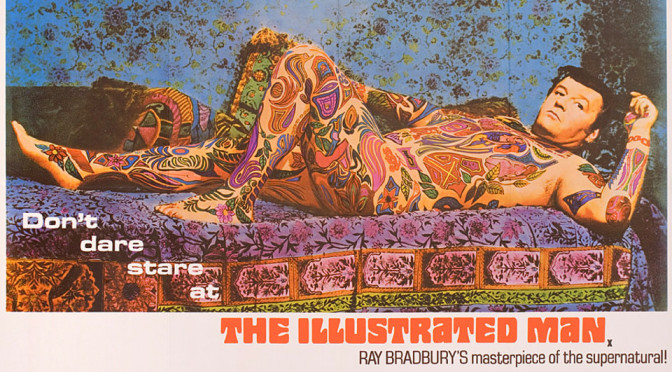
The Illustrated Man has a complex history. Bradbury first published a short story with that title, and shortly afterwards he published a short story collection with the same title... but the collection didn't include the short story! Instead, he took his tattoed-man character out for another stroll, and used him to provide a framing device for the other short stories in the book, using the conceit that each story dramatises one of the man's tattoos.
Many years later, the short story was incorporated into the book, but only in some editions.
In the early 1960s, Bradbury wanted to turn The Illustrated Man into a film, and wrote a full screenplay. Unfortunately, it became another of Bradbury's "lost films". But later in the decade, a completely different script was used for the film that was made. Starring Rod Steiger and his then wife Claire Bloom, the movie is a portmanteau film which adapts three of the short stories from the book - with Steiger and Bloom inexplicably playing different characters in each story.
You can find out what I think of the film by listening to the podcast:
http://pavementpodcast.com/podcast/tmtyr-episode-81-lighter-than-the-movie-the-illustrated-man-feat-dr-phil-nichols/
Tuesday, August 20, 2019
Find that story!
Ever wanted to re-read a particular Ray Bradbury story, but didn't know which collection it was in? Allow me to introduce you to a handy feature of Bradburymedia: the Short Story Finder!
The Short Story Finder lists (nearly) every Ray Bradbury story, and tells you where it was originally published, and which Bradbury collections you can find it in.
It also includes the "Eller Reference" for each story. This is a two part number-code which indicates the year of original publication, and the position of publication within that year. For example 46-04 indicates the fourth Btradbury story published in the year 1946. This numbering scheme originated with Jon Eller, Ray's literary biographer, who used it in Ray Bradbury: The Life of Fiction and in the ongoing Collected Stories of Ray Bradbury series of books.
So, without any further ado, I give you:
The Short Story Finder!
Friday, August 16, 2019
Ray Bradbury wins another Retro Hugo

Retro Hugos are special awards given for years where the standard Hugo Award was not awarded for some reason, mostly due to the Second World War interrupting the usual continuity of the Worldcon.
Bradbury has been awarded Retro Hugos in the past - the 1939 award for Best Fanzine, and the 1954 award for best novel (Fahrenheit 451).
"King of the Gray Spaces" is an early Bradbury science fiction tale, and is typically considered as the first to show the emotive style he is associated with. First published in Famous Fantastic Mysteries magazine in December 1943, the story has frequently been reprinted under the more familiar title "R is for Rocket".
In the story, fourteen year old Christopher and his friends long to be chosen for the space corps. They know that they can't "apply" for this; they have to be chosen. The key emotion of the story comes when Chris is indeed chosen, but as part of the selection process he has to keep it a secret even from his best friend Ralph. Chris's elation is contrasted with his sadness at having to leave Ralph behind, and with Ralph's muted understanding of what is happening to Chris.
Some elements of the story are quite dated now, and in fact Bradbury was aware of this when he made it the title story of his 1962 collection R is for Rocket: he made some changes to the story to bring it more up to date.
When the story first appeared in Famous Fantastic Mysteries, it was accompanied by a magnificent illustration by Lawrence Sterne Stevens (shown above).
When the Retro Hugo win was announced, my friend Jason Aukerman of the Center for Ray Bradbury Studies took the stage to receive it on behalf of the Bradbury family and the Bradbury estate. Jason took the opportunity to remind the Worldcon audience that in exactly one year and one week it will be Bradbury's one hundredth birthday. The awarding of the Retro Hugo makes a fine lead-in to the Bradbury Centenary.
Here's the award announcement and Jason's speech.
Wednesday, April 17, 2019
Family Tree

https://bradburymedia.blogspot.com/2009/08/ancestry.html
Wednesday, April 03, 2019
Another Fine Mess

Twenty-four years ago, in April 1995, The Magazine of Fantasy and Science Fiction debuted a new Ray Bradbury short story. "Another Fine Mess" is one of Bradbury's tributes to Laurel and Hardy, and another of his laments for the old Hollywood of his childhood.
Bella Winters, newly moved into a house near Effie Street in Los Angeles, awakens one night and hears voices outside. And what sounds like a piano being hit. She becomes convinced that she is hearing, in the darkness outside, Laurel and Hardy attempting to get a piano up the steep concrete steps. She calls her friend Zelda, a silent film fanatic, and Zelda too becomes convinced that Stan and Ollie are somehow haunting the steps. Perhaps, Bella suggests, they have returned because no one has ever told them how much they are loved...
The piano reference is, of course, to Laurel and Hardy's classic, Oscar-winning short film The Music Box (1932), in which the comic duo repeatedly attempt to get a boxed upright piano up an impossibly long flight of stairs.
As a longtime resident of Los Angeles, and a lifelong fan of Laurel and Hardy, Bradbury knew and loved the old Hollywood. Bella and Zelda represent aspects of himself, both characters being around his own age, and speaking of seeing Laurel and Hardy films in their early childhood. The old Hollywood may be gone, but vestiges of its geography survive even today, and Bradbury's story is partly a celebration of this. Bradbury had previously returned to old Hollywood in his 1990 novel A Graveyard for Lunatics, a fictionalised account of his own adventures in 1950s Tinseltown.
Oddly, for all his Angeleno knowledge and familiarity with Hollywood, Bradbury doesn't place "Another Fine Mess" at the real location used in The Music Box. The steps seen in the film are located in the Silver Lake area of Los Angeles, and run between Vendome Street and Descanso Drive. For some reason, though, Bradbury sets his story on nearby Effie Street. It's a similarly hilly place, and does indeed have some long concrete steps. But it has nowhere quite like the real Music Box steps. Of course, the story is a fantasy - Bella Winters' waking dream - so has no obligation to reflect reality. But it makes me wonder if Ray was basing the story's location on a particular house that he knew.
Laurel and Hardy purists might further object to Bradbury's Ollie repeatedly saying "Another fine mess" - when the real Hardy tended to say "Another nice mess". However, I'm going to give Ray a pass on this, since there is a Laurel and Hardy short called Another Fine Mess (1930). If Laurel and Hardy are allowed to misquote, then so is Ray!
Bradbury refers to The Music Box in another of his short stories, "The Laurel and Hardy Love Affair" (1987), and he put "the boys" into yet another story, "The Laurel and Hardy Alpha Centauri Farewell Tour", in 2000. And he famously saw Laurel and Hardy live on stage in Dublin in the 1950s, when he was in Ireland to write the film version of Moby Dick (1956). The love for Stan and Ollie declared by Bella and Zelda is heartfelt, and undoubtedly reflects Bradbury's own love for Laurel and Hardy.
Today, you can find "Another Fine Mess" in two of Ray's books: Quicker Than The Eye and Bradbury Stories: 100 of His Most Celebrated Tales.
And you can learn how the once-lost Music Box steps were "re-discovered" here: http://www.laurel-and-hardy.com/films/talkies/music-location.html
Subscribe to:
Posts (Atom)