
You can listen to the pod via any good podcast player, or play it from the players below. There's an audio version, and a YouTube video version. Take your pick!
Here's the video version:

You can listen to the pod via any good podcast player, or play it from the players below. There's an audio version, and a YouTube video version. Take your pick!
Here's the video version:

Ray Bradbury's The Martian Chronicles, 1980 TV miniseries on Blu-ray: order from ViaVision Entertainment
Phoenix 451, a collection of Ray's own dramatisations of Fahrenheit 451: order from Gauntlet Press
It Came From Outer Space, 1953 film written by Ray, on 4K HDR Blu-ray: order from Amazon US - or order from Amazon UK
Here's the pod. Enjoy!
Amazon Music - Audible - Bullhorn - Castbox - Deezer - Listen Notes - Player FM - Pocket Casts - Podbean - Podcast Addict - Podcast Index - Podcast Republic - Podchaser - Podfriend - Podlink - TuneIn

.jpg)
Ray Bradbury himself said that this miniseries, starring Rock Hudson, was "boring". He got in trouble with NBC and Charles Fries Productions for this, but he wasn't wrong. Fries' lawyers, however, pointed out that Bradbury's contract forbade him from badmouthing the production...
Here's the podcast, where we're discussing episode 2 of the miniseries:
https://continuumdrag.podbean.com/e/189-the-martian-chronicles-part-2/
Here's a little curiosity that I've mentioned before, but now with added evidence:
In the 1980 TV miniseries of The Martian Chronicles, there is a brief scene of people coming out of (what I assume to be) a cinema. Either side of the door is a rather amateurish poster with the title The Silver Locusts. The artwork on the poster is taken from... the UK paperback of The Silver Locusts, which was the original UK title for... The Martian Chronicles.
How meta is that? People in MC going to watch a film about themselves!
I noticed this in 1980, when the show was first aired on British TV. But this was before VCRs, and the appearance of the artwork was so fleeting as to be unprovable. The commercial DVD release allowed the image to be paused, but it was rather muddy.
But thanks to Bluray, we can now get a closer look. So here is the proof:
 | |||
| Silver Locusts posters as the crowd emerges from the cinema. |

 |
| UK paperback, 1970s. Artwork by Peter Goodfellow. |
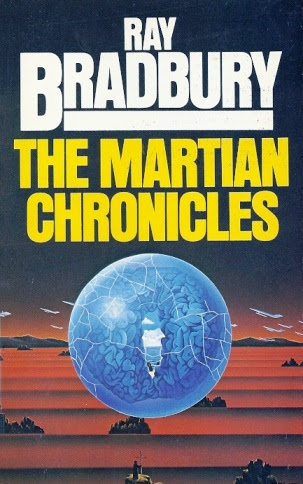 | |||||
| When the miniseries was released, UK publisher Granada decided to cash in by re-issuing The Silver Locusts as The Martian Chronicles. |
In the same sequence, there are some other posters on display, but I haven't been able to figure out what they are. They're probably completely fictional, but who knows? What are we looking at here? mtext? Invasion?


These stories have only once been all collected together, and that was in the limited-edition book The Martian Chronicles: The Complete Edition (2009). I've mentioned this book before, and have also mentioned my love-hate relationship with it. On the one hand, the book was a great idea, but on the other hand, it turned out to be far from "complete".
One section of that book is titled "the other martian tales of Ray Bradbury", and is based on a selection of stories originally collated by Marc Scott Zicree, writer of the famous Twilight Zone Companion. Zicree figured out which other Mars-related stories Bradbury wrote, and also dug around in Ray's archives to find any that remained unpublished. Zicree's proposed book didn't happen, but the selection of stories was absorbed into the Complete Edition. Actually, not everything Zicree collated ended up in the book; the editors of the Complete Edition decided to only include stories set on Mars, and to eliminate any that were set elsewhere. A reasonable choice... except not all of The Martian Chronicles is set on Mars... so they hadn't thought it through...
Here's the list of "other Mars stories" used in the so-called Complete Edition, which I work through in the podcast episode (UPDATE: I somehow missed "The Martian Ghosts" of this list - but I've added it now):
Anyone who is expecting any major revelations in this list will be disappointed. It is mostly a list of (a) stories which are easily available in Bradbury's other books; (b) unfinished stories; and (c) tiny fragments and bridging material, pages or paragraphs left on the cutting-room floor. The only truly interesting find here is "They All Had Grandfathers".
Please listen to the episode, where I go through the intricacies of these stories, and explain how a couple of the fragments such as "The Wheel" and "The Disease" reveal something of Bradbury's process of assembling The Martian Chronicles.

Seasons Greetings!
It's time for a new episode of my Bradbury 100 podcast. This time I explore some of the best movies never made, by looking at Ray Bradbury's multiple unfilmed screenplays for The Martian Chronicles.
The book came out in 1950, and The Martian Chronicles immediately became a mini sensation that same year, thanks to the radio drama series Dimension X, which dramatised several stories from the book. Ray knew that there was dramatic potential in his Martian tales, and the late 1950s saw him - by now an established screenwriter, thanks to Moby Dick and It Came From Outer Space - drawing up plans for a TV series to be called Report From Space.
Alas, the series didn't make it to air, and his attempts to develop The Martian Chronicles further for the big screen also came to nothing. But the scripts are pretty good, and allow us to play a game of what if:
To find out more... listen to the episode...!
You may have seen this post on LitHub. It reproduces a 1962 letter that Ray Bradbury wrote to Arthur M. Schlesinger, the historian who was a special advisor to President Kennedy. Bradbury offers his services - whichever services the president might feel appropriate - in promoting the new space age.

It's time for another new episode of the Bradbury 100 podcast. This week, I'm joined by writer and Bradbury scholar Steve Gronert Ellerhoff.
We talk about Ray Bradbury - and also Kurt Vonnegut! Did you know that Bradbury and Vonnegut knew each other? Or that they both had a TV series at the same time, from the same production company?
Following on from the success of Ray Bradbury Theatre (1985-1992), production company Atlantis signed up with Vonnegut to do a similar series, adapting Vonnegut's short stories in a similar way to Bradbury's stories. Kurt Vonnegut's Monkey House ran for two very short seasons - a total of seven episodes altogether. This pales in comparison to Ray's sixty-five episodes.
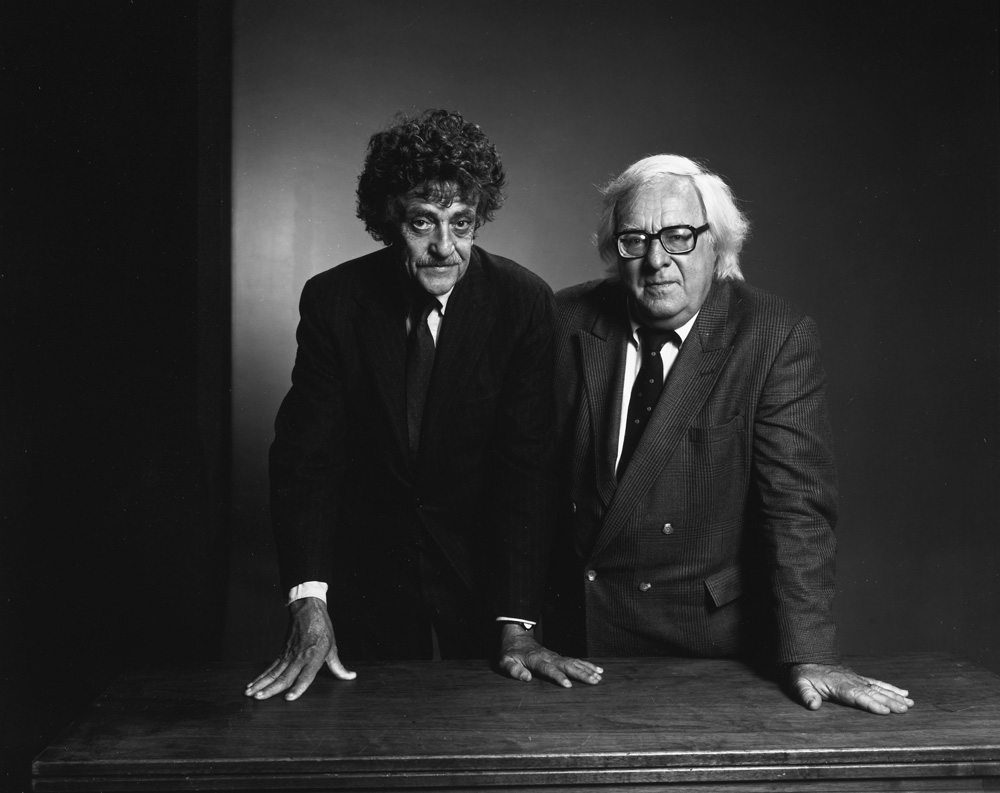 | ||
| Kurt Vonnegut and Ray Bradbury, in a publicity still for Atlantis by leading photographer Karsh. |
In the podcast, we talk a bit about Vonnegut because Steve Ellerhoff wrote a book called Post-Jungian Psychology and the Short Stories of Ray Bradbury and Kurt Vonnegut: Golden Apples of the Monkey House!
We also tackle the difficult issue of how race is portrayed in some Bradbury stories from the 1950s. Bradbury took a strong stand against racism in a number of stories, including two of his Mars tales. Ironically, because they use dated language, they are today sometimes accused of being racist stories. I generally defend these stories as bold and brave anti-racist works, but I admit to being uncomfortable with the language used.
Find out more about Steve Ellerhoff's work on his website: http://www.sgellerhoff.com/
A couple of weeks ago, I gave a public lecture as part of the University of Wolverhampton's ArtsFest 2020. My topic was Ray Bradbury's The Martian Chronicles at Seventy, marking the seventieth anniversary of the first publication of that book.
Bradbury himself recognised that The Martian Chronicles was a "half-cousin to a novel", being neither a short story collection nor a full novel. In the lecture, I discussed how this came about, and how it influences the way the book has survived these last seventy years.
I released the audio from the lecture as part of a recent Bradbury 100 podcast, but you can now also see the video of the lecture. Given that it was an illustrated talk, this has to be the best way to enjoy it...
 This week's Bradbury 100 is a bit different: instead of a featured guest interview, I present highlights from two Bradbury Centenary events from recent times, as well as summing up some of the key centary events of the year so far.
The first of the highlights is a selection from the discussion in the first (and so far, only) Bradbury 100 LIVE episode. This was an event I ran on Facebook Live back in September. In this recording, I talk to John King Tarpinian - a friend of Ray Bradbury's who often accompanied him to public events - and educator George Jack.
The second is the audio from a public lecture I gave earlier this week, celebrating seventy years of Bradbury's book The Martian Chronicles.
I hope you enjoy this format!
Find out more about the many Bradbury Centennial events - both past and future - by visiting the Centennial page on the official Ray Bradbury website.
Read more of my assessment of The Martian Chronicles here.
JKT - John King Tarpinian - is a frequent contributor to Mike Glyer's File 770, where he often provides news stories relating to Ray Bradbury. View his posts here.

It will also be recorded, and made available for future viewing, but this could take a few weeks.
The talk is part of the University of Wolverhampton's annual ArtsFest. Here's the official blurb for the event:
This year saw the widely celebrated one-hundredth anniversary of the birth of Ray Bradbury (1920-2012), the American author whose best-known work Fahrenheit 451 stands alongside Brave New World and Nineteen Eighty-Four as a classic of twentieth-century dystopian fiction, and still holds relevance today.
But this year also saw the seventieth anniversary of Bradbury’s earlier The Martian Chronicles, a book which better captures the breadth and fragmentary nature of Bradbury’s many styles and interests, and one which more clearly reveals the irony of Bradbury’s association with the science fiction genre. For all its reliance on science-fictional tropes, The Martian Chronicles is a work which builds dream-like fantasy on top of Bradbury’s own fantastical influences. And, while projecting and warning about our future, it relies heavily on a rear-view mirror to reflect on colonialism, invasion and occupation.
In this illustrated lecture, Phil Nichols recounts the history of The Martian Chronicles, and shows how this short-story collection masquerading as a novel has constantly evolved with our changing times. He considers the long shadow the book has cast over television, radio and film science fiction, and shows how Bradbury’s unscientific book has nevertheless inspired several generations of real-life scientists and astronauts.
The online lecture will be followed by a question-and-answer session.
Dr Phil Nichols, Course Leader for Film & Television Production at the University of Wolverhampton, has been called “the leading scholar on Bradbury's media adaptation history" by Bradbury biographer Professor Jonathan R. Eller (Bradbury Beyond Apollo, University of Illinois Press, 2020). Phil has spoken about Bradbury on the BBC World Service and National Public Radio, and has published and presented widely on Bradbury’s work in all media. He currently produces and presents a podcast, Bradbury 100, which explores Bradbury’s centenary.
Click the link below to sign up for the talk!
 |
| First edition, Doubleday 1950 |
 |
| Doubleday launches a new line of science fiction books, much to the annoyance of the science fiction author who argued that this book was not SF. |
 |
| Spot the difference... The UK had always had a repackaged version of the book, titled The Silver Locusts.Until the TV miniseries, when lucrative tie-in opportunities arose. Granada/Panther paperback editions, 1979/1980. |
And then a long wave of warmth crossed the small town. A flooding sea of hot air; it seemed as if someone had left a bakery door open. The heat pulsed among the cottages and bushes and children. The icicles dropped, shattering, to melt. The doors flew open. The windows flew up. The children worked off their wool clothes. The housewives shed their bear disguises. The snow dissolved and showed last summer's ancient green lawns.
"A small boy's standing in the yard and won't answer me," said the old man, trembling. "He looks like Tom!"The old woman looks, but has to wave the figure away. Shortly after, in bed, she says "It's a terrible night. I feel so old."
"Come to bed, you're dreaming,"
"But he's there; see for yourself."
"There they are," said Dad, and he shifted Michael on his shoulder and pointed straight down. [...]
The Martians were there - in the canal - reflected in the water. Timothy and Michael and Robert and Mom and Dad.
The Martians stared back up at them for a long, long, silent time from the rippling water...
 |
| Flyer for the 1977 Colony Theater stage production in Los Angeles, 1977. |
In November 2020, I gave a public lecture over Zoom all about The Martian Chronicles, as part of the University of Wolverhampton's ArtsFest Online series. You can watch it here:


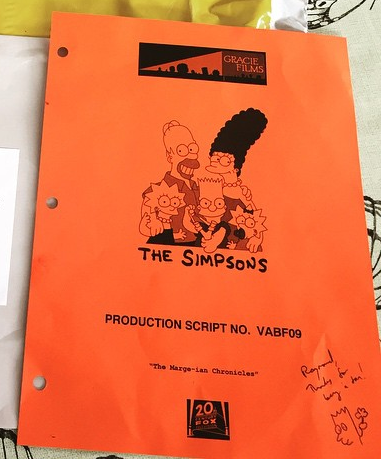
"Not feeling unique, Lisa signs up for the Mars One Space Colony – to Marge's dismay. Then, Marge hires Bart to go through the tryout process with Lisa to make her want to quit."It's called (wait for it!) ... "The Marge-ian Chronicles."
 You can't fail to have noticed the widespread tributes to Leonard Nimoy, who died recently at the age of 83. Of course, Star Trek, and of course, Spock. But Nimoy also had an incredibly long career that spanned stage, television, film - and was recognised for his acting, teaching, writing, directing and photography.


