Showing posts with label Mars. Show all posts

Thursday, January 20, 2022

New Bradbury 100 podcast - Ray Bradbury's OTHER martian stories

In the latest Bradbury 100 podcast episode, I discuss Ray Bradbury's other martian stories - stories set on Mars which are not part of The Martian Chronicles.

These stories have only once been all collected together, and that was in the limited-edition book The Martian Chronicles: The Complete Edition (2009). I've mentioned this book before, and have also mentioned my love-hate relationship with it. On the one hand, the book was a great idea, but on the other hand, it turned out to be far from "complete".

One section of that book is titled "the other martian tales of Ray Bradbury", and is based on a selection of stories originally collated by Marc Scott Zicree, writer of the famous Twilight Zone Companion. Zicree figured out which other Mars-related stories Bradbury wrote, and also dug around in Ray's archives to find any that remained unpublished. Zicree's proposed book didn't happen, but the selection of stories was absorbed into the Complete Edition. Actually, not everything Zicree collated ended up in the book; the editors of the Complete Edition decided to only include stories set on Mars, and to eliminate any that were set elsewhere. A reasonable choice... except not all of The Martian Chronicles is set on Mars... so they hadn't thought it through...

Here's the list of "other Mars stories" used in the so-called Complete Edition, which I work through in the podcast episode (UPDATE: I somehow missed "The Martian Ghosts" of this list - but I've added it now):

  1. The Lonely Ones
  2. The Exiles
  3. The One Who Waits
  4. The Disease
  5. Dead of Summer
  6. The Martian Ghosts
  7. Jemima True
  8. They All Had Grandfathers
  9. The Strawberry Window
  10. Way in the Middle of the Air (included in the "other" section, because the Complete Edition contains a version of The Martian Chronicles which deliberately omits this story)
  11. The Other Foot
  12. The Wheel
  13. The Love Affair
  14. The Marriage
  15. The Visitor
  16. The Lost City of Mars
  17. Holiday
  18. Payment in Full
  19. The Messiah
  20. Night Call, Collect (aka I, Mars)
  21. The Blue Bottle
  22. Dark They Were, and Golden Eyed (aka The Naming of Names)

Anyone who is expecting any major revelations in this list will be disappointed. It is mostly a list of (a) stories which are easily available in Bradbury's other books; (b) unfinished stories; and (c) tiny fragments and bridging material, pages or paragraphs left on the cutting-room floor. The only truly interesting find here is "They All Had Grandfathers".

Please listen to the episode, where I go through the intricacies of these stories, and explain how a couple of the fragments such as "The Wheel" and "The Disease" reveal something of Bradbury's process of assembling The Martian Chronicles. 


Wednesday, January 20, 2016

David G. Hartwell

In a strange echo of what happened with George Clayton Johnson, there have been announcements - followed by rapid retractions - of the death of Hugo Award-winning editor and critic David G. Hartwell. He evidently suffered a massive stroke.

I once sat on a conference panel with David, although my interaction with him was minimal. But I am very familiar with his work. The "Timescape" imprint he started at Pocket Books in the 1980s gave me plenty of quality reading back in the day, and that accounts for only a tiny proportion of his career's work. You can read about this influential SF figure here: https://en.wikipedia.org/wiki/David_G._Hartwell

This photo shows the panel at the 2008 Eaton Conference at University of California Riverside where I met David. Left to right: Paul Alkon, David G. Hartwell, Eric Palfreyman​ and me. The theme of the panel was the Mars and Ray Bradbury, and the whole conference was entitled "Chronicling Mars".


Wednesday, May 22, 2013

Orbiting Bradbury's Mars

Coming soon, Orbiting Ray Bradbury's Mars, edited by Gloria McMillan. The blurb for this essay collection says:

Noting the impact of the Southwest on Bradbury, some of the essays analyze Bradbury’s southwest metaphors: colonial pollution of a pristine ecology, the impacts of a colonial invasion upon an indigenous population, the meeting of cultures with different values and physical aspects. Other essays view Bradbury via the lens of post-colonialism, drawing parallels between such works as The Martian Chronicles and real-life colonialism and its effects. Others view Bradbury sociologically, analyzing border issues in his 1947 New Yorker story "I See You Never," written long before the issue of Mexican deportees appeared on the American literary horizon. From the scientific side, four essays by astronomers document how Bradbury formed the minds of many budding scientists with his vision.

The book is due for release towards the end of the 2013, but is available for pre-order now from the website of the publisher, McFarland. McFarland previously published Visions of Mars, to which I contributed an essay on Bradbury's Mars.

Thursday, August 23, 2012

Bradbury Landing!

As expected, yesterday - what would have been Ray Bradbury's 92nd birthday - saw some more tributes paid to Ray:


Practical Magic author Alice Hoffman recalled her first direct contact with Ray, and his response to the story she submitted for the tribute volume Shadow Show in "A Birthday Wish For Ray".


Bradbury's friend, the British writer and broadcaster Brian Sibley uploaded a radio documentary he made in 1989 for the BBC World Service.


The Curiosity rover on Mars dedicated its landing site to Ray, announced in a tweet which reads "In tribute, I dedicate my landing spot on Mars to you, Ray Bradbury. Greetings from Bradbury Landing!" Here's the photo of Bradbury Landing:


Space.com was the first website to attempt to place "Bradbury Landing" in the context of other named landing spots on Mars. Read more here.


In their 11.30am (PST) press conference, the NASA/JPL team started with Ray Bradbury - playing a clip of him from the 1971 "Mars and the Mind of Man" symposium - and concluded with a short video showing Ray's last visit to JPL in 2009, when he was shown models of Mars rovers and was allowed to drive one of them in simulation. NBC have the best coverage of the contents of the press conference, and have included the two video clips, here.


Tuesday, August 14, 2012

Why Mars?

For most of the past year, I have immersed myself in Bradbury's unfilmed (and mostly unpublished) screenplay versions of The Martian Chronicles. One of the outputs from this research was a paper which I presented at the 2012 Science Fiction Research Association conference in Detroit. In the paper I attempted to unpick what Bradbury was trying to do in his early-1960s Chronicles film work.

Although the screenplays are adaptations of his book, each version takes on a different flavour. The published 1965 screenplay (found in the limited edition volume The Complete Martian Chronicles) appears to address, head on, the reasons we might be compelled to explore space. This is not entirely surprising, given that the script was written at the height of the space age, when the successes of the Mercury and Gemini programmes were coming thick and fast, and when Bradbury was himself becoming something of a spokesman for the space programme.

It was interesting, therefore, to see Steven Paul Leiva's excellent recent article "Ray Bradbury, the Masterheart of Mars" in which he identifies three reasons for going to Mars. Bradbury "instinctually understood" two of these, Leiva writes, and "was a poet of the third". Read the article at the KCET website, here. Steven, you may recall, was the organiser of "Ray Bradbury Week" in Los Angeles in 2010.

Steven Paul Leiva, pictured at Bradbury's 90th birthday party.

Steven has also been instrumental in the campaign over the Los Angeles Palms-Rancho Park branch library, which I recently reported on. He has pointed out that my report of the library's potential name change was incorrect: rather than being renamed in honour of Ray (something which isn't possible), the proposal is that the branch be dedicated to Ray.

This is how Steven, writing on Facebook, describes last week's meeting:
I spent the morning attending the monthly meeting of the LA Library Board of Commissioners, which - at the request of Councilmember Paul Koretz - was held at the Palms-Rancho Park Library. Also at Paul's request they gave consideration to the idea of dedicating the Palms to Ray. Several members of the public representing the neighborhood council and home owners association, the Greater Los Angeles Writers Club, and the Friends of the Palms Library spoke at the meeting and all very enthusiastically endorsed the idea. They all gave intelligent, passionate, and moving speeches. One broke into tears. At least one audience member started to weep (you know him, his name is Steven). Then the president of the council spoke, very tearfully, for the measure. It was moved and seconded -- and passed unanimously.

We now have to wait a mandate period of three months for public comment, but, essentially, it's a done deal!

The Palms-Rancho Park Library is very appropriate as this was Ray's local library, close to his home of over 50 years in Cheviot Hills. His daughters have very fond memories of Ray walking them to the library when they were children and spending much time there. Ray spoke there often and was a huge supporter of the library, as he was of all libraries. There is already a Ray Bradbury room at the Palms, but now the whole library will be dedicated to him.

Sunday, July 08, 2012

Tribute through... stamps!

The Smithsonian National Postal Museum has put together a little tribute to Ray Bradbury, using postage stamps to illustrate key points in his life and career. It's rather cute, as you can see by clicking here.

It occurred to me that this idea could be taken further, especially if you bring in stamps from other nations that theUS - such as the Soviet Sputnik stamp shown on the left.

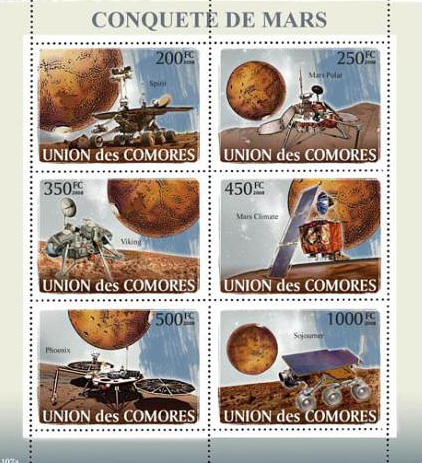
Here are some other stamps which should have some resonance for Bradbury aficionados. See if you can work out the Bradbury connections:


Thursday, June 14, 2012

Fred Pohl on Bradbury

There aren't many writers still active who were exact contemporaries of Ray Bradbury. Ursula LeGuin, Richard Matheson and Brian Aldiss come close, but they all began publishing in the 1950s, around a decade after Bradbury got started as a professional.

Fred Pohl was born about nine months before Bradbury, and he is still active today, writing both fiction and... blog posts.

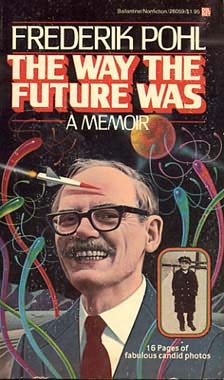
Fred's blog is The Way The Future Blogs, a play on the title of his autobiographical book The Way The Future Was. In a recent post, Fred blogs some memories of his association with Ray.

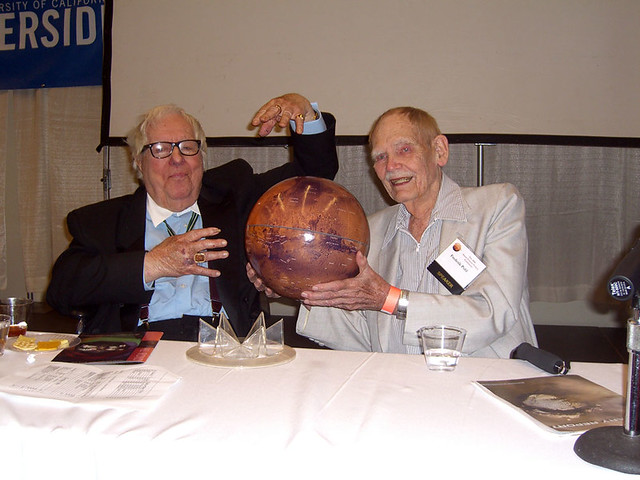
I had the privilege of meeting both Fred and Ray, and saw them together on a panel about Mars. They both have a connection to the red planet, Bradbury through his Martian Chronicles, and Pohl through his award-winning 1976 novel Man Plus and its sequel.

Hence, they both delighted in playing with the red planet:


Monday, December 26, 2011

Past Futures

Back in 1963, we had barely left the confines of Earth. The Mercury program was underway, and a few Moon probes had been flung toward our natural satellite. With the developing space age, the media were beginning to pick out certain figures from the science fiction field who appeared to have some expertise in envisaging the future.

Somewhat oddly, given his lack of interest in technical and hardware matters, Ray Bradbury became one of the leading representatives of the SF community in media coverage of the Mercury-Gemini-Apollo programmes. Another, more logical choice for such a role was Bradbury's friend Arthur C. Clarke: not only an SF writer, but something of a scientist and "inventor" of the geostationary communication satellite.

Which brings me to a fascinating piece of television history: a recently re-discovered (previously considered lost)  episode of the BBC's astronomy series The Sky at Night. Although usually broadcast only once a month, the series claims to be the longest continuously running TV show in history - and is still presented to this day by its original host, Patrick Moore (himself a science fiction writer, as well as an astronomer). What's interesting in this episode is the guest: Arthur C.Clarke. Clarke talks about all manner of proposals for bases on the Moon and Mars. It all sounds so logical, obvious, and inarguable... and yet most of what Clarke predicts did not come to pass. Because we got bored with the Moon shortly after Apollo 11!


Friday, December 09, 2011

Travelling Far and Wide

If you happen to be in Bradbury's home town of Waukegan, Illinois, now would be a good time to get down to your local museum. The Waukegan History Museum has an Open House on Saturday, offering a chance to view an exhibit called “Ray Bradbury: Waukegan’s Influence On A Visionary”. The exhbit runs until 22 December. More details can be found here.

 And if you want to travel a bit further from home, why not consider what Mars has to offer. This selection of books from the Washington Post provides suggested reading about the red planet in fiction and fact. Top of the list? The Martian Chronicles, of course.

Saturday, June 12, 2010

Bradbury, Bradbury everywhere

There are some potentially interesting materials to help with the use of Fahrenheit 451 in the classroom at the website Shmoop, here. Some parts of it are unlockable only by paying money, but other parts are free. From a cursory glance, it's not clear to me what age range they are assuming, but it may be useful to some teachers.


I gave up watching the TV series Lost a couple of years ago, and have been amused at the amount of blogosphere coverage the series finale has garnered. I was more amused by this Los Angeles Times review which suggested how Ray Bradbury might have enlivened proceedings...


At the Huffington Post, a "college English instructor in Northern California" gives high praise to Ray Bradbury.


I finally received my copy of The Martian Chronicles: the Complete Edition. This large volume from Subterranean Press collects (supposedly) all of Bradbury's Mars stories, both the ones from the original Martian Chronicles and the ones that were published elsewhere. It also includes two complete Bradbury screenplay adaptations of the book. For my research into Bradbury's media work, this volume is a godsend; previously I had to make a trek to Indianapolis to inspect Bradbury's screenplays at the Center for Ray Bradbury Studies.

I said "supposedly" above, not to question the editorial completeness of the Subterranean volume, but simply because I expect Bradbury has some more Martian tales lying around somewhere.

The Martian Chronicles: the Complete Edition is a handsome book, but there is little point in me trying to persuade you to save up to buy a copy... because it's already sold out!

Saturday, May 24, 2008

Eaton Conference 2008: Chronicling Mars

From 16th to 18th May 2008, I attended the J.Lloyd Eaton Conference at the University of California, Riverside. I presented a paper entitled "Re-Presenting Mars: Ray Bradbury's Martian Stories in Media Adaptation".

On the panel with me were two Bradbury-related speakers. The noted SF editor, publisher and anthologist David Hartwell spoke on "The Non-Scientific Mars from Burroughs, Brackett & Bradbury to Today". And from Collin College (McKinney, Texas), Eric Palfreyman spoke on "Mars is Heaven: Ray Bradbury's Martian Landscape as a Mythological Setting for his Philosophical and Religious Ideas".

Our panel chair was USC's Paul Alkon, who gave each of us a Mars bar. Highly appropriate!

The panel was privileged in being scheduled immediately before the star attractions: a talk by leading author Kim Stanley Robinson, and a special presentation by Ray Bradbury himself. The conference chairs had warned delegates that if they weren't in the conference hall early, they may not get a seat for the Bradbury talk. And so it was that David, Eric and I were blessed (or cursed) with having the largest audience of the entire conference.

Stan Robinson - with whom I had I very brief chat while looking at old astronomical images of Mars - gave a fascinating account of his dealings with the planet Mars (through his terraforming novel trilogy Red Mars, Green Mars and Blue Mars). He made it clear how indebted he is, and other Mars writers are, to Ray Bradbury for his master work The Martian Chronicles (1950).

Bradbury's talk covered his life and career, and his involvement with Mars. It was followed by a question and answer session, and a mammoth book-signing session.

In attendance for the Bradbury presentation were fellow raybradbury.com Message Board members Nard, Doug Spaulding, and jkt. When added to conference delegates philnic, Mr Dark and PatR, this probably made the biggest Board gathering of recent times.

Following the Bradbury talk, a select few (self-selected for the most part) retired to a buffet with Mr B. Much talk and photo-taking followed.

To see my photos of the conference, click on the image below: