Showing posts with label The Bradbury Chronicles. Show all posts

Monday, April 16, 2012

Searching for Bradbury's "The Crowd"

Although Ray Bradbury is a fantasist, occasionally you hear of one of his works of fiction being inspired by real-life events. One classic example is the short story "The Crowd", which deals with a ghoulish, apparently supernatural crowd of people who gather at car crashes.


The story is supposedly inspired by an incident Bradbury witnessed in Los Angeles in his teens. Bradbury's biographer Sam Weller, writing in The Bradbury Chronicles, describes it like this:


[...] in 1935 Ray was visiting Eddie Barrera at his house on Washington Boulevard when they heard a terrific crash outside. The boys bounded out the front door and saw a smoldering car about a hundred yards up the street, in front of a cemetery. The car had hit a telephone pole head-on and the passengers had been catapulted onto the pavement. [...] Three people had already died; another - a woman - was barely alive.


It was the sight of this woman that created a vivid memory that compelled Bradbury to think about the event over and over until, some eight years later, he was inspired to produce "The Crowd", which was first published in Weird Tales in May 1943. Today, you can find the story in The Stories of Ray Bradbury.

In The Complete Stories of Ray Bradbury: a Critical Edition, Jon Eller gives a little bit more information: that Bradbury was  located at Washington Boulevard [Eller says Avenue, but there is no Washington Avenue in LA] and Berendo Street. Armed with this information, and Google Maps, this allows us to work out where the crash must have taken place: outside Rosedale Cemetary. The nearest part of the cemetery is about a hundred yards from the corner of Berendo and Washington.


View Larger Map


I thought I would try to locate detailed information about this car crash. Such an incident must surely have made the local press, I thought.

Searching through the online archives of the Los Angeles Times for 1935, I found just one news story that contained details of a car crash and a reference to Berendo/Washington, reported on 1 May 1935.

Unfortunately, none of the content ties in with Bradbury's recollection. The headline, "AUTOS TAKE TWO LIVES", gave me hope that this was indeed the account of the source of "The Crowd". But alas this one brief news story tells of two separate road traffic accidents happening the day before, both being incidents where pedestrians were hit by cars... and reports a conviction for manslaughter due to dangerous driving in another incident... and reports on a police officer being struck by a motorcycle and sidecar... and reports on a court appearance by a man arrested for drunk driving... and on and on.

I was forgetting. This is Los Angeles. The home of the road traffic accident, even in 1935.

No wonder Bradbury was always afraid to drive, and became a champion of public transport!

Sunday, July 24, 2011

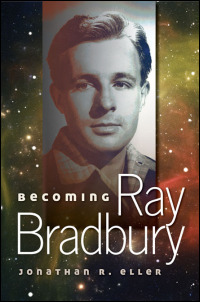
Becoming Ray Bradbury

If you have a shelf full of Ray Bradbury's books, you may think you know his work well. You'd be wrong.

Professor Jonathan Eller of Indiana University has made it the work of a decade or so to pull off Bradbury's mask and find what's beneath. Some of this work has been done in studies of single works by Bradbury. Eller has edited, co-edited or contributed to volumes such as It Came From Outer Space, Moby Dick: a Screenplay, and The Halloween Tree. These have all revealed previously invisible aspects of Bradbury's work, by publishing intermediate aftefacts such as screen treatments, outlines and screenplays.

In his work with his Indiana colleague Prof William Touponce, Eller has substantially overturned our assumed wisdom about Bradbury's authorship. Their mammoth study Ray Bradbury: the Life of Fiction presented new readings of Bradbury's major works in light of archaeological diggings into Bradbury's typescripts and working papers. Before Eller and Touponce, we tended to assume that each book Bradbury put out was a reflection of his writing at the time of publication. After The Life of Fiction we can see that the vast majority of Bradbury's work stems from an extensive outpouring of creativity in the 1940s and early 1950s.

Eller and Touponce are continuing to "set the record straight" through their ongoing multi-volume critical edition of The Collected Stories of Ray Bradbury. This series of books seeks to restore Bradbury's original texts and to establish the original compositional sequence and chronology of Bradbury's short stories. It's really quite stunning to discover how many of Bradbury's classic tales were conceived or written before 1950.

Now Eller has completed a volume which serves as an excellent companion to The Life of Fiction and The Collected Stories.

Becoming Ray Bradbury is a biography of Bradbury's early career, concentrating on his creative, literary and intellectual development. It goes up to the key turning point of Bradbury's professional life: his sojourn in Ireland working on Moby Dick for John Huston. The remainder of Bradbury's career is due to be covered in a sequel volume.

There have been Bradbury biographies before, of course, most notably Sam Weller's The Bradbury Chronicles. Why do we we need another?

The answer to that one is simple. Sam Weller writes about every facet of Bradbury. Not just Bradbury the writer, but Bradbury the young film fan who hung around studio gates waiting for an autograph from W.C.Fields. Bradbury the celebrity who walked out on David Frost on the night of the Moon landing. Bradbury the friend of the stars and honoree of presidents from around the globe. All of this makes The Bradbury Chronicles a rounded and fascinating read.

But what Eller does in Becoming Ray Bradbury is carefully examine the details of Bradbury's writerly development. Here we learn of exactly what Bradbury was reading and writing during his early attempts to become a writer; of the importance of mentors such as Jack Williamson, Edmond Hamilton and Leigh Brackett; of his encounters with the works of Steinbeck and Hemingway. Some of this is covered in Weller's book, but Jon Eller takes us deeply into Bradbury's reading and can tell us that, for example, in 1944 Bradbury read Charles Jackson's The Lost Weekend and E.B. White's One Man's Meat. In many cases, he is able to tell us how and why Bradbury came to each volume: perhaps a chance discovery in a bookshop; perhaps a recommendation from friend Henry Kuttner; perhaps a gift from his wife.

Why does any of this matter? Well, because Eller is trying to piece together factors that influenced Bradbury's writing, thinking and worldview. It is clear in the early chapters that Bradbury was quite susceptible to influence from others, as we discover through the account of Bradbury's aligning himself with the "Technocracy" movement. It is equally clear that the young Bradbury was astute in making up his own mind, and having explored an idea in depth would be quite prepared to toss it aside if it was found wanting.

Becoming Ray Bradbury is particularly good in covering Bradbury's early professional years, presumably in part because Bradbury himself kept good records. (He has a reputation, to this day, of never throwing anything away.) It also gives an excellent account of Bradbury's oscillation between optimism and pessimism in terms of his knowledge and understanding of the world. Many critics are confused over this, and find it hard to reconcile a perceived "anti-science" bias in some of Bradbury's work with a profound optimism found elsewhere.

At the heart of Becoming Ray Bradbury is a pair of chapters dealing with Bradbury's "miracle year", a twelve-month period in which he submitted three of his major works: The Martian Chronicles, The Illustrated Man and "The Fireman" (the earliest published version of Fahrenheit 451.)

You can probably tell by now that I think highly of this book, but that doesn't mean I find it without its flaws and foibles, although they are really quite minor. Although it is far more detailed than The Bradbury Chronicles, it doesn't attempt to cover every aspect of Bradbury's life. For some readers - particularly those who haven't read The Bradbury Chronicles - that might make this seem an oddly-balanced volume. In fact, the book is probably best seen as complementary to The Bradbury Chronicles. I still think it will make perfect sense to anyone who hasn't read Weller.

The only other slight weakness emerges from the difficulty of trying to draw out themes from a literary career while still sticking to a broadly chronological telling of events. There are occasions where the narrative has to backtrack, and with a work as detailed as this it's easy for the reader (me, at least) to have forgotten a crucial detail from a previous chapter.

The book is very clearly written. Don't be put off that this is written by a professor, and is published by a university press. It is free of scholarly jargon and doesn't demand that you have a degree in Eng. Lit.

Becoming Ray Bradbury is a fine companion to The Life of Fiction and The Collected Stories of Ray Bradbury. Together, they round out a significant re-evaluation of Bradbury's life and work.

Wednesday, April 21, 2010

We'll Always Have Paris Review...

The Paris Review's latest issue carries one of Sam Weller's interviews with Ray Bradbury. Weller, of course, if Bradbury's official biographer, author of The Bradbury Chronicles. In the course of developing the biography, Weller undertook many hours of interviews with Bradbury. In June of this year, another book containing nothing but interviews will be released. Entitled Listen to the Echoes and consisting of over three hundred pages of chat, the book is available for pre-ordering now.

I confess to being a little (I emphasise little) tired of Bradbury's interviews, in the sense that he often reels out the same anecdotes again and again. But I attribute this to interviewers asking the same questions again and again. Steven Aggelis's Conversations with Ray Bradbury is fascinating precisely because Aggelis carefully selected interviews that allowed us to see how Bradbury's thought evolved over his career. I am hoping that Weller's Listen to the Echoes will work because his in-depth knowledge of Bradbury's life enables him to come up with new questions and new angles.

The Paris Review website has a short extract from the Weller/Bradbury interview, in which Bradbury amusingly recounts what happened when he was invited to adapt War and Peace for King Vidor.


The B-Movie Film Vault Blog has an amusing top ten of the best Ray Harryhausen creatures. At number nine is the rhedosaurus. This, of course, is the dinosaur that was The Beast From 20,000 Fathoms, based on the Bradbury story also known as "The Fog Horn". My own review of the film can be found here.


Subterranean Press are highlighting reviews of their edition of Pleasure to Burn, a collection of the stories that were directly ancestral to Fahrenheit 451. I haven't yet seen the book in the flesh, but I believe it has essentially the same fiction content as Gauntlet's Match to Flame. As far as I can tell, however, only Match to Flame has the contextual essays from Jon Eller and Bill Touponce. There are some other small differences as well, but I can't quite figure them all out.


Urban Archipelago Films has announced the DVD release of their film Ray Bradbury's Chrysalis. I haven't seen the film yet, but I know it has been doing well on the festival circuit. The DVD will be out on 27 July 2010 - full details are here. I'm pretty sure this date was announced a while ago, but I may not have mentioned it on this site.


Ever wondered what "a Ray Bradbury" is? Maybe one of these Gene Roddenberrys will know the answer:


Monday, August 24, 2009

Ancestry

I'm not really one for genealogy, but sometimes a simple family tree is all you need to be able to make sense of a biography. Whenever Ray Bradbury is biographised [find out if that is a real word - Ed.], his biographers have a tendency to trace his family history back to two solid points:
  • the first Bradbury to arrive in the Americas (Thomas Bradbury in 1634)
  • Mary Bradbury, accused of witchcraft in Salem (in 1692)
Unfortunately, there are a good ten generations between Thomas, Mary and Ray; ten generations in which certain names get re-used: there are a lot of Hinkstons, Spauldings and Samuels in the family. I find it difficult to keep my head straight when a biographer is talking about "Samuel Bradbury" - do they mean Samuel IRVING Bradbury, Samuel HINKSTON Bradbury, Samuel Hinkston Bradbury JUNIOR, or one of several plain old Samuel Bradburys (no suffix, no middle name)?

Oddly, none of the biographers has thought to provide a family tree. Maybe they are as confused about all this as I am...

To resolve the problem, I had to draw up a family tree myself, based on information gleaned from various sources. Most helpful were The Bradbury Chronicles by Sam Weller and Red Planet, Flaming Phoenix, Green Town by Marvin E. Mengeling. I had to cross-check some information on full names and dates using www.rootsweb.ancestry.com, an excellent genealogy resource, although one which is prone to occasional error since, like Wikipedia, anyone can contribute to it.

No doubt there will be some real genealogists who will be unhappy that I haven't filled in every branch of the Bradbury family tree. My excuse is that I created this to help me make sense of the biographies I was reading. Uncles Bion, Inar and Lester seem to have been influential on Bradbury's life and art - so they are shown. Their spouses and offspring don't seem to have been so influential - so they are left out.

See for yourself: click the image below to reveal my attempt at the Bradbury family tree: