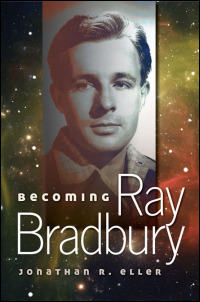
For a very limited time, Jon Eller's literary biography of Ray Bradbury - Becoming Ray Bradbury - is being offered in a special promotion from the publisher, Illinois University Press. In case you don't know, the book is a fascinating study of Bradbury's early writing career, and reveals the influences on Bradbury's developing authorship during the period when he was at his most creative and most prolific.
If you are an e-book user, you can get the full e-book version for a ridiculously cheap price of $2.99. Versions are available for Kindle, Nook and Kobo. The offer is good until the end of June. I don't know whether the offer is geographically limited.
Here's a direct link to the publisher's page. Scroll down to find the links for Becoming Ray Bradbury:
http://www.press.uillinois.edu/wordpress/?p=11910
Showing posts with label e-book. Show all posts
Wednesday, June 19, 2013
Saturday, February 23, 2013
Bradbury News
Earlier this week, The Guardian reported that Ray Bradbury's books are finally to be released as e-books in the UK. No big deal, you might think - except that Bradbury was famously opposed to his works being made available in this form right up until his final year on this planet. I don't believe there was any great earth-shattering moment when he "caved in", or when he had some great epiphany; I think it was just a case of the new contract arriving, and the continued publication of the print editions of his works would be conditional on e-book rights also being made available to his publisher.
The Guardian faithfully reported this story, but slipped in a new piece of information which to me is much more significant. It appears that Dark Carnival is among the books which will be made available as an e-book.
Dark Carnival. Bradbury's first book. Not science fiction, but dark fantasy and horror. The book that he refused to be re-issued, on the grounds that he had re-written (improved?) all of its constituent short stories, which continued to be available in the collection The October Country.
Dark Carnival has only ever been available in three editions: the US hardcover, out of print since the 1940s; the UK hardcover, also out of print since that decade; and a limited edition re-issue from Gauntlett Press (2001), also long out of print.
At the moment, any copy of Dark Carnival is likely to set you back at least £600 (900 USD). The first edition typically goes for 2000USD.
So issuing Dark Carnival as an e-book is a very big deal. (Assuming, of course, that they use the original text from Dark Carnival. If they instead cobble the contents together from the text in The October Country, thinking that the stories are identical, they will be making a big mistake.)
Is there much of a difference between the stories in Dark Carnival and the re-written versions in The October Country? In some cases, not so much. But in other cases the stories are somewhat transformed. In general, the earlier versions of the stories are darker and a bit more raw; the re-writes are a bit more poetic, but sometimes read like a more "respectable" Bradbury has gone back and tidied up the work of his earlier self. This isn't far from what actually happened, as Dark Carnival came out when Bradbury was known only from stories in pulp magazines like Weird Tales, but The October Country was assembled when he had gone up in the world and was appearing in slick, upmarket magazines.
Speaking of Dark Carnival, BBC Radio 4 Extra this week broadcast a dramatisation of one of the stories from that book. "The Emissary" is a thirty-minute drama broadcast in the Haunted strand. Although marked on the BBC website as a "Radio 4 Extra debut", the closing credits of the show place it as a BBC World Service production, so it is probably not new... but I haven't been able to work out when it was made. Oddly, the late Percy Edwards is credited with playing the dog in the story, but he died a long time ago. Either it's a much older recording than it appears, or Percy is being played in as a sound effect!
"The Emissary" is still available right now for listening online, but it won't stay there forever. Get it while you can.
Monday, December 12, 2011
New Tech, Old Tech
You may have seen the recent flap about Ray Bradbury finally authorising e-book editions of his work - apparently starting with the delightfully ironic Kindle edition of Fahrenheit 451. Here's The Guardian's report.
Many of the reports focus on the theme of F451 as being the dangers of destroying books... but overlook the key lesson of F451, which is that it's the TEXT that matters, not the physical form of the book. This, after all, is why the book people memorise the texts.
While we're thinking of Bradbury moving into the modern era, it's nice to be reminded of the mechanical means he used to create most of his works: this story shows one of Bradbury's old typewriters.
And if you think Bradbury is able to conjure up amazing images at his typewriter, just see what this other creative typist can do!
At some point in his career, Bradbury switched from manual typewriters to electric ones, although he continued to use manual portables when travelling. Some of his early '60s electric typing can be seen in the "symbolism survey" that swept across the blogosphere this last week: this article in The Paris Review tells of a series of responses a sixteen-year-old high school student received in 1963 when he wrote to famous writers. Some, such as those from Kerouac and Rand, take issue with the questions or the assumptions behind the questionnaire. Others, such as Ralph Ellison and Bradbury, take a more helpful and thoughtful line.
Labels:
e-book,
Kindle,
letters,
Paris Review,
symbolism,
typewriter
Subscribe to:
Posts (Atom)
