Showing posts with label reviews. Show all posts

Wednesday, August 17, 2011

451 in the UK

When Fahrenheit 451 was first published in the UK, it didn't exactly make a big splash with the critics. The Guardian newspaper carried a single paragraph review, part of a "books of the day" column, although it was written by a significant literary critic.

Hugh I'Anson Fausset is little known today, but was evidently an important reviewer, as suggested by the list of his critical works in his Wikipedia entry.

Here is what he had to say about Fahrenheit 451 on 23 March 1954:
Mr Ray Bradbury is reputed to write science-fiction poetically, but in Fahrenheit 451 [...] his acutely picturesque manner ill suits the dreary subject matter - future America where the firemen's duty is to burn such books as remain or be destroyed as enemies of the State by a radar-controlled Mechanical Hound. The masses have given up reading, except comics and technology. They have four-wall television and high-speed games. If without a clue to the brains in control, we are visually thrilled when the Hound is up after Montag, a rebellious fireman, and there is real gusto in the descriptions of burning.
I'm not sure what Fausset is referring to with "high-speed games". Maybe he saw premonitions of Wii and PS3 in Bradbury's writing...

Saturday, August 13, 2011

Critical Judgement

Do you sometimes read a TV or film review and wonder whether the critic has been watching the same thing as you?

I had this (familiar) thought when I recently read a contemporary review of the 1964 Alfred Hitchcock Hour production of Bradbury's "The Jar". The review was written by critic Derek Malcolm in The Guardian (13 March 1964).

Malcolm is generally dismissive of the series as a whole, saying "by the end of the show one generally feels a little cheated".

Of "The Jar" in particular, he writes

The story, which may have been a good one as written by Ray Bradbury, collapsed in a sea of cliches about half way through and drowned without trace long before the end. It revolved around a simpleton who buys a mysterious bottle from a carnival sideshow [...] The jar, reckoned to hold the secret of life and death, is wrecked by his baby-doll wife, so he ups and puts her in another one to regale the natives even further. Mock not that ye be not mocked appeared to be the moral of the piece. But it needed better handling than it got to drive the point home past the numbing tedium which spread like glue across the screen.

[...] Even old stagers like Slim Pickens and Jane Darwell were unable to retrieve the situation for more than a couple of seconds. However, one has seen better Hitchcock Hours than this. But even the best look like Hitchcock at his most glib and facile, so there seems little point in connecting him with such goggle-box ephemera at all. Maybe he needs the money.

While the Hitchcock Hours were generally not as good as the half-hour format used in Alfred Hitchcock Presents - and while I would tend to agree with Malcolm that any artistic correlation between Alfred Hitchcock, film director, and The Alfred Hitchcock Hour was somewhat tenuous - I can't help thinking that he has almost entirely missed the point of "The Jar". First, the show hinges on the visceral and visual fascination of the jar's mysterious contents, which drives people to do strange things. Second, the direction of the episode by Norman Lloyd is deliberately contrived to mirror the way people sit around the TV, entranced by its vague and flickering movements.

Perhaps Malcolm, being best known as a film critic, was unable to appreciate this as a particularly televisual production. Or perhaps this is a reading of the show which is more evident today than it would have been in 1964.

My own review of "The Jar" can be found here. I also have reviews of the Ray Bradbury Theatre version, and the weak 1980s Alfred Hitchcock Presents version.

Tuesday, August 09, 2011

Back in '53

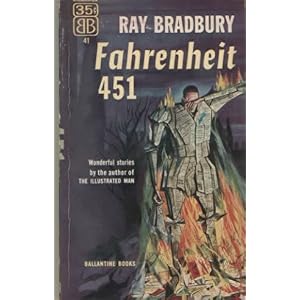
Back in 1953, you could get a hardcover novel for $2.50... or a paperback for 35 cents. Specifically, you could get Fahrenheit 451 for those prices, in the first edition from Ballantine Books.

Strictly speaking, I suppose Fahrenheit 451 was a collection rather than a novel, since that first edition also contained two other stories: "The Pedestrian" and "And The Rock Cried Out".

Among the first reviewers of Fahrenheit was J. Francis McComas, then co-editor of the influential Magazine of Fantasy and Science Fiction. Writing for The New York Times, McComas described the book as "an unsettling experience". He characterised the book as "a polemic: moving and convincing at times, this glum portrayal of a dismal future seldom makes its appeal exclusively to the emotions."

McComas uses some extreme terms, describing the book's "virulent hatred for many aspects of present-day culture" in its depiction of "a grisly world". He does, however, acknowledge the idea as intriguing and not altogether implausible.

Ultimately, McComas finds the world of the novel to be sketchily portrayed, and particularly criticises the lack of detail in accounting for the politics behind the all-out atomic war. He also finds the characters lacking, "spare symbols whose imagined lives are curiously inconsistent with established fact."

I have some sympathy with some of McComas's observations, but I tend to disagree about the atomic war. Bradbury tells the whole story from the restricted viewpoint of Guy Montag, whose knowledge of what goes on in his world is very limited. Montag's understanding dawns slowly, and does so in what immediately surrounds him. His knowledge of government and politics is completely lacking precisely because of the lack of meaningful information allowed to citizens of 451's world.

(Source: "Nothing But TV", New York Times, 8 Nov 1953, p BR43)

Friday, April 08, 2011

Mixed Reviews...

Ray Bradbury's affection for Ireland and the Irish is well known, and well documented in his fictional account of his time in Dublin, Green Shadows, White Whale. The feeling isn't always mutual, unfortunately. On 2nd March 1963, the Irish Times published a brief review of Bradbury's then new book Something Wicked This Way Comes:

Finally to a novel which, because, it seems, I have read only the best of Ray Bradbury, appeared to me to be a sorry lapse. It is a piece of horrific whimsy about a sort of satanic carnival which arrives outside a little town in the middle of the night with all sorts of weird devices for the destruction of its citizens, in particular of the two wholesome boy heroes. It seemed to me incredibly puerile, but I am informed that is is "usual" Ray Bradbury, and that a volume in which a brilliant and truly horrible story called "The Next in Line" appeared is not typical. Perhaps, therefore, readers who really know their Ray Bradbury will not be too disappointed with his latest offering.

The review was written
by Irish novelist and short story writer Val Mulkerns. I appreciate her honesty in admitting to only a partial knowledge of Bradbury's body of work, but wonder at the editorial wisdom of allocating the review to someone apparently ill-equipped to appreciate its qualities.

Wednesday, March 09, 2011

Bradbury's British Debut

Sixty-two years and one month ago the British Guardian newspaper carried its first review of a writer's first book. The book was Dark Carnival by Ray Bradbury, in its British edition from Hamish Hamilton publishers - which was slightly different from the US Arkham House edition.

Here, in its entirety, is what reviewer Charles Marriott had to say of young Bradbury's first short story collection:

Ingenuity rather than imagination is responsible for the twenty stories in Dark Carnival by Ray Bradbury, with the result that, though several of them, like the title one, are painstakingly nasty, they do not make your flesh creep. It is a dangerous thing for a young writer to get a reputation for the macabre.

With hindsight, I think it's safe to say that the reputation for the macabre didn't do Bradbury any harm.

I am rather baffled, though, by that phrase "like the title one", because Dark Carnival doesn't have a title story! The contents of the Hamish Hamilton edition were as follows:

The Homecoming
Skeleton
The Jar
The Lake
The Tombstone
The Smiling People
The Emissary
The Traveller
The Small Assassin
The Crowd
The Handler
Let's Play 'Poison'
Uncle Einar
The Wind
The Night
There Was an Old Woman
The Dead Man
The Man Upstairs
Cistern
The Next in Line

If you are familiar with the US edition of Dark Carnival, you will notice that missing from the table of contents are "The Maiden", "Reunion", "The Coffin", "Interim", "Jack in the Box", "The Scythe", "The Night Sets". I believe post-war paper shortages were partly responsible for the UK edition being reduced from the US version.