Shadow Show, the short story anthology in honour of Ray Bradbury is now out. I have a copy, but haven't had time to read it properly yet, just dip in here and there. Eventually I will get round to reviewing it. Meanwhile, there are other reviews out there to help you decide whether it is for you. This one from Ryan Britt at Tor.com gives a good overview from someone who has actually read it. The book was never intended to be a memorial to Bradbury, having been planned for months or years prior to Ray's recent death - but it looks as if it will serve as timely commemoration of the man and his writing. Those who don't know the history of the volume might be surprised to see that there is an introduction by Bradbury himself.
Journalist and political commentator Paul Street has written a long article relating Bradbury's Fahrenheit 451 to our modern world. Much of what he writes is familiar: Bradbury's apparent prescience in his use of immersive TV systems, loss of literacy and increasing personal isolation through (for example) personal earphones. However, he makes a number of less familiar extrapolations, and manages to link in Facebook and other "evils" of the modern world. You may not agree with everything he writes, but it's a good piece. Read it here.
Thursday, July 12, 2012
Sunday, July 08, 2012
Tribute through... stamps!
The Smithsonian National Postal Museum has put together a little tribute to Ray Bradbury, using postage stamps to illustrate key points in his life and career. It's rather cute, as you can see by clicking here.
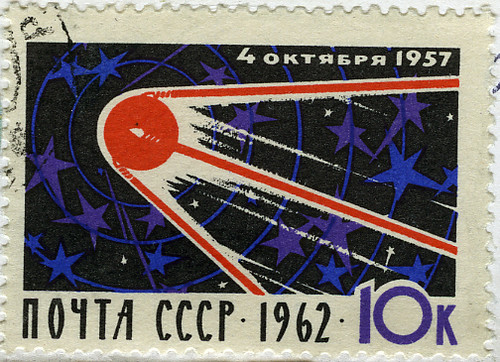
It occurred to me that this idea could be taken further, especially if you bring in stamps from other nations that theUS - such as the Soviet Sputnik stamp shown on the left.
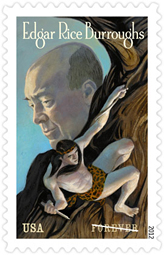
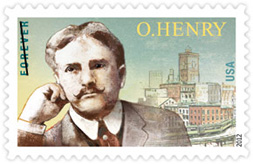
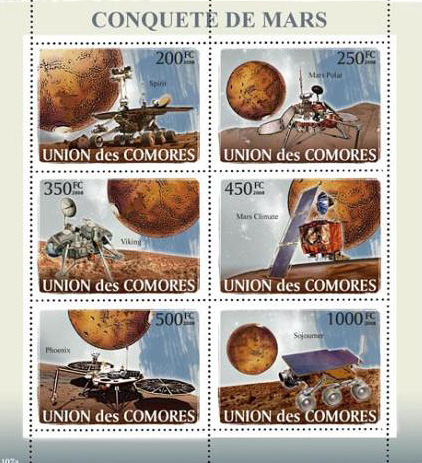
Here are some other stamps which should have some resonance for Bradbury aficionados. See if you can work out the Bradbury connections:
Friday, July 06, 2012
Impact
It's a month since Ray Bradbury shuffled off this mortal coil. At the SFRA conference in Detroit last week, several conversations involved "where were you when you heard the news" threads, a bit like "where were you when you heard that JFK was assassinated?" or "where were you when you heard about the Challenger disaster?"
The actual announcement of Bradbury's death was quite low key: a relative tweeted it, but it took a couple of hours for the more formal news services to pick up on it. Around this time, there wasn't much information being given, so people started casting around. Nothing shows the impact of the man's passing as much as the "hit counter" on this very blog. You can see the day of Bradbury's death quite clearly, as the normal level of traffic is thoroughly dwarfed:
Wednesday, July 04, 2012
Dragoncon '98
I haven't seen many photos showing Ray Bradbury with Harlan Ellison - but here's one that's come my way. It's from DragonCon 1998, and also shows Ray Harryhausen on the left and Julius Schwartz on the right.
Monday, July 02, 2012
Predictions
I don't really hold with the idea that science fiction is about predicting the future, and Bradbury's approach to the genre was in any case built upon the tropes he was already familiar with through a lifetime of reading SF.
Having given those caveats, I now give you this link: Ray Bradbury Predictions Fulfilled!
Saturday, June 30, 2012
Welcome!
If you are new to Bradburymedia, you may not be fully aware of what is on this site. Let me give you a quick run through what's here.
First, there's this blog. I tend to post news relating to Ray Bradbury, quality links to other online resources, and any interesting little nuggets of information I find during my research. My research, incidentally, is mainly into Bradbury's media work. Over on the right hand side of the screen, you will see ARCHIVES, which lets you browse the blog contacts over the last six years.
Second, there's the substantial bibliographic and filmographic content, most of which is unique to this site (or was until people started copying it elsewhere...) I have details on Bradbury's books, his work in film & TV, his work in radio, and I have the unique Bradbury Story Finder, which lets you look up a short story and determine where to find it.
Third, there are some detailed reviews of a number of Bradbury media adaptations. These are linked individually from the film & TV and radio listings. Browse around and you will find some fascinating information on the process of adaptation.
Of course, this is a never-ending work in progress. Some of the content desperately needs updating, but that will have to wait until I get the time to do it.
If you would like to discuss anything you see here, I am always pleased to receive your comments. You can click on the "comments" link at the bottom of a blog post, or you can email directly at:
phil AT bradburymedia DOT co DOT uk
... I'm sure you can figure out how to express that as a proper email address...
Thursday, June 28, 2012
Conferring on Bradbury
On Friday 29 June I will be presenting a paper at the SFRA (Science Fiction Research Association) conference in Detroit, Michigan. My paper is about the way Bradbury used the end of the world as a device in The Martian Chronicles screenplays, and in comparison with his original book. When I initially proposed the paper, I envisaged writing about all sorts of other Bradburyan apocalypses, but when it came to drafting it, it became obvious that a twenty-minute paper wouldn't allow room.
Joining me on the Bradbury-themed panel will be Jon Eller of the Center for Ray Bradbury Studies at Indiana University, and Adam Frisch of Briar Cliff University (a past-president of SFRA).
The conference guest of honour is Eric Rabkin, who has himself written and lectured about Bradbury in the past.
The last scheduled panel in the conference (on Saturday afternoon) will be a "Bradbury memorial". I will be moderating this session, and will be showing a selection of rare Bradbury video clips.
Full details of the SFRA conference can be found here.
Monday, June 25, 2012
Asimov on Bradbury
"What is the name of the Bradbury story where..." is the frequent start to questions on the Bradbury message boards. Some of the time, the description which follows is indeed a summary of a Bradbury story. Surprisingly often, though, there will follow an outline of a story by someone else. Most frequently it will be Kurt Vonnegut's "Harrison Bergeron", but other writers frequently mistaken for Bradbury include Arthur C. Clarke, John Wyndham and Isaac Asimov.
Bradbury and Asimov were completely different in terms of writing style, imagery and themes. And yet they were remarkably similar in a number of ways:
Oh, and neither of them cared much for flying.
So you'd think they might know each other, or even be the best of friends. And yet I can find very few references to them meeting.
Asimov wrote magnificently detailed autobiographies, based in part on the careful diaries he kept for most of his adult life. In these he makes just a couple of references to Bradbury. The first appears in In Memory Yet Green (pages 320-321), where he mentions Bradbury's first appearance in the leading science fiction pulp magazine Astounding Stories:
In the sequel volume In Joy Still Felt, Asimov mentions his first ever meeting with Bradbury, which occurred in 1965 (although they could conceivably have met at the 1939 Worldcon without realising it - there were around 185 attendees at the convention). It is the only meeting between the two that he mentions, although I find it hard to believe that their paths crossed only once. Here is how Asimov describes (on page 381) the meeting, which took place on a TV show:
Bradbury and Asimov were completely different in terms of writing style, imagery and themes. And yet they were remarkably similar in a number of ways:
- They were born in the same year, 1920.
- They both attended the first ever World Science Fiction Convention, in New York, 1939.
- They both started their prolific writing careers with short stories in the 1940s pulp magazines before moving into mainstream publications and 1950s hardcovers.
- From the 1960s onwards, they both became somewhat distanced from the SF genre which had given them their early successes, Bradbury by working in film, theatre and poetry, and Asimov by working on non-fiction works.
- They both had something of a creative resurgence in the 1980s, with a return to major novel writing.
Oh, and neither of them cared much for flying.
So you'd think they might know each other, or even be the best of friends. And yet I can find very few references to them meeting.
Asimov wrote magnificently detailed autobiographies, based in part on the careful diaries he kept for most of his adult life. In these he makes just a couple of references to Bradbury. The first appears in In Memory Yet Green (pages 320-321), where he mentions Bradbury's first appearance in the leading science fiction pulp magazine Astounding Stories:
On November 17 [1942], the day Campbell took “Bridle and Saddle,” he told me of a plan of his for starting a new department in Astounding, one to be called “Probability Zero”.
This was to be a department of short-shorts, five hundred to one thousand words each, which were to be in the nature of plausible and entertaining Munchausen-like lies. Campbell’s notion was that, aside from the entertainment value of these things, they would offer a place where beginners could penetrate the market without having to compete quite so hard with established writers. They would form a stairway to professional status.
This was a good idea in theory and even worked a little in practice. Ray Bradbury, who was to become one of the best-known and most successful of all science-fiction writers, broke into the field with a “probability Zero” item half a year later. Hal Clement and George O. Smith also published “Probability Zero” items near the very start of their careers.
Unfortunately, it didn’t work enough. Campbell had to start the department going with professionals, hoping to let the amateurs carry on once they saw what it was Campbell wanted. There were, however, never enough amateurs who could meet Campbell’s standards even for short-shorts of an undemanding nature, and after twelve appearances of “Probability Zero” over a space of 2.5 years, Campbell gave up.
In the sequel volume In Joy Still Felt, Asimov mentions his first ever meeting with Bradbury, which occurred in 1965 (although they could conceivably have met at the 1939 Worldcon without realising it - there were around 185 attendees at the convention). It is the only meeting between the two that he mentions, although I find it hard to believe that their paths crossed only once. Here is how Asimov describes (on page 381) the meeting, which took place on a TV show:
Bradbury was a Californian for the whole of his adult life. Asimov was a New Yorker. Perhaps this is what prevented them meeting more often. I think today we have this idea that science fiction and fantasy writers all know each other, largely because of the historical importance to the genre of conventions and other social gatherings. It therefore seems odd that these two similar men, whose works were often mistaken for each other's, met so rarely.The next day [Oct 8 1965] I went to Newark to tape a talk show with David Susskind. It was my first nationally televised talk show since “The Last Word” with Bergen Evans six years before.This one was devoted to science fiction, and along with me were Lester del Rey and Ray Bradbury. It was the first time I had ever met Ray Bradbury, though of course we knew each other well enough from our writings to be on a first-name basis at once. Neither he nor I would fly in airplanes, so since I lived in Newton and he in Los Angeles it was clear we couldn’t meet often.The session was not successful. Lester was in one of his talkative moods and gave neither Ray nor myself much chance to do anything but stare at the ceiling, and Susskind had a list of questions, silly in themselves, from which he lacked the wit to depart. It meant that all the interesting starts that any of us made were muffled and killed when he asked the next silly question.
Friday, June 22, 2012
Green Town Tribute
As I mentioned a while ago, Bradbury's home town of Waukegan Illinois - fictionalised as Green Town in his books Dandelion Wine, Farewell Summer and Something Wicked This Way Comes - paid tribute to Ray on the day he died. TV news crews were in attendance, and so we have an opportunity to see a little of the event at the city's public library:
There is now gathering momentum for some kind of memorial to Bradbury in Waukegan, and the 1903 Carnegie Library (currently empty and disused) is naturally being looked at as a potential centre for honouring his memory. In his lifetime, Bradbury supported the campaign to save the Carnegie from demolition, and indicated that he would support some kind of Bradbury collection being deposited in the building, perhaps turning it into a museum or tourist attraction.
Though it may be sad to think that Bradbury's death would be the trigger for some action to finally be taken to restore the Carnegie Library to public life, it would be a fitting place to commemorate one of Waukegan's favourite sons.
There is more information about the preservation of the library at the website of the Carnegie Preservation Project. My thanks to Wayne Munn for the link.
Wednesday, June 20, 2012
Bradbury on Disneyland
Holiday magazine was published from 1946-1977, and carried articles by an amazing array of writers. Ray Bradbury was one of them, contributing an essay about Disneyland in 1965. You can read the piece, entitled "The Machine-Tooled Happy Land" on the delightful blog The Astounding World of HOLIDAY.
You can read more about the magazine and its literary legacy in The Paris Review.
Bradbury's fiction is sometimes described as having a unique voice, so I was amused to discover what BookBrowse.com's ReadAlike feature suggests for authors who write like Bradbury.
You can read more about the magazine and its literary legacy in The Paris Review.
Bradbury's fiction is sometimes described as having a unique voice, so I was amused to discover what BookBrowse.com's ReadAlike feature suggests for authors who write like Bradbury.
Subscribe to:
Posts (Atom)