Tuesday, March 31, 2020

Lockdown Choices - Issue #1: Dark Carnival

With the whole world in COVID-19 lockdown, and with it being the centenary year of Ray Bradbury, I toyed with the idea of starting a podcast to give Bradbury fans something to listen to. And then I started recording one, unscripted, and decided it might be too painful for human ears to listen to...

Instead, I thought, I could just get back into the habit of blogging regularly. Now, there's a novelty.

So welcome to the first in a new series of posts, my Lockdown Choices. In these posts, I will cover each of Ray Bradbury's books, say something about the contents, then pick the best stories: some will be chosen because they're damned good stories; and others will be chosen because they resulted in a damned fine adaptation.

(Note to self: there's going to be a Bradbury book which contains not a single adapted story. Deal with that issue when it arises.)


Lockdown Choice #1: Dark Carnival

First edition, Arkham House 1947.

The Book

Dark Carnival was Ray Bradbury's first book, a collection of dark fantasy tales published by the legendary Arkham House in 1947.  It collected twenty-seven stories, most of which had appeared earlier in Weird Tales magazine. There were also six previously unpublished stories. Any one of those "new" stories would have made the book worth buying.

It's worth pausing for a moment to reflect on Bradbury's success in Weird Tales. In 1943, when he was twenty-three years old, Bradbury appeared three times in that magazine. In 1944, five times. Three times in 1945 and 1946, and twice in 1947. That's a remarkable track record, in what was undoubtedly Bradbury's most prolific period.

The excited reader (of this blog) might at this point go running off to the interwebs to find where they can buy a copy of this wonderful book, which collects so much of Bradbury's early writing. But hold your horses. You'll need big money. First editions of Dark Carnival sell for upwards of $350, and the truncated UK edition published by Hamish Hamilton in 1948 isn't much cheaper.

Why should this be? Well, partly because it's an old book from a relatively minor publisher. But partly, too, because there never was a second edition. The Arkham edition, the UK edition, and that's it. Until fifty years later, when a limited edition came out - but more on that below.

It's not that Dark Carnival didn't sell enough for there to be any other editions. It's all down to Bradbury himself. He decided to re-write some of the stories; to refine the whole package; and his preferred versions of the stories came out in 1955 as The October Country. You can still get The October Country today, and it's never been out of print. But Dark Carnival was allowed by Bradbury to slip into relative obscurity.

Until 2001, that is, and the aforementioned limited edition. This came from Gauntlet Press, and came with Ray's blessing. Gauntlet also issued a CD of an interview with Ray, where he talked about some of the stories. But Ray was never interested in having any kind of mass-market reissue of Dark Carnival.

Find out how Dark Carnival became Bradbury's great "lost book" in my Bradbury 101 video below. And scroll further down the page for my pick of the best stories from the book.


The Stories

There's no question, some of Bradbury's finest stories are found in this collection. The acclaimed "Homecoming", which established Ray's "family". The much adapted and endlessly fascinating "The Jar". The much imitated but seldom bettered "The Small Assassin", in which a paranoid mother who thinks her baby is out to get her - turns out... to be right. And "The Next in Line", one of Ray's Mexican stories, set amid the mummy-filled catacombs of Guanajuato.

My personal picks from Dark Carnival are these:

"Skeleton" - part horrifying, part humorous, this is the story of a man who one day realises that inside him is... a skeleton. As with so many of the Dark Carnival stories, this is about paranoia. And as with "The Small Assassin" (and "The Wind" and "The Crowd") the paranoid central character is vindicated: there really is something out to get them. In the case of "Skeleton", it's the mysterious figure of M.Munigant, the bone specialist whose interest in bones is not quite what you might expect.

Bradbury said that this story was inspired by something that actually happened to him:

I went to my doctor with a sore throat, and I said, “Would you look in there? It feels kind of funny all around.”

He looked at my throat, and he says, “Oh, it’s a little red. It’s normal.” He says, “You know what you’re suffering from?”

And I said, “No. What?”

He says, “You’re suffering from a bad case of discovery of the
larynx.”

And I said, “What he’s saying, in other words…he’s saying it’s all normal.” And I went out of there feeling all of my bones.

And he said, “Well, you’ve got all kinds of bones in your body you’ve never noticed. Maybe you haven’t felt the medulla, or the bone on the end of your knee, here, the knee cap, that moves around if you get it in a certain position.”


From "Sum and Substance: With Ray Bradbury and Herman Harvey", 1962.
Quoted in Steven Aggelis, Conversations with Ray Bradbury.

"The Crowd" - one of Ray's finest compositions, in my humble opinion. It hinges on a character who becomes intrigued by the crowd that gathers around a car crash. Later, he witnesses another crash - and sees the same crowd. Not just the same type of crowd, but the exact same one - and: "There was a vast wrongness to them. He couldn't put his finger on it." Investigating, he finds that this crowd has been around for a very, very long time. Eventually, our hero himself is in a car crash...

"The Crowd" is one of the stories which Bradbury revised for Dark Carnival, and the revised version is all the stronger for it. Jon Eller and Bill Touponce's book Ray Bradbury: the Life of Fiction reproduces a short passage of the revised version side-by-side with the original text, and you can see here how Ray adds a vivid metaphor of an explosion happening in reverse, coupled directly to Spallner, the centrally character. And note also how he italicises the last word of the last sentence in the passage, making so much difference to how we read both the sentence and the passage.

Excerpt from "The Crowd": original Weird Tales text (left) and revised Dark Carnival text (right). From Eller & Touponce, Ray Bradbury: the Life of Fiction (Kent State University Press, 2004, p.72).


"The Scythe" - I found this story both creepy and unnerving when I first read it in my teens, and it still packs a powerful wallop today. A family takes over a farm; the man goes out to cut the wheat; his family die. And he keeps on doing it. He is the grim reaper, if you like. Bradbury wrote this story during wartime (it was first published in July 1943), and in the view of Bradbury scholar Bill Touponce he "expands the traditional figure [the grim reaper] to include all the horrors of modern mechanised warfare".

Bradbury's friend Leigh Brackett - herself a successful writer of science fiction, fantasy and Hollywood screenplays (The Big Sleep, The Empire Strikes Back to name but two) - wrote the opening five hundred words of "The Scythe", apparently because Bradbury was struggling to provide the appropriate narrative frame for the story. But bear in mind that the story was revised by Bradbury for Dark Carnival, and so it is difficult in the currently-available version of the story to see the "join".


"The Lake" - my final pick from Dark Carnival is the story which Bradbury said really established him as a writer. In his own mind, that is. It's a really haunting story of a man who returns to a lake familiar from his childhood, where one of his closest friends lost her life. Now, after many years, her body washes ashore. It's frightening and heartbreaking, and I'll say no more about it. If you haven't read it yet: go! Read it now!


The Adaptations

For a book that is out of print, there is an astonishing amount of proven source material for media adaptation here. More than half of these stories (fourteen to be exact) were adapted by Bradbury himself for his TV series The Ray Bradbury Theater. Other adaptations appeared on TV in The Alfred Hitchcock Hour and the 1980s revival of Alfred Hitchcock Presents. And on radio, multiple stories were turned into episodes of Bradbury Thirteen and the BBC series Tales of the Bizarre.

The clear winner in terms of number of adaptations is "The Jar". This one story has been dramatised at least four times, and it works both on TV and on radio. The concept is simple: a man acquires a jar from a carnival sideshow, and inside is... Well, no one can quite tell. The waters in the jar are somewhat murky. Clearly there's something in there, and it might even be moving around, but...

The best adaptation to date has to be the 1964 Hitchcock Hour version, adapted by James Bridges and directed by Norman Lloyd. In this one, the family in possession of the jar sit around it and stare - just as we can imagine the TV viewers of the time would have been doing when it first aired.

Find Out More...

Find out more about Dark Carnival on my page about the book, here.
Learn more about "The Jar" on The Alfred Hitchcock Hour on my page about that show, here.

Listen...


The first of the Dark Carnival stories to be adapted to another medium was "The Crowd". Click here to listen to Suspense from 1950, with Dana Andrews in the lead role.

And if you really, really want to hear me in a podcast, you can find my guest appearances on other people's pods here!


Next Up...

The next of my Lockdown Choices will be Bradbury's second book: The Martian Chronicles.

Monday, February 17, 2020

The Martian Chronicles revisited?

According to The Illuminerdi, a new screen adaptation of Ray Bradbury's The Martian Chronicles is in development. As usual with such announcements, I caution against getting too excited: "in development" just means someone is signed up to write a script or treatment. Whether said script ever goes into production is another matter entirely.

The new, big name atached to the project is James Gunn, filmmaker of considerable talent - and not a little controversy. In 2018 he was fired by Disney when some decade-old tweets came to light which showed poor judgment and poor taste. (He was later re-hired when Gunn apologised and recanted; and when the unearthing of the old tweets was found to be the work of alt-right activists.)

The bigger picture is that The Martian Chronicles spent most of the 1950s, 1960s and 1970s "in development". Back in the 1950s, Ray Bradbury and Kirk Douglas tried to get the Chronicles onto TV and then into film, with scripts and treatments by Ray. Then in the 1960s, he worked with Alan J. Pakula and Robert Mulligan on a film version. None of these came to anything. The Martian Chronicles did eventually get onto the screen in the late 1970s/early 1980s, in the wake of (a) the unexpected global success of Star Wars and (b) the unexpected stage success in Los Angeles of Ray's theatrical production of the Chronicles.

After the critical flop of the 1980 TV miniseries version of The Martian Chronicles, Ray adapted various of the constituent stories of his book as episodes of his TV series The Ray Bradbury Theater. And then attempted, yet again, to get The Martian Chronicles on the big screen, with his own screenplay adaptation. Various attempts were made through the 1990s and early 2000s.

So the latest news is actually nothing new. Once again, a big Hollywood name is attached, but we've seen this all before. Whatever happened to the remakes of The Illustrated Man and Something Wicked This Way Comes? It is Hollywood's way to spend a lot of time (and sometimes money, too) on development, but somehow never quite get to an end product.

I hope things will turn out differently this time. It would be a nice way to celebrate the Bradbury Centenary, and the seventieth anniversary of The Martian Chronicles book. But don't hold your breath!

Thursday, February 13, 2020

The official Ray Bradbury website

In case you haven't visited it recently, please note that the official Ray Bradbury website is now under new management, and the old site has been completely replaced.

The new-look site has some excellent text content, mostly supplied by the Center for Ray Bradbury Studies. There are also some fascinating images, some never published before.

The new site keeps a link to the previous discussion board, which is the only facet of the old site to be retained. And it carries a Centennial page which list all the Bradbury-related events due to take place in 2020.

I was given a sneak preview of the site a few weeks ago, when I was invited to comment on the content. I found very little to criticise, but lots to like. But now it's publicly available.View the new site here: https://raybradbury.com/

Wednesday, January 15, 2020

The Bradbury Centenary

https://scontent-lhr8-1.xx.fbcdn.net/v/t31.0-8/11947854_1057179617640607_3391389619660500898_o.jpg?_nc_cat=110&_nc_ohc=mL67nvdFUmMAX8t4MjM&_nc_ht=scontent-lhr8-1.xx&oh=ae1ea570eb8d258f77bc23793c26573b&oe=5E96EEE6

Well, we're finally here. 2020. Cue all those jokes about 2020 vision, and people drawing parallels with (19)20s flappers. For Bradbury fans, 2020 is a nice big round number: one hundred years since the birth of Ray Bradbury.

When I first became aware of Ray Bradbury's fiction, he must have been in his fifties. The first time I saw his photo, probably on a book cover, he would have been about 58 - which was quite old to me at the time; much older than my parents, for example. I saw Ray a lot in magazine interviews and on TV when he was in his sixties. And I finally met him when he was 87, and again when he was 90. Old, quite old. And yet...

His fiction was always so young and lively. What I didn't know when I first read Bradbury was that his amazing stories of dinosaurs, time machines, rockets, youth and death were mostly written when he was young and lively. His peak years, measured in terms of "best stories" were in the 1940s and 1950s, when he was aged between 20 and 40. And yet...

His amazing peak of productivity which produced The Martian Chronicles in 1950 (age 30), The Illustrated Man in 1951 (age 31), and Fahrenheit 451 in 1953 (age 33) was followed by a long tail of work which would never quite gain the same recognition. Bradbury continued writing right up to his final days, which means that there is nearly sixty years' worth of material out there (or hidden away) which most people are unfamiliar with.

A lot of books and essays about Bradbury talk of his career somehow petering out after those classic works of the 1950s. He stopped writing fiction, they say. He turned to poetry and plays, they say. He went to Hollywood, but didn't have much success.

Well, all of that has some grain of truth. His early success in Hollywood - It Came From Outer Space (he created it, but someone else did the final screenplay), Moby Dick (he adapted it, but John Huston nabbed half the screenplay credit), scripts for the TV series Alfred Hitchcock Presents - must have given him a taste of an alternative career, not to mention a significant alternative income stream. It can be argued that the alternative income enabled him to indulge in poetry, and to produce his own plays. Bradbury himself said that his income from Hollywood options is what put his children through college.

Ironically, Bradbury was a far better poet when writing short stories than he ever was when writing poetry. And yet he still managed to get books of poetry put out by major publishers. These things sold. They may not have been bestsellers, but they did the business.

As for his plays, they tended to fall into two camps. There were the original plays, mostly "Irish" stories which had been inspired by his time in Ireland writing Moby Dick, and most of which eventually also came out as short stories. And then there were the adaptations, of numerous short stories and his major novels. Some of these worked, and some didn't. If you ever get the chance to see his stage version of "The Veldt", see it. It's great, and in its reliance on the imagination of the audience, it works far better than any of the screen adaptations of it created so far. Similarly, if you get the chance to see Bradbury's stage version of Fahrenheit 451, grab it - but beware that Bradbury couldn't resist rewriting the story somewhat, so that it has some twists and turns which differ from the original novel.

As Jon Eller's biographies of Ray have pointed out, Bradbury's career was split into two halves. In the first half, he was an extraordinary short story writer and novelist. And in the second half, he might have run dry of original ideas, or he may have been distracted by those other media (poetry, plays, films). And also in that second half he must surely have been distracted by being a figure in the public eye, especially as the space age evolved and he became something of a spokesman for science fiction and an advocate of space exploration. I have always been amazed that he was able to get any real work done at all during this period.

By the 1980s, with Ray now into his sixties, he finally had his own TV series, the excruciatingly low-budget Ray Bradbury Theater. This show was a pioneer of original programming on cable TV, being one of HBO's first original productions, but with none of the investment that HBO today puts into original programming. At times the show was an embarrassment of poor production quality, but at other times it was able to produce some gems. Sixty-odd episodes were made, shot all over the world, with every one scripted by Bradbury himself. In the seven or so years that the show was in production, it is again hard to imagine how he found time for any other work. And yet...

The 1980s and 1990s saw a new burst of activity from Bradbury. Now in his 60s and 70s, he turned out a series of remarkable new novels and short story collections. The best of these were among his best (and the worst were among his worst). And in his final years, in his 80s and 90s, Bradbury put the finishing touches to a number of works-in-progress. A sequel to Dandelion Wine. A new patchwork novel tying a set of short stories together in From The Dust Return. Long-delayed novellas "Leviathan '99" and "Somewhere a Band is Playing".

One hell of a life of writing!

And now, so soon, we reach 2020. The Bradbury Centenary. There will be celebrations, that's for sure. Bradbury's home town of Waukegan, Illinois, has some plans. So does the Center for Ray Bradbury Studies, based in Indianapolis.

And if anyone out there wants me to talk about Bradbury, just ask. I'm available for conferences, lectures, podcasts, possibly even barmitzvahs!

Watch this space for news and further developments...

ADDENDUM:  I thought I should use this post to keep a record of planned centenary events. I will add to the list as more events come to light. Here goes:

Feb 9, Pasadena: http://cabookfair.com/features.php#bradbury

Feb 21-23, 28-9, March 1, Pasadena: https://www.facebook.com/events/208921433571387/


March 5-8, San Diego: https://www.sdcomicfest.org/

March 11, Gurnee, Illinois: https://www.facebook.com/events/1421663071366314/

May 17, Bath, UK: https://bathfestivals.org.uk/the-bath-festival/event/neil-gaiman-ray-bradbury-at-100/

May 20, New York: https://www.symphonyspace.org/events/selected-shorts-ray-bradbury-centennial-celebration

July 24-25, Bicknell, Utah: https://www.facebook.com/BicknellInternationalFilmFestival/

For more events, please also keep an eye on this web page: https://raybradbury.com/centennial/

Wednesday, November 06, 2019

Bradbury on The Simpsons

Ray Bradbury has been referenced many times on The Simpsons. Here's one instance, from "Treehouse of Terror XXV", in which Bart Simpson finds his school is (in) hell:


See also:
http://bradburymedia.blogspot.com/2016/03/another-bradbury-reference-from-simpsons.html
http://bradburymedia.blogspot.com/2013/10/blink-and-youll-miss-it.html


Thursday, October 31, 2019

Podcasts - all in one handy place


I've taken part in a number of podcasts over the years, discussing various Ray Bradbury works in film, television, theatre and radio. I thought it was time to put links for them all in one handy place.

So, without further ado, I give you Phil's podcasts!


A Sound of Thunder - short story, film and other adaptations - Take Me To Your Reader 

Fahrenheit 451 - novel and 1966 film - Take Me To Your Reader 

Ray Bradbury and Ray Harryhausen - The Ray Harryhausen Podcast 

Fahrenheit 451 - novel and 2018 TV film - Radio Free Acton

Fahrenheit 451 - novel and 2018 TV film - Take Me To Your Reader

Fahrenheit 451 - novel and 2018 TV film - Studio 360/American Icons 

The Halloween Tree - book, film and radio play - Take Me To Your Reader 

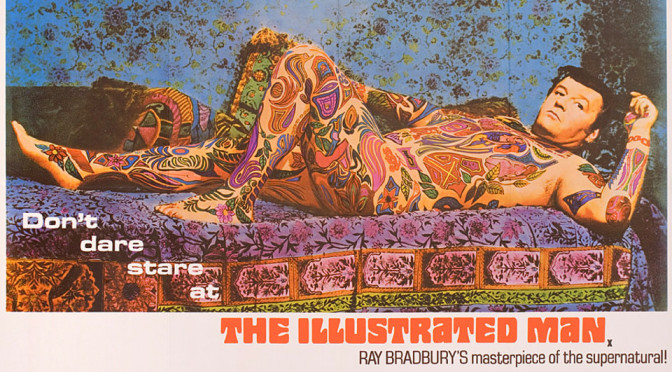
The Illustrated Man - short story, book and film - Take Me To Your Reader

Saturday, September 28, 2019

The Illustrated Man - Podcast episode

 I always enjoy joining the gang from the podcast series Take Me To Your Reader - and today my latest appearance goes live. The discussion this time centres around Ray Bradbury's The Illustrated Man.

The Illustrated Man has a complex history. Bradbury first published a short story with that title, and shortly afterwards he published a short story collection with the same title... but the collection didn't include the short story! Instead, he took his tattoed-man character out for another stroll, and used him to provide a framing device for the other short stories in the book, using the conceit that each story dramatises one of the man's tattoos.


Many years later, the short story was incorporated into the book, but only in some editions.

In the early 1960s, Bradbury wanted to turn The Illustrated Man into a film, and wrote a full screenplay. Unfortunately, it became another of Bradbury's "lost films". But later in the decade, a completely different script was used for the film that was made. Starring Rod Steiger and his then wife Claire Bloom, the movie is a portmanteau film which adapts three of the short stories from the book - with Steiger and Bloom inexplicably playing different characters in each story.

You can find out what I think of the film by listening to the podcast:

http://pavementpodcast.com/podcast/tmtyr-episode-81-lighter-than-the-movie-the-illustrated-man-feat-dr-phil-nichols/

Tuesday, August 20, 2019

Find that story!

Ever wanted to re-read a particular Ray Bradbury story, but didn't know which collection it was in? Allow me to introduce you to a handy feature of Bradburymedia: the Short Story Finder!

The Short Story Finder lists (nearly) every Ray Bradbury story, and tells you where it was originally published, and which Bradbury collections you can find it in.

It also includes the "Eller Reference" for each story. This is a two part number-code which indicates the year of original publication, and the position of publication within that year. For example 46-04 indicates the fourth Btradbury story published in the year 1946. This numbering scheme originated with Jon Eller, Ray's literary biographer, who used it in Ray Bradbury: The Life of Fiction and in the ongoing Collected Stories of Ray Bradbury series of books.

So, without any further ado, I give you:

The Short Story Finder!

Friday, August 16, 2019

Ray Bradbury wins another Retro Hugo

Ray Bradbury's classic short story "King of the Gray Spaces" has won a Retro Hugo Award from the World Science Fiction Convention 2019, which began yesterday in Dublin.

Retro Hugos are special awards given for years where the standard Hugo Award was not awarded for some reason, mostly due to the Second World War interrupting the usual continuity of the Worldcon.

Bradbury has been awarded Retro Hugos in the past - the 1939 award for Best Fanzine, and the 1954 award for best novel (Fahrenheit 451).

"King of the Gray Spaces" is an early Bradbury science fiction tale, and is typically considered as the first to show the emotive style he is associated with. First published in Famous Fantastic Mysteries magazine in December 1943, the story has frequently been reprinted under the more familiar title "R is for Rocket".

In the story, fourteen year old Christopher and his friends long to be chosen for the space corps. They know that they can't "apply" for this; they have to be chosen. The key emotion of the story comes when Chris is indeed chosen, but as part of the selection process he has to keep it a secret even from his best friend Ralph. Chris's elation is contrasted with his sadness at having to leave Ralph behind, and with Ralph's muted understanding of what is happening to Chris.

Some elements of the story are quite dated now, and in fact Bradbury was aware of this when he made it the title story of his 1962 collection R is for Rocket: he made some changes to the story to bring it more up to date.

When the story first appeared in Famous Fantastic Mysteries, it was accompanied by a magnificent illustration by Lawrence Sterne Stevens (shown above).

When the Retro Hugo win was announced, my friend Jason Aukerman of the Center for Ray Bradbury Studies took the stage to receive it on behalf of the Bradbury family and the Bradbury estate. Jason took the opportunity to remind the Worldcon audience that in exactly one year and one week it will be Bradbury's one hundredth birthday. The awarding of the Retro Hugo makes a fine lead-in to the Bradbury Centenary.

Here's the award announcement and Jason's speech.


Wednesday, April 17, 2019

Family Tree

I occasionally get emails asking about Ray Bradbury's ancestry. So, as a public service, here's a link to an earlier post (wow, it's nearly ten years old!) where I unveiled his family tree:

https://bradburymedia.blogspot.com/2009/08/ancestry.html