This is the sixth in my series of Lockdown Choices, where I seek to entertain you while in coronavirus-isolation, and remind you of Bradbury's great works in this, his centenary year.
In
these posts, I cover each of Ray Bradbury's books, say something
about the contents, then pick the best stories and adaptations.
Lockdown Choice #6: Switch on the Night
First edition, illustrated by Madeleine Gekiere. Pantheon, 1955.
The Book
Switch on the Night (1955) was Ray Bradbury's shortest book to date. It contains just a single story, and runs to about fifty pages. This is because it is an illustrated book for children. Yes, the author who started out in Weird Tales scaring the bejeezus out of us with visceral horrors such as "Skeleton" and existential angst in "The Crowd" and "The Wind", has by now turned into a children's author! Well, if it's good enough for Roald Dahl...
From a biographical point of view, there is a clue as to how this shift occurred, right there on the dedication page:
Dedication to Switch on the Night.
Susan and Ramona were Ray's first two daughters, and Susan happened to be scared of the dark. And so Bradbury devised a story to counter this fear. According to Sam Weller's The Bradbury Chronicles (p.236), Bradbury shipped the book around various publishers for six years before, finally, Pantheon (Random House) picked it up. And I have seen a colour photocopy of the original 1949 manuscript (in the Center for Ray Bradbury Studies, Indianapolis) which shows that Ray always intended it to be an illustrated book. The manuscript has primitive colour images, presumably created by Bradbury himself.
The book was illustrated throughout by Madeleine Gekiere, the Swiss-born American artist, writer and filmmaker, whose previous work for children's books had been recognised by the New York Times. According to an obituary in the New York Post (July 2, 2014), Bradbury shared the royalties from the book with Gekiere - something that she said was unheard of: "I never got any royalties on my other books [...b]ut Ray Bradbury, no problem, he
shared the profits . . . Just a very nice man.” Gekiere alas commited suicide in 2014.
The Gekiere version of the book stayed in print for a number of years, with the last reissue being a library edition issued in 1963.
Perhaps more familiar today, though, is the version first published in 1993, with illustrations by the phenomenal Diane and Leo Dillon.
Bradbury/Dillons version. Knopf, 1993.
What's curious about this is to see two different visual interpretations of the same text - although Bradbury's text has also been published a number of times with minimal illustration, such as in the 1990 Oxford Book of Story Poems.
Last page of the story/poem's appearance in the Oxford Book of Story Poems, with illustrations (just three of them) by Robina Green. Oxford University Press, 1990.
The Stories
There's just a single story here: of a little boy who likes light and hates darkness. He dislikes switches, we are told, because they turn off the light. He won't go out in the dark, but stays lonely in his room surrounded by candles and torches.
One night, wandering around the house, the boy spies a curious figure: a little girl who introduces herself as "Dark". She explains the wonders of darkness, and how switches actually work differently to how the boy sees it. When you flick a lightswitch off, you are turning on the night; you can switch on the stars, the crickets, and the frogs.
With this new understanding, the boy can now marvel at the darkness.
Naturally, this is a very slight tale, and designed to be read to (or with) a small child. But we can still see some Bradbury hallmarks here. The most obvious, perhaps, is the poetic way with words. From the layout of the words on the page, you may even wonder if this is a story or a poem. (Who can say? Which is why it was included in the Oxford Book of Story Poems, I imagine...)
Then there is the twist: that reversal of point of view, which allows the boy (and the reader) to see a single phenomenon from a totally different angle. This is characteristic of early and middle Bradbury. Remember "The Million-Year Picnic", where the humans are the Martians now?
And finally there is "Dark". She reminds me of Clarisse in Fahrenheit 451: a young but worldly-wise catalyst who brings about a change in another character. (Except for her name, dark hair, dark eyes, dark clothes and dark shoes. All of those remind me of Mr Dark from Something Wicked This Way Comes - but oh look, I've jumped the timeline; that book hasn't been written yet...)
The Adaptations
As far as I'm aware (and believe me, I do a lot of digging for this sort of thing), there has only ever been one official media adaptation of Switch on the Night. And that was simply a reading with some atmospheric sounds and music, as part of a BBC radio series called White Nights (July 2006).
Find Out More...
Read about the remarkable career of artist Madeleine Gekiere, here.
Learn about the extraordinary range of titles illustrated by the Dillons, here.
Listen...
Switch on the Night is a lovely piece of writing to be read aloud, and so you will
find some (usually unauthorised) readings online. There's a charming one
here.
Next Up...
The next of my Lockdown Choices will be Bradbury's seventh book: The October Country.
Another short break from my Lockdown Choices series, to bring you a short slideshow introduction ot the 1966 film of Fahrenheit 451. I originally created the slideshow for a presentation I gave at Wolverhampton's Light House Cinema in 2016. This version has a "temp" narration (apologies for the sound quality...)
For best results, click the little square in the bottom-right corner, and go fullscreen.
This is the fifth in my series of Lockdown Choices, where I seek to entertain you while in coronavirus-isolation, and remind you of Bradbury's great works in this, his centenary year.
In these posts, I cover each of Ray Bradbury's books, say something about the contents, then pick the best stories and adaptations.
Lockdown Choice #5: Fahrenheit 451
First edition. Ballantine books, 1953. Cover art by Joe Mugnaini.
The Book
Fahrenheit 451 is legendary. A presentation of a dystopian future, it is sometimes considered alongside other classic dystopias such as Nineteen Eighty-Four and Brave New World. Its central conceit - that those in charge have banned all books because of the dangerous ideas found in some of them - has great resonance, since censorship has so many times been a defining characteristic of real-life oppressive regimes. That one central idea, providing a great "what if...?", would be enough for most novelists, but Bradbury ties it to other ideas which continue to fascinate us, such as our willingness to be manipulated by the media, and our tendency to turn to addictive substances. Every time you think Fahrenheit must be rendered obsolete because its world has become impossible in real life, real life has a way of making the book all too relevant again.
And yet the book you can buy today is not the same as the original Fahrenheit 451.
The original volume in hardcover from Ballantine, published in October 1953, contained three stories: Fahrenheit itself, plus "The Playground" and "And the Rock Cried Out". It was a story collection, rather than a novel. And you can see why this might be: Fahrenheit 451 is a mere 46,000 words long, and barely counts as a novel; it is really a novella, longer than a short story but shorter than a novel. But Ballantine's paperback edition published that same year (which is technically the second edition) dropped the other two stories, leaving Fahrenheit to stand alone. And this is mostly how you will find Fahrenheit 451 today.
Find out how Fahrenheit 451 mutated from a story collection into a standalone novel in myBradbury 101 video below. And scroll further down the page for more on the evolution of the book.
The Stories
If you've been following these blog posts, you'll know by now that Bradbury's four previous books were all short story collections (The Martian Chronicles looks like a novel, but is made up from a bunch of short stories). And so it should come as no surprise that his first "novel", Fahrenheit, is an expansion of a shorter work, "The Fireman".
"The Fireman" - the first appearance of Montag's story. Galaxy magazine, 1951.
"The Fireman" sure reads a lot like Fahrenheit 451, and that's because Bradbury ported nearly all of it over into the longer work. But he also added some material - a lot of really good material. The whole business of Mildred and her substance abuse is new to the longer work, and so is the implied critique of television. In other words, two of the three thematic strands which have given Fahrenheit its longevity and ongoing relevance come from Bradbury's re-writing of his earlier short story.
When I worked on my PhD a couple of years ago, this was one of the features of Bradbury's writing that fascinated me: his tendency to re-write and re-visit earlier works, and to uncover (or generate, I suppose) gold in those re-writings. My own fascination is with how he does this in his adaptations between media - how he re-works a story when he adapts it for film - but his re-writing of prose works follows a similar pattern.
Bradbury's view on re-writing was somewhat mixed, in his public utterances at least. On the one hand he strongly advocated a two-stage process to writing, which he sometimes described vividly as "throw up in the morning, clean up at noon". The first stage of writing should be completely unrestrained, letting the imagination and the typing fingers run wild. But then there should be a second stage, where the intellect is engaged. It is here that the writer can apply some analysis to what has emerged during the first stage, and impose structure and order on what might otherwise have been random verbiage.
But on the other hand, Bradbury claimed that he didn't believe in re-writing his younger self. He let his works stand as first published, warts and all. Except... The October Country was a re-written and re-edited Dark Carnival... and he pulled stories out of collections that he didn't think fit any more, and added new ones in... and he really enjoyed taking an earlier short story and turning it into a play, or taking one of his film scripts and turning it into a novel...
The roots of Fahrenheit go back even further than 1951's "The Fireman". Jon Eller, in the book Match to Flame: the Fictional Paths to Fahrenheit 451 (ed. by Donn Albright, Gauntlet Press 2006) traces the genes of the story all the way back to 1942, and a short story called "Reincarnate". Bradbury worked through all sorts of variations of book-burning, finally arriving at this theme's finest expression in "The Fireman".
Match to Flame (Gauntlet 2006) was a limited edition volume tracing the history of Fahrenheit 451, and included all the precursor stories. The stories were re-packaged without the historical explanation as a mainstream book, A Pleasure to Burn: Fahrenheit 451 Stories (HarperCollins, 2010). Match has cover art by the editor, Donn Albright. Pleasure has a Joe Mugnaini variation of the original F451 cover art.
Ray Bradbury was aware that Fahrenheit 451 was his masterpiece, at least as far as novels were concerned. His gravestone, which he had carved several years before he died, reads simply "Ray Bradbury - author of Fahrenheit 451."
The Stories
In this section I usually write about individual stories making up a collection, but in the case of Fahrenheit 451 that doesn't really work. I suppose I could write about the three stories in the first edition of the book, but who has access to the first edition?
Instead, I thought I would write about the best scenes in the book. So let's see how this turns out...
Meeting Clarisse - Clarisse is the most charming character in the book. She's a bit kooky, a bit flaky, very naive, and yet very wise beyond her years. She says she's seventeen and crazy. When the thoroughly institutionalised fireman Montag meets her, his outlook is transformed:
They walked in the warm-cool blowing night on the silvered pavement and there was the faintest breath of fresh apricots and strawberries in the air, and he looked around and realized this was quite impossible, so late in the year.
Soon, Montag is brought to a point of self-awareness. He is triggered to question what he does, and is totally floored by Clarisse's last utterance:
She started up her walk. Then she seemed to remember something and came back to look at him with wonder and curiosity.
"Are you happy?" she said.
"Am I what?" he cried.
But she was gone running in the moonlight. Her front door shut gently.
"Happy! Of all the nonsense."
He stopped laughing.
The old woman - The best sequence in the book, in my view, is when Montag and colleagues go on a book burning. An old woman has been found hoarding books, and the instructions are to torch the lot. In gathering the books together, Montag inadvertently finds himself reading brief passages of texts - he has already by this point been shown as being curious about the books that he is forced to burn.
The firemen try to remove the woman from her house, but she refuses to go, causing Montag to wonder why anyone would become so attached to their books. And then comes the flashpoint.
Standing amid piles her books, scattered all around, all of them now soaked in kerosene, the woman pulls out... a match. I've waxed lyrical about the structure of this scene many times before. I marvel at how like a screenplay it is:
Montag placed his hand on the woman's elbow. "You can come with me."
"No," she said. "Thank you, anyway."
"I'm counting to ten," said Beatty. "One. Two."
"Please," said Montag.
"Go on," said the woman.
"Three. Four."
"Here." Montag pulled at the woman.
The woman replied quietly, "I want to stay here."
"Five. Six."
"You can stop counting," she said. She opened the fingers of one hand slightly and in the palm of the hand was a single slender object.
An ordinary kitchen match.
The sight of it rushed the men out and down away from the house. Captain Beatty, keeping his dignity, backed slowly through the front door, his pink face burnt and shiny from a thousand fires and night excitements.
I love the way Bradbury's word choices focus the mind's eye like a film camera. Going from the woman; to the opening of her fingers; to the kitchen match; is like a camera going into ever-tighter close-up. And that single-sentence-fragment paragraph, "An ordinary kitchen match" sits alone on the page allowing the eye to absorb its implications, before the helter-skelter reaction of the firemen dashing from the tinderbox house.
The bomb - An ever-present threat in the book, an atomic war finally breaks out near the end. It is the destruction of the city that will, eventually, allow the "book people" to return and re-establish civilisation. But in typical Bradbury fashion, the dropping of the first bomb is focused entirely through Montag's perceptions.
Montag held the bombs in the sky for a single moment, with his mind and his hands reaching helplessly up at them. "Run!" he cried to Faber. To Clarisse, "Run!" To Mildred, "Get out, get out of there! " But Clarisse, he remembered, was dead. And Faber was out; there in the deep valleys of the country somewhere the five a.m. bus was on its way from one desolation to another. Though the desolation had not yet arrived, was still in the air, it was certain as man could make it. Before the bus had run another fifty yards on the highway, its destination would be meaningless, and its point of departure changed from metropolis to junkyard.
And Mildred...
Get out, run!
One of the things that has been bugging Montag is that he can't remember
where he met Mildred, his wife. This seems to be a characteristic of
Montag's world: in the absence of books and literature, everything
has become so ephemeral. People go about their lives without thinking or
reflecting. But now, in the climactic destruction of the city, Montag's
memory is jolted:
I remember. Montag clung to the earth. I remember. Chicago. Chicago, a long time ago. Millie and I. That's where we met! I remember now. Chicago. A long time ago.
If you ever suggest to me that Bradbury can't write characters, I will tear the pages from Fahrenheit 451 and stuff them into your eyes!
The Adaptations
Fahrenheit 451 has been adapted for radio several times, with two dramatisations by BBC radio. The best of these was by David Calcutt, adding some British flavouring to the story by referencing John Bunyan's The Pilgrim's Progress - which turns out to be a pretty good parallel to aspects of Montag's journey. Calcutt also adds to the "oral tradition" elements of Bradbury's story by including a number of nursery rhymes and playground games, the kind of thing we all learn by rote as children.
And of course Fahrenheit has twice made it to the screen. In 1966, François Truffaut directed his own adaptation (co-written with Jean-Louis Richard), starring a multinational cast. Truffaut was by far the biggest-name filmmaker to have so far directed a Bradbury adaptation, and in many ways was an unlikely choice. Except that Truffaut was a bibliophile even more than he was a cinephile, and the concept of Bradbury's novel appealed to him. Truffaut invited Bradbury to write the screenplay, but Ray was burned out from a succession of bad experiences in Hollywood, and declined.
Truffaut originally planned to make Fahrenheit 451 in French, in black and white, with Charles Aznavour (the star of his earlier Shoot the Pianist), but the film was delayed. Eventually American money was secured, and Truffaut instead filmed in England, in English, in colour, and with Austrian actor Oskar Werner in the lead.
Just one problem: Truffaut spoke no English, and had failed repeatedly in his efforts to learn it. And so it was that Truffaut directed through an interpreter. Fortunately co-star Julie Christie and cinematographer Nicolas Roeg both spoke fluent French, and this gave Truffaut an easier ride than he might otherwise have had.
Truffaut film poster.
At the time of release, Bradbury was very much in love with Truffaut's film, and wrote of the film and the book being reflections of each other. And while Truffaut made a number of changes (eliminating the atomic war, for one thing), there were whole sections where Truffaut brought Bradbury's sequences to detailed life. The "old woman" sequence I discussed above is filmed almost exactly as written, and remains the high point of the movie. Over time, however, Bradbury became publicly critical of the film - despite having lifted a few ideas from Truffaut when writing his own stage play version of Fahrenheit.
Despite decades of talk of new film adaptations from the likes of Mel Gibson and Frank Darabont, Bradbury passed away in 2012 without ever seeing another screen version. When one finally reached the screen in 2018 for HBO, it was something of a curate's egg: good in parts.
Ramin Bahrani, director and co-writer of the 2018 version, came with a solid reputation, but had never worked on anything remotely science fictional. His script smartly updated certain aspects of Fahrenheit's world - managing to make it broadly plausible that books might continue to be important in a world of ebooks and emojis. But a bit of hokey SF (storing books in the DNA of a pigeon) really spoiled Bradbury's practical and philosophical ending.
DVD of the HBO film. Note the empty space to the left of Montag - which could thematically have been easily filled by Montag's wife (oops, the film forgot to give him a wife) or by Clarisse (oops, the film downplayed any significance of that character).
Find Out More...
I wrote about the interplay between Bradbury and FrançoisTruffaut in a journal article, based on my PhD research in the Bradbury archives. You can read it on my Academia page, here.
I wrote about adaptations of Fahrenheit and other Bradbury works in a book chapter. You can read that on my Academia page, too, here.
Listen...
I took part in two lively discussions of Fahrenheit and its movie adaptations on the Take Me To Your Reader podcast. Listen to them here... and here.
Listen to David Calcutt's BBC radio adaptation of Fahrenheit 451, here.
Next Up...
The next of my Lockdown Choices will be Bradbury's sixth book: Switch on the Night.
Something a little different today, as I take a brief pause from my Lockdown Choices series...
Some years ago, I presented a paper on images in Bradbury's fiction, at a conference in France. Note the term "images", rather than "imagery". The point being: I talked about how characters within Bradbury stories experience images such as photographs, paintings and tattoos.
As is my wont, I made a Powerpoint slide show to illustrate my talk. And now, these many years later, I've glued the slide show to a recording of me reading the paper. Here it is, for your delectation and delight. (Click the little square in the corner to make it fill the screen.)
By the way, my pronunciation of "Peirce" is correct. I say this to forestall a load of comments from those who assume it is pronounced the same as "pierce"...
If you'd prefer to read the paper, you can find it on my Academia page, here.
This is the fourth in my series of Lockdown Choices, where I seek to entertain you while in coronavirus-isolation, and remind you of Bradbury's great works in this, his centenary year.
In these posts, I cover each of Ray Bradbury's books, say something about the contents, then pick the best stories and adaptations.
Lockdown Choice #4: The Golden Apples of the Sun
First edition. Doubleday, 1953.
The Book
The Golden Apples of the Sun was Ray Bradbury's fourth book, a collection of science-fictional, fantasy, and "realistic" tales. With Bradbury, of course, "realism" can be very far from our everyday reality, but what I mean here is the type of story which does not hinge upon a science-fictional or fantastical premise.
The book collected twenty-two stories, most of which had previously been published in various magazines between 1944 and 1953. Like Bradbury's first book, Dark Carnival, the stories are presented as is, without any attempt to connect them through a linking narrative. It is therefore the first of Bradbury's Doubleday books to be allowed the luxury of being an undisguised short story collection. (Remember that editor Walter Bradbury (no relation) had asked of Ray, "We've disguised The Martian Chronicles as a novel, do you think we can somehow do the same thing with The Illustrated Man?")
As well as being "just" a collection of short stories, Golden Apples has the distinction of collecting a number of stories which had won awards or had been published in venues of some prestige. "Power House", for example, had won an O. Henry Prize; "The Big Black and White Game" had been selected for Best American Short Stories 1946; and "I See You Never" for Best American Short Stories 1948. And by now, Bradbury's short stories were being collected not just from pulp magazines, but from major-market publications such as American Mercury, Saturday Evening Post and The New Yorker. Appearing in these majors brought more than just prestige: they brought better income.
Another distinctive feature of Golden Apples is the art direction. For the first time, Bradbury's work was surrounded by the work of artist Joe Mugnaini. Mugnaini provided both the cover art (see above) and a uniform series of line drawings, one for each story. Mugnaini and Bradbury became good friends, and collaborated repeatedly over the year, to the extent that many readers find the two inextricably linked. Where else might you recognise that Mugnaini style from? For a start, there's that iconic newspaper-fireman from the cover of Fahrenheit 451.
For some reason, the first UK edition of Golden Apples deleted one story, "The Big Black and White Game" - perhaps on the grounds that the baseball theme might be meaningless to British readers. Subsequent UK editions restored the full table of contents, however.
Unfortunately, Golden Apples has become somewhat confusing in more recent times. Somewhere along the line, it became part of a set of editorial mash-ups which resulted in The Golden Apples of the Sun disappearing, and being effectively supplanted by The Golden Apples of the Sun AND OTHER STORIES. This latter title (which usually has "and other stories" written as a whispering footnote) scrambles the order of the stories and mixes in others from elsewhere. And - blasphemy! - removes the Mugnaini illustrations.
For some readers, there's no problem here. It's just a collection of short stories. But to others (i.e. me), the art direction and the running order is all part of "the book". If you're a person who puts their MP3s on shuffle, you probably don't care about this. But if you like to hear, say, Sergeant Pepper's Lonely Hearts Club Band with all the tracks in the right order, then this is a very big deal indeed.
In fact, according to Eller and Touponce, the visual theme of the original book was Bradbury's concept, and was his alternative way of having a consistent authorial thread running throughout the book (Ray Bradbury: the Life of Fiction, p. 367). So taking away the Mugnaini artwork would be the equivalent of removing the linking material from The Martian Chronicles.
Check the small print to see whether you have an actual Golden Apples, or an ...and other stories edition. Current paperback, HarperCollins.
Find out how The Golden Apples of the Sun finally allowed Bradbury to break out of the fantasy/science fiction "ghetto" and gain respect in the mainstream in myBradbury 101 video below. And scroll further down the page for my pick of the best stories from the book.
The Stories
Because of its eclectic nature, pulling in science fiction, fantasy and realistic stories, Golden Apples feels less coherent than any of Bradbury's previous books. But that does set a pattern which would continue through most of his subsequent short-story collections. Here are my personal story picks, perhaps heavily influenced by the fact that this is the first Bradbury book I ever read.
"The Pedestrian" - a really simple concept, and strangely appropriate for the COVID-19 lockdown: in some unspecified future, it is illegal to walk anywhere. Instead, everyone is supposed to stay home and watch TV. Mr Leonard Mead, however, breaks the rules. He goes out (gasp!) for a solitary stroll. Of course, it being the future and everything, he is stopped by what turns out to be... Well, read it for yourself.
According to Bradbury, one day he took his pedestrian out for another stroll - and found himself writing a new story, "The Fireman", which he would later expand into Fahrenheit 451.
Mugnaini illustration for "The Pedestrian".
"The Fruit at the Bottom of the Bowl" - I think this is truly the first piece of fiction I ever read which amazed me, and convinced me that words on a page could be magical and insightful. This when I was, I suppose, twelve years old. It's a simple story of a murder, except that the murderer becomes obsessed with the fingerprints he has left behind. Or probably left behind. Or must have, or possibly left behind. His gradual descent into obsession is masterfullywritten, and is another fine example of Bradbury constructing a character, even though that's something he is alleged not to be able to do. It's also full of beautifully poetic writing which is also narratively purposeful.
He has forgotten to wash the fourth wall of the room! And while he was gone the little spiders had popped from the fourth unwashed wall and swarmed over the already clean walls, dirtying them again! On the ceilings, from the chandelier, in the corners, on the floor, a million little whorled webs hung billowing at his scream! Tiny, tiny little webs, no bigger than, ironically, your - finger!
As he watched, the webs were woven over the picture frame, the fruit bowl, the body, the floor. Prints wielded the paper knife, pulled out drawers, touched the table top, touched, touched, touched everything everywhere.
"The Fruit..." was originally published with Bradbury's punning title "Touch and Go!", but he wisely switched to the title the story is now better known by. The significance of the fruit? Our murderous protagonist becomes so obsessed with fingerprints that he cleans even things he knows he didn't ever touch...
"The Fruit at the Bottom of the Bowl" first appeared as "Touch and Go" in Detective Book Magazine, November 1948.
" A Sound of Thunder" - how could I not pick this story? It's one of the most anthologised short stories of all time, and one of the best known science fiction shorts. In case you don't recall this one, it's the one where people go back in time to hunt dinosaurs. Bradbury didn't originate that concept of course, and there are numerous other variations on the theme from other authors. But what Bradbury does so much better than, say, L. Sprague de Camp's "A Gun for Dinosaur", is create a clear connection and contrast between small, selfish actions, and large-scale consequences. And this is why I could also have said, "in case you don't recall this one, it's the one with the butterfly".
"Thunder" was rejected by The Magazine of Fantasy of Science Fiction, whose editor declared it was unbelievable because of the way it handles the time-travel paradox. But Bradbury stuck with his story, believing that the powerful imagery far outweighed any appeal to logic. The story was published instead by the mainstream magazine Collier's.
"A Sound of Thunder" first appearance. Collier's, 1952.
"The Great Wide World Over There" - proof if it were needed that Bradbury can write stories without a science-fictional or fantastical premise. This tale is of Cora, who longs to be like her neighbour and receive letters from far and wide - except that Cora can't read or write. She gets Benjy to send off for things for her. All sorts of things: a free muscle chart, a free health map, information from a detective school, anything that she can eagerly anticipate arriving.
There's a neat little plot within the story, and again a demonstration that Bradbury can craft characters who are tightly bound to his narrative and theme.
Mugnaini illustration for "The Great Wide World Over There".
"Hail and Farewell" - an often overlooked story of a boy who cannot grow up, this is an exquisite example of Bradbury taking a simple fantasy concept (Peter Pan anyone?) and finding the tragedy within it, just as he had done with the earlier story "The Martian" in The Martian Chronicles. The tragedy here comes from the fact that every time the boy (outwardly stuck at the age of twelve, but actually born forty-three years ago) finds himself a family to adopt, he must eventually walk away from them. The reason: they will eventually discover his secret, and will no longer be able to love him: "after three years, or five years, they guessed, or a travelling man came through, or a carnival man saw me, and it was over. It always had to end."
Mugnaini illustration for "Hail and Farewell".
The Adaptations
"The Pedestrian" was adapted for the stage, and later for TV, by Bradbury himself. In both of these adaptations, he was faced with a slight problem: Mr Leonard Mead does most of his walking alone among empty streets, and therefore doesn't have much to say or anyone to interact with; not exactly the most riveting of stories to perform with actors on a stage or on screen. His solution? He gives Mead a walking companion. It's not a bad piece of theatre - see for yourself in the Ray Bradbury Theatre adaptation, here - but it really turns it into a very different story, and I think I prefer the original tale.
"The Fruit at the Bottom of the Bowl" was adapted by Ilona Ference for a British series, Television Playhouse, in 1963 with Leonard Rossiter in the role of the nervous killer, and adapted by Bradbury himself for an early episode of Ray Bradbury Theater, with Michael Ironside and Robert Vaughn.
"The Meadow" is something of a reverse adaptation: Bradbury wrote the short story first, then adapted it for radio for World Security Workshop. But the radio adaptation appeared in 1947, and the short story in 1953, giving the impression that the story is an adaptation of the play.
"Hail and Farewell" was also adapted for Ray Bradbury Theatre, albeit as a rather non-memorable instalment.
But Golden Apples' biggest stories are the two creature features. Both "The Fog Horn" and "A Sound of Thunder" feature prehistoric creatures, and both have had a long afterlife in media adaptation. "The Fog Horn" was originally published in the Saturday Evening Post under the title "The Beast from 20,000 Fathoms", and served as the inspiration for Ray Harryhausen's first solo animation feature under that name, and arguably inspired the similarly themed original Godzilla. "Thunder" was not quite so lucky.
"A Sound of Thunder" has been adapted for radio quite successfully, as in the NPR series Bradbury Thirteen, and even the Ray Bradbury Theater version scripted by Ray was OK (apart from the pre-Jurassic Park rubber monster). But it was also the basis of a dodgy feature film directed by Peter Hyams in 2005; Hyams got the job after Bradbury allegedly had an earlier director fired from the project for trying to remove the butterfly from the story. The story also inspired a segment of The Simpsons!
This is the third in a new series of posts, my Lockdown Choices, where I seek to entertain you while in coronavirus-isolation, and remind you of Bradbury's great works in this, his centenary year.
In these posts, I cover each of Ray Bradbury's books, say something about the contents, then pick the best stories and adaptations.
Lockdown Choice #3: The Illustrated Man
First edition. Doubleday, 1951.
The Book
The Illustrated Man was Ray Bradbury's third book, a collection of mostly science-fictional tales. It collected twenty stories, most of which had previously been published in various magazines between 1947 and 1951. As with Bradbury's second book The Martian Chronicles, the stories are linked together to create an impression of being more than "just" a collection of stories, although the linking is much sparser here: an introduction and an epilogue to frame the stories, and the occasional reminder of the link between a couple of the stories. It's received wisdom in publishing that short story collections don't sell as well as novels, so it's understandable that Doubleday would favour any attempt to make a collection look like a novel. According to Bradbury (quoted in Sam Weller's The Bradbury Chronicles), it was editor Walter Bradbury (no relation) who asked, "We've disguised The Martian Chronicles as a novel, do you think we can somehow do the same thing with The Illustrated Man?"
You may recall that The Martian Chronicles was marketed as science fiction, against Bradbury's express wishes. Well, if Chronicles established him in the public mind as a writer of SF, it was The Illustrated Man which would confirm it. With two books of SF material in a row, Bradbury would find himself branded forever after as a "sci-fi writer", despite the fact that most of his published works across his whole career was decidedly not science fiction.
Eller & Touponce's book Ray Bradbury: the Life of Fiction (Kent State UP, 2004) reveals some of the compositional history of this book. In May 1950, Bradbury put together a proposed table of contents for a short story collection, with a "tentative title" (his phrase) of Frost and Fire. He clearly tried out various combinations of stories, since the typed table of contents has lots of handwritten crossings out and insertions. But most of the stories which we strongly associate with The Illustrated Man are there, such as "Kaleidoscope", "The Veldt", "The Rocket Man", and "Marionettes, Inc." By Bradbury's own tally, this version of the book would have run to 78,000 words.
Following some back-and-forth between Ray and his editor Walter Bradbury, the contents and title of the book shifted. Ray wanted to have a section of SF stories and a section of fantasy tales, with his fantasy short "The Illustrated Man" as the title story of the volume. But Walter pushed the collection much more towards the science fiction stories, although he did yield to Ray's request for the book not to have the "Doubleday Science Fiction" logo on it. As Ray was gradually won over to Walter's concept, he was finally persuaded that The Illustrated Man would be a great title for the book, but admitted that the titular short story would be out of place in a collection of SF. He instead took the concept of his short story and used it to create a framing device for the book. And hence, one of the twentieth-century's finest SF short story collections is framed by a narrative of total fantasy.
Somewhere along the way, someone or other noted that many of Ray's Illustrated Man tales appear to be hostile to technology. There's a terrible futuristic nursery which seems to run out of control. There's a bunch of astronauts left falling to their doom. The world comes to an end. Bradbury, it was claimed, is anti-science, anti-technology, anti-progress; showing us nothing but a future where everything is bad.
Bradbury's counter-claim was that he wrote such stories not to predict the future but to prevent it. To warn us of the dangers, and thereby allow us to create a good future. A good example of this is "The Veldt". While it's true that the nursery takes over, the villain of "The Veldt" is not the machine. It's the parents, who are really science-fictional analogues for real-life parents who dump their kids in front of the TV. If we carry on like this, says Bradbury, look where we will end up.
Nevertheless, the skewed claim that Bradbury is anti-progress - like the inaccurate badge "sci-fi writer" - would be pinned to Bradbury for the rest of his writing career.
The Illustrated Man, like The Martian Chronicles, proved to be a very unstable text. With each passing edition, it seems, the table of contents would change. Eventually, even the short story "The Illustrated Man" - originally ejected from the book because it was fantasy rather than SF - would find a home in some editions.
Find out how The Illustrated Man locked Bradbury firmly in as a "science fiction writer" in my Bradbury 101 video below. And scroll further down the page for my pick of the best stories from the book.
The Stories
This is tough. The Illustrated Man doesn't contain a single duff story. Some of them have become famous in their own right (I'm looking at you, "The Veldt") through countless appearances in anthologies and media adaptations. Some ("The Rocket Man") now look like perfect encapsulations of post-war America. But when I started on this series I decided I would pick a few stories from each book, so I shall stick to my own rules. Here then are my personal picks from The Illustrated Man:
"The Veldt" - an absolute classic SF story. A family installs an all-singing-all-dancing nursery in which their children can have the ultimate virtual reality* experience. Their favourite holodeck* programme shows the African veldt:
Now the hidden odorophonics were beginning to blow a wind of odor at the two people in the middle of the baked veldtland. The hot straw smell of lion grass, the cool green smell of the hidden water hole, the great rusty smell of animals, the smell of dust like a red paprika in the hot air. And now the sounds: the thump of distant antelope feet on grassy sod, the papery rustling of vultures. A shadow passed through the sky. The shadow flickered on George Hadley’s upturned, sweating face.
Bradbury is at his prose-poetic best in his detailing of the nursery. Just look at how many appeals to the senses he makes in the paragraph above, and how evocative his word choices are - hot straw smell, cool green smell, great rusty smell, paper rustling. Beautiful.
The parents are only too happy to leave their children - aptly named Peter and Wendy - to play alone in the nursery, while they go about their tedious adult lives. No spoilers, but let's just say that there is a price to pay for parents George and Lydia.
"The Veldt" in its first published appearance, under the title "The World the Children Made", Saturday Evening Post, September 23 1950.
*Bradbury uses none of these terms, which came into the SF lexicon many years later. Even so, Bradbury was the first writer to really bring to life the ideas we now recognise from VR and Star Trek's holodeck.
"The Rocket Man" - there's no way that the detailing of space exploration in this story would pass muster today. The references to Venus, Mars and Jupiter - common places to visit in pulp science fiction, but not realistic desitinations for us now - really date this story. And the ideal, all-American, nuclear family, sitting on the porch, mowing lawns... all of this is redolent of 1950s America. And yet...
And yet the drama of this story, told directly by a child who hero-worships his astronaut father, and indirectly through what we see and hear of the mother's responses, is heart-breaking. The normality of the father who repeatedly goes off to work, and repeatedly comes home again is contrasted both with the child's heroic vision of the "spaceman", and the reality of the risks of space travel.
We are told, "When he was gone, [mother] never talked of him. She never said anything about
anything but the weather or the condition of my neck and the need of a
washcloth for it, or the fact that she didn’t sleep nights. Once she
said the light was too strong at night." Which, it turns out, reflects the deep fear of the mother, a fear which she cannot share with her child.
Later, the father urges his son not to follow in his footsteps: “Because when you’re out there you want to be
here, and when you’re here you want to be out there. Don’t start that.
Don’t let it get hold of you. [...] You don’t know what it is. Every time I’m out there I think, If I
ever get back to Earth I’ll stay there; I’ll never go out again. But I
go out, and I guess I’ll always go out. [...] Promise me you won’t be like me."
There's a beautifully crafted triangle here: father who can't help but go into space; mother who dreads every minute of it; and child who so desperately wants to be like his father, but has to stay home with his fearful mother.
Some people say Bradbury can't write characters. I say: read "The Rocket Man". And if you ever read the biographies of any of the early astronauts who died on launchpads, test flights or landings, you will see that the drives and fears of Bradbury's characters ring absolutely true.
"The Rocket Man" in its first appearance, in Maclean's magazine, March 1951.
"The Last Night of the World" - a story whose very title contains a spoiler! This is a very spare piece of writing, literally a dialogue between two characters. It begins as a "what-if": What if this were the last night of the world? What would you do? It turns out not to be hypothetical; lots of people have had the same dream, of the end of the world, a "closing of a book"; it's going to happen, and happen tonight. The story is by turns philosophical, amusing and sad. It ends with the man and the woman saying "good night" to each other.
"The Fox and the Forest" - I think of this as being one of the few "plotted" stories in this collection. It starts off in Mexico in 1938, but it transpires that the central characters are from 2155. They have travelled back through time to escape an oppressive regime - but have been pursued into the past. How often have we seen this story in science fiction books and movies? But Bradbury was possibly the first writer to use this device in a story of quality.
Some of the mechanics of time travel will be familiar to you if you know Bradbury's other celebrated time-travel story, "A Sound of Thunder".
Bradbury himself clearly liked this story, and saw film potential in it: he wrote more than one screen adaptation of it, although none of them were ever filmed.
"The Fox and the Forest" first appeared under the title "To the Future", Collier's magazine May 1950.
The Adaptations
The Illustrated Man as a whole has been adapted once for film, and once for radio. But if you think about it, it's an odd book to adapt. Because it's not a novel, it's a short story collection. Consequently, the would-be adaptor is faced with a couple of key choices: how much time to devote to the framing story involving the tattooed man, and which of the stories to adapt?
The most famous adaptation is the 1969 film, starring then-husband-and-wife team Rod Steiger and Clare Bloom. It was written, according to Bradbury, by a real-estate agent. And it shows. While the framing story with the tattooed man is engaging up to a point, the decision to use Steiger in all of the short story adaptations ends up being nothing but (a) mysterious or (b) confusing, depending on your point of view. The framing story weaves in and out of the individual stories, suggesting that there might be some grand reveal, or a unifying of all the story threads. But it never achieves this. I've always thought that the people who made it had no understanding of fantasy storytelling, in particular the need in fantasy to have an underlying logic to the story. It's a shame, because Steiger is impressive in the title role, and the opening scenes of the film seem to capture the essence of Bradbury.
Press book for the 1969 film. No mention here of screenwriter Kreitsek being a real estate agent...(Click image to embiggen!)
Less well known is the BBC radio dramatisation of 2014. This was written by Brian Sibley, the dramatist behind the 1990s Bradbury series Tales of the Bizarre. The atmosphere was exactly right in both the script and the production, showing once again that radio is an ideal medium for capturing the magic of Bradbury. You can read about Brian's choices of story and how he approached the framing device here.
Many of the individual stories from The Illustrated Man have also been repeatedly adapted for other media. "Zero Hour" has been done for radio several times, and TV a couple of times - and was the basis for the short-lived 2015 ABC TV series The Whispers. "The Veldt" has also been adapted multiple times, as has "Marionettes, Inc."
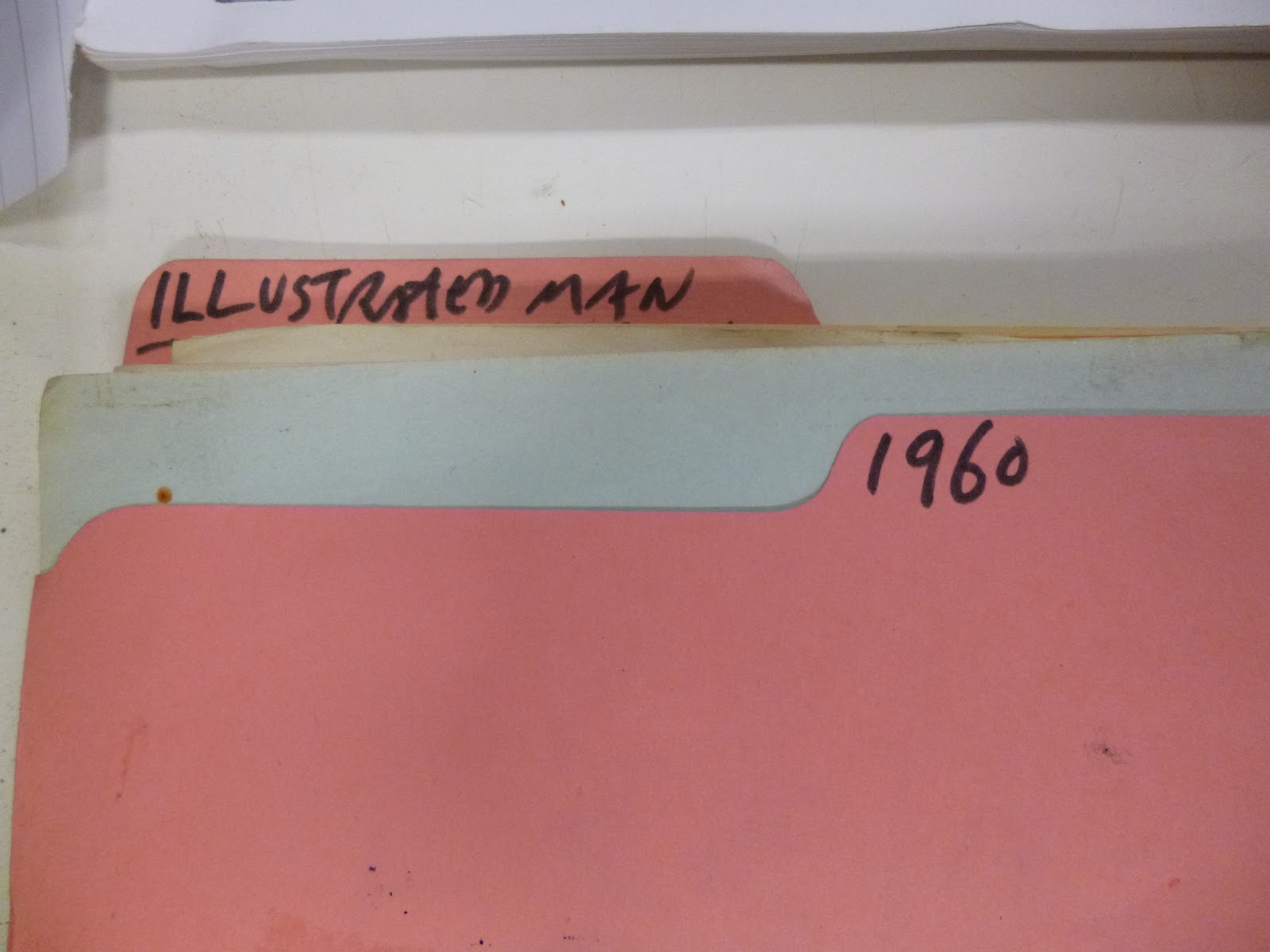
What isn't so well known is that Bradbury himself wrote several film scripts for adaptations of The Illustrated Man. In 1960, he completed a screenplay for producer Jerry Wald; the film was never produced. In this version, Ray adapted the framing story from the book, plus the stories "The Veldt", "Sun and Shadow", "In a Season of Calm Weather" and "The Crowd" - but only one of these stories ("The Veldt") comes from the book!
Ray Bradbury's file for the Illustrated Man screenplay, now part of the Allbright collection housed at the Center for Ray Bradbury Studies in Indianapolis. Photo by Phil Nichols.
It's clear that Ray saw The Illustrated Man as an opportunity to put his favourite stories on screen, regardless of whether they had any connection to the book. Late in life he wrote another screenplay for The Illustrated Man, this time for the Sci-Fi Channel; again, it went unproduced. The stories in this version? "On the Orient, North" (not from the book!) and "The Veldt" (from the book).
Find Out More...
Read "The Rocket Man " in the official archive of Maclean's magazine, here.
Read "The Last Night of the World" on the Esquire website, here.
I had a lively discussion about The Illustrated Man and the 1969 film adaptation on the Take Me To our Reader podcast, which you can hear here.
In 1969, when the Illustrated Man film was in production, Bradbury was profiled by Canadian TV network CBC for their Telescope series. Watch the documentary here.
Listen...
The classic SF radio series X Minus One adapted a number of stories from The Illustrated Man. Check out "Zero Hour" here.
Watch...
In November 2021, I gave a live online talk about The Illustrated Man, in celebration of its seventieth anniversary. Watch it here:
This is the second in a new series of posts, my Lockdown Choices, where I seek to entertain you while in coronavirus-isolation, and remind you of Bradbury's great works in this, his centenary year.
In these posts, I cover each of Ray Bradbury's books, say something about the contents, then pick the best stories and adaptations.
Lockdown Choice #2: The Martian Chronicles
First edition, Doubleday 1950
The Book
The Martian Chronicles was Ray Bradbury's first book from a mainstream publisher, a collection of linked science fiction and fantasy tales published by Doubleday in 1950. Many of the stories had previously been published in magazines ranging from Thrilling Wonder Stories to Mademoiselle. But there was also a lot of new material, mostly in linking stories and passages crafted to join the disjointed tales together. The result is sometimes called a novel, and sometimes called a short story collection. The label "fix-up" is also sometimes applied: this term from the science fiction field refers to a work originally published in sections in pulp magazines, but then stitched together as a novel for book publication. The best description, although it's a bit of a mouthful, is the term Eller and Touponce use: "novelised story-cycle".
Bradbury often told the tale of how this novel/collection/fix-up/novelised story-cycle came to be. He met with editor Walter Bradbury (no relation), who suggested to Ray that he could take some of his disparate Mars stories and weave them into a novel. In fact, Ray already had the idea of collecting his Mars stories as far back as 1948, when he wrote some notes under the title "The Martian Chronicles, a book of short stories".But perhaps it was Walter Bradbury's suggestion which gave him "permission" to link the stories together.
In this first major publication, Bradbury shows his influences quite clearly. Here you will find some remarkably spare and clear writing, reflecting the influence of Hemingway. In the "chronicling" approach with its explanatory and linking chapters you will find the influence of Steinbeck's The Grapes of Wrath. (Remember how Steinbeck alternates between his fictional narrative and his more journalistic interstitial chapters?) And in the stories themselves, with their quirky character portrayals, you will see the influence of Sherwood Anderson's Winesburg, Ohio. All of these literary influences, of course, sit alongside the tropes of science fiction, since Bradbury's Mars is an extension of the common-coin concepts of Mars which Ray knew from his childhood reading of Edgar Rice Burroughs.
Ah yes, science fiction.
That's a problem with Bradbury. And it was a problem for Bradbury.
The first problem is that Bradbury uses the backdrop of Mars, but it's not at all a scientific backdrop. It's based on Burroughs, who based it on the work of astronomer Percival Lowell... whose work was discredited the moment it was first published. By 1950, when real rockets had been developed, Bradbury's presentation of Mars was decidedly quaint. He caught a lot of flak over the years for writing something so unscientific under the guise of science fiction.
Which leads me to the second problem. Bradbury knew this wasn't science fiction. He said it was fantasy. Bradbury's personal definition of science fiction was that it had to be possible. And since The Martian Chronicles is set on a Mars that doesn't really exist, every word of the book was, in his mind, pure fantasy. And yet...
Doubleday launches a new line of science fiction books, much to the annoyance of
the science fiction author who argued that this book was not SF.
...right there, on the cover of the book, was this nifty new logo that Doubleday had devised. They were marketing this book, Bradbury's breakthrough into mainstream hardcover publication, as something it wasn't.
Bradbury fought it, but couldn't win. Doubleday knew that science fiction was going to become a big genre in the 1950s, and they were determined to grab a piece of that particular pie, and hadn't they just signed this Bradbury guy who was being celebrated as one of the most creative of those science fiction pulp writers?
Shortly after the Doubleday edition appeared, there was a British edition, which had a more poetic (but also more obscure) title: The Silver Locusts. This variant title continued to be used for all British editions right up until 1980, when The Martian Chronicles was made into a TV miniseries. The opportunity for a bit of cross-marketing got the better of publisher Granada, and The Silver Locusts quietly became The Martian Chronicles on British shores. And we've never looked back.
Spot the difference... The UK had always had a repackaged version of the book, titled The Silver Locusts.Until the TV miniseries, when lucrative tie-in opportunities arose. Granada/Panther paperback editions, 1979/1980.
The Silver Locusts also had some variation in the content, and this is where Bradbury's book reveals itself as really being a short story collection, rather than a novel. The British first edition from Hart-Davis removes "Usher II" and replaces it with "The Fire Balloons". This was reportedly at Bradbury's request, and reflected a change he would have made to the Doubleday edition if he had had the opportunity before it went to press.
Over the years, The Martian Chronicles has become something of an unstable text, since there have been many additions and removals, most of them originating with Bradbury himself. "The Wilderness" slips its way in, giving a much needed role to some female characters (which Chronicles is otherwise short of). And slipping its way out: "Way in the Middle of the Air", a remarkable story in which American black people decide, en masse, to abandon Earth once and for all, and to start over on Mars. There are elements of this story which foreshadow the civil rights movement which would come in the 1960s; it was really ahead of its time, but also rapidly came to look outdated, prompting Bradbury to remove it from the book.
And speaking of time, you will find that The Martian Chronicles takes place in different time periods depending on which edition you have. All the chapters have dates attached to them - running from February 1999 to October 2026 in the first edition, but shifted to January 2030 to October 2057 in late twentieth-century editions! As the book is fantasy, Bradbury felt no need to update any of the technology, but he did feel the need to keep the story forever in the future, just out of reach.
The Stories
If The Martian Chronicles truly were a novel, it would be next to impossible to choose "stories" from it. But it isn't. (As Ray said, it's a "half-cousin to a novel".)
My personal picks from The Martian Chronicles are these:
"Rocket Summer" - strictly speaking not a story, but one of the bits of linking material Ray crafted for the book, "Rocket Summer" is one of Bradbury's best pieces of prose poetry. From the opening single-sentence paragraph, you know you're in for a poetic ride in this book. It's "Ohio winter", until the rocket fires up in paragraph 2:
And then a long wave of warmth crossed the small town. A flooding sea of hot air; it seemed as if someone had left a bakery door open. The heat pulsed among the cottages and bushes and children. The icicles dropped, shattering, to melt. The doors flew open. The windows flew up. The children worked off their wool clothes. The housewives shed their bear disguises. The snow dissolved and showed last summer's ancient green lawns.
"- And The Moon Be Still As Bright" - a story which depicts a major turning point in the colonisation of Mars. In the stories leading up to this one, there has been a series of attempts by Earthmen (for they are all men; a sign of the times in which this was written) to conquer the red planet - but each attempt has been thwarted by the Martians. Now the fourth expedition settles in, and is shocked to find all of Mars now dead. It turns out the humans have inadvertently brought disease to Mars, and the martians are wiped out by something as simple as chicken pox.
For most of the rocketship's crew, this is a fine state of affairs, giving them free rein over a whole planet. But for one, Spender, it's a tragedy. Spender alone is able to see the great loss of martian civilisation. His empathy for the martians leads to him presenting himself as one of them. For the rest of the book we will encounter a number of other martians, all of them ethereal or ghostly. Humankind may take over the planet, but they will be forever haunted by the former civilisation they have destroyed.
"The Martian" - unlike "And the Moon..." and "The Third Expedition" (aka "Mars is Heaven!"), "The Martian" is rarely reprinted outside of this book. Take a look on the Internet Speculative Fiction Database, and you will see that "Mars is Heaven" - one of the best known short stories in the science fiction field - is endlessly anthologised, whereas "The Martian" doesn't get a look-in.
So what's so great about it? Well, it captures a true sense of loneliness. Mr and Mrs Lafarge live on Mars, and are in perpetual mourning the loss of their son, Tom. Until, one day:
"A small boy's standing in the yard and won't answer me," said the old man, trembling. "He looks like Tom!"
"Come to bed, you're dreaming,"
"But he's there; see for yourself."
The old woman looks, but has to wave the figure away. Shortly after, in bed, she says "It's a terrible night. I feel so old."
It turns out that it is their beloved Tom. Or, actually, a martian who is able to take on the form of Tom. The martian, too, is lonely. If only the Lafarges can accept him as their son, they can all be happy.
If you've not read the story before, I won't spoil it by revealing anything further. But I do recommend you read it. You don't have to know anything else about what's going on in The Martian Chronicles; "The Martian" works perfectly well as a standalone short story.
"There Will Come Soft Rains" - another story with a title taken from a poem (the other one being "And the Moon..."). This is perfection. A science fiction story written as a prose poem. There is barely any human presence in the story, which is the whole point: back on Earth, a global nuclear war wipes everything out. In "There Will Come Soft Rains" we see the poignant decline of a fully-automated house after its owners have been killed in an atomic flash. Only Bradbury can make you feel sorry for a house ("The house tried to save itself. Doors sprang tightly shut, but the windows were broken by the heat and the wind blew and sucked upon the fire.") Ever dutiful, the robotic house chooses a poem to read, since "Mrs McClellan" doesn't answer when asked for her selection. The chosen poem is by Sara Teasdale, and provides the title for the story. The final line of the poem sums up the short story: "And Spring herself, when she awoke at dawn / Would scarcely know that we were gone."
"The Million-Year Picnic" - (SPOILER ALERT!) - a perfect ending for an astonishing book, and yet another turning point in humankind's relationship with Mars. Following the destruction of Earth, all that remains of the human race is the smattering of colonists who were unable to get back home prior to the nuclear war. In the aftermath of that destruction, one family goes off on the martian canals for a picnic, with a promise from "Dad" that they will see martians. They travel amid the ruins of the martian cities, a reminder of the destroyed cities on Earth, but there is no life there. The kids really want to see a martian. "Where are they, Dad? You promised." Dad eventually shows them:
"There they are," said Dad, and he shifted Michael on his shoulder and pointed straight down. [...]
The Martians were there - in the canal - reflected in the water. Timothy and Michael and Robert and Mom and Dad.
The Martians stared back up at them for a long, long, silent time from the rippling water...
The Adaptations
The Martian Chronicles and its constituent stories were grabbed for adaptation almost immediately: the NBC radio series Dimension X had four episodes based on parts of the book in 1950, and the appeal of the book/stories continued for decades. The most popular story for adaptation is "Mars is Heaven!" ("The Third Expedition"), probably because it is as much a horror/suspense story as it is an SF tale. Horror writer Stephen King describes how, as a child listening-in to the Dimension X adaptation, he was scared so much that he couldn't sleep (see Danse Macabre, chapter V).
Bradbury himself was very keen to get The Martian Chronicles made into a film. From the late 1950s onwards he would return again and again to drafting different screenplay versions, but they unfortunately never sold. Even as late as 2005, when Bradbury was 85 years old, he was putting together new proposals for film or TV.
But wait, I hear you cry. There was a Martian Chronicles TV series. I saw it with my own two eyes!
Well, we don't like to talk about that...
It's true, in the late '70s, in the wake of Star Wars and Close Encounters, every studio in Hollywood was falling over itself to try to have the next hot SF property. The Martian Chronicles had a remarkably success run as a stage play around that same time in Los Angeles. And so was born the idea of adapting The Martian Chronicles for TV. Which Ray had been banging on about for years, but would anyone listen?
Flyer for the 1977 Colony Theater stage production in Los Angeles, 1977.
In theory, it should have been great. It had a respectful script from Richard Matheson, one of the most successful genre screenwriters (The Twilight Zone, The Night Stalker, Duel). And it had Michael Anderson directing (1984, Logan's Run). But alas, Anderson phoned it in, and the special effects were made out of plastic bottles and cornflake packets. Bradbury wasn't the only one to notice that the whole miniseries was boring. Unfortunately, he said it during a press conference, and got chastised by the studio's legal department.
About a decade later Bradbury tried to "do it right". He got the rights back to all the stories, and began adapting them for his TV series The Ray Bradbury Theatre. The budget wasn't good, but the production team did the best they could, turning out some respectable episodes in "The Earthmen" and "The Long Years".
Every now and again, we hear that The Martian Chronicles is going into production again, but I think ultimately it will never be done well. The book is too fragmented to make into a coherent movie, and although a TV series would probably work best, I fear that viewers today expect season-long arcs, not episodes with different casts every week (Black Mirror notwithstanding).
So forget TV and film, and consider radio: Colonial Radio Theatre did an excellent job with the whole of the Chronicles nearly ten years ago.
Find Out More...
Find out more about The Martian Chronicles on my page about the book, here.
Learn more about the Colonial Radio Theatre dramatisation of The Martian Chronicles in my review of the production, here.
Learn more about Bradbury's definition of "science fiction" and "fantasy" in my blog post, here.
Watch...
In November 2020, I gave a public lecture over Zoom all about The Martian Chronicles, as part of the University of Wolverhampton's ArtsFest Online series. You can watch it here:
Listen...
One of the earliest adaptations from The Martian Chronicles was the one that scared the bejeezus out of Stephen King: this Ernest Kinoy-scripted version of "Mars is Heaven!" (aka "The Third Expedition"): click here.
Next Up...
The next of my Lockdown Choices will be Bradbury's third book: The Illustrated Man.