Here's something unusual: book boxes. A little crafting project that involves printing out a piece of artwork which can be folded up into a box, and printing out cards with quotations on, to store inside the box.
Amanda over at WordsDance.com talks you through the process, using "book box #1" - which is Ray Bradbury's Fahrenheit 451.
Monday, June 10, 2013
Saturday, June 08, 2013
Fahrenheit 451 poster
Here's the poster from OTHERWORLD THEATRE's Chicago production of Fahrenheit 451.
Bonus points to anyone who can identify the book the fireman is hiding...
Friday, June 07, 2013
Bradbury Events This Weekend
In Chicago, Otherworld Theatre are staging various events in a Ray Bradbury Festival: several performances of Bradbury's own stage play version of Fahrenheit 451, a discussion panel featuring Mort Castle and others, radio drama and more.
Full details are here. Many thanks to Sara Livingston for alerting me to these events.
Meanwhile, in New York on Sunday there is a performance of selected songs from the new musical based on The Martian Chronicles. I have reported on this production previously (when it was being referred to as a sci-fi opera, two terms which have now been dropped as it was felt that they were giving a misleading impression). You can learn more about Sunday's event here, and more about the musical project here. Thanks to Daniel Levy for keeping me informed of developments with this ambitious project.
Full details are here. Many thanks to Sara Livingston for alerting me to these events.
Meanwhile, in New York on Sunday there is a performance of selected songs from the new musical based on The Martian Chronicles. I have reported on this production previously (when it was being referred to as a sci-fi opera, two terms which have now been dropped as it was felt that they were giving a misleading impression). You can learn more about Sunday's event here, and more about the musical project here. Thanks to Daniel Levy for keeping me informed of developments with this ambitious project.
Wednesday, June 05, 2013
One Year On...
Exactly one year ago Ray Bradbury passed away.
Although gone, he has been anything but forgotten. In the year since his death there has been a square named after him in Los Angeles, right next to the city's library; a tribute panel at the Science Fiction Research Association conference in Detroit; tribute books from Steven Paul Leiva and William F. Nolan; a 60th anniversary special edition of Fahrenheit 451 from Simon & Shuster; and, forthcoming, new studies by William Touponce and Jonathan Eller, and the second volume of the Collected Stories Critical Edition.
Not to mention special tribute editions of Rosebud magazine and Famous Monsters.
Onward! as Ray was so fond of saying.
Although gone, he has been anything but forgotten. In the year since his death there has been a square named after him in Los Angeles, right next to the city's library; a tribute panel at the Science Fiction Research Association conference in Detroit; tribute books from Steven Paul Leiva and William F. Nolan; a 60th anniversary special edition of Fahrenheit 451 from Simon & Shuster; and, forthcoming, new studies by William Touponce and Jonathan Eller, and the second volume of the Collected Stories Critical Edition.
Not to mention special tribute editions of Rosebud magazine and Famous Monsters.
Onward! as Ray was so fond of saying.
Wednesday, May 22, 2013
Orbiting Bradbury's Mars
Coming soon, Orbiting Ray Bradbury's Mars, edited by Gloria McMillan. The blurb for this essay collection says:
The book is due for release towards the end of the 2013, but is available for pre-order now from the website of the publisher, McFarland. McFarland previously published Visions of Mars, to which I contributed an essay on Bradbury's Mars.
Noting the impact of the Southwest on Bradbury, some of the essays analyze Bradbury’s southwest metaphors: colonial pollution of a pristine ecology, the impacts of a colonial invasion upon an indigenous population, the meeting of cultures with different values and physical aspects. Other essays view Bradbury via the lens of post-colonialism, drawing parallels between such works as The Martian Chronicles and real-life colonialism and its effects. Others view Bradbury sociologically, analyzing border issues in his 1947 New Yorker story "I See You Never," written long before the issue of Mexican deportees appeared on the American literary horizon. From the scientific side, four essays by astronomers document how Bradbury formed the minds of many budding scientists with his vision.
The book is due for release towards the end of the 2013, but is available for pre-order now from the website of the publisher, McFarland. McFarland previously published Visions of Mars, to which I contributed an essay on Bradbury's Mars.
Thursday, May 09, 2013
New Short Film - All Summer in a Day
All Summer in a Day is a short film production funded via Kickstarter, the crowd-funding website. It's based on the Ray Bradbury short story, which has been filmed once before. The Kickstarter target was a modest $5000 or so, which was reached in April.
You can read more about the production here, and here is the trailer/pitch:
Tuesday, May 07, 2013
Ray Harryhausen (1920-2013)
It was reported today that animator Ray Harryhausen has passed away. He was 92 years old.
He and Ray Bradbury were born in the same year, and first met in Los Angeles when they were both in their teens. They shared a passion for dinosaurs and King Kong, and remained friends across the decades.
The two Rays never directly collaborated, but they both had credits on the 1950s movie The Beast From 20,000 Fathoms. Bradbury wrote the story the film derived from; Harryhausen brought the Beast to life with his amazing animation, achieved on a remarkably low budget.
Some years later, Bradbury wrote a short story called "Tyrannosaurus Rex", about a monstrous film producer and the stop-motion animator who wreaks sweet revenge on him. Harryhausen was clearly the model for the animator (but I don't think the real-life producer has ever been identified...).
Later still, Bradbury made a fictionalised version of Harryhausen into a central character of his Hollywood novel Graveyard for Lunatics.
As the two Rays aged, and travel became difficult, they saw less of each other. Their last meeting was about six years ago when London-based Harryhausen made his last trip to Los Angeles. The photo above shows the two at a public event in 2007.
Three years ago, Ray Harryhausen announced that he was donating the life's work - models, papers, the lot - to the National Media Museum in Bradford, England. This should ensure that his work is properly memorialised, and that researchers will be able to gain access to his sketches and working papers.
Looking back, I am surprised to see how often I mentioned Harryhausen on this blog, but when you consider the importance of the two Rays to each other, there is no real surprise. Click here to see previous posts about the late, great Ray Harryhausen.
He and Ray Bradbury were born in the same year, and first met in Los Angeles when they were both in their teens. They shared a passion for dinosaurs and King Kong, and remained friends across the decades.
The two Rays never directly collaborated, but they both had credits on the 1950s movie The Beast From 20,000 Fathoms. Bradbury wrote the story the film derived from; Harryhausen brought the Beast to life with his amazing animation, achieved on a remarkably low budget.
Some years later, Bradbury wrote a short story called "Tyrannosaurus Rex", about a monstrous film producer and the stop-motion animator who wreaks sweet revenge on him. Harryhausen was clearly the model for the animator (but I don't think the real-life producer has ever been identified...).
Later still, Bradbury made a fictionalised version of Harryhausen into a central character of his Hollywood novel Graveyard for Lunatics.
As the two Rays aged, and travel became difficult, they saw less of each other. Their last meeting was about six years ago when London-based Harryhausen made his last trip to Los Angeles. The photo above shows the two at a public event in 2007.
Three years ago, Ray Harryhausen announced that he was donating the life's work - models, papers, the lot - to the National Media Museum in Bradford, England. This should ensure that his work is properly memorialised, and that researchers will be able to gain access to his sketches and working papers.
Looking back, I am surprised to see how often I mentioned Harryhausen on this blog, but when you consider the importance of the two Rays to each other, there is no real surprise. Click here to see previous posts about the late, great Ray Harryhausen.
Sunday, May 05, 2013
Books on Bradbury, new and forthcoming
It's nearly a year since Ray Bradbury died, but interest in his work continues, as evidenced in a number of books newly released or announced.
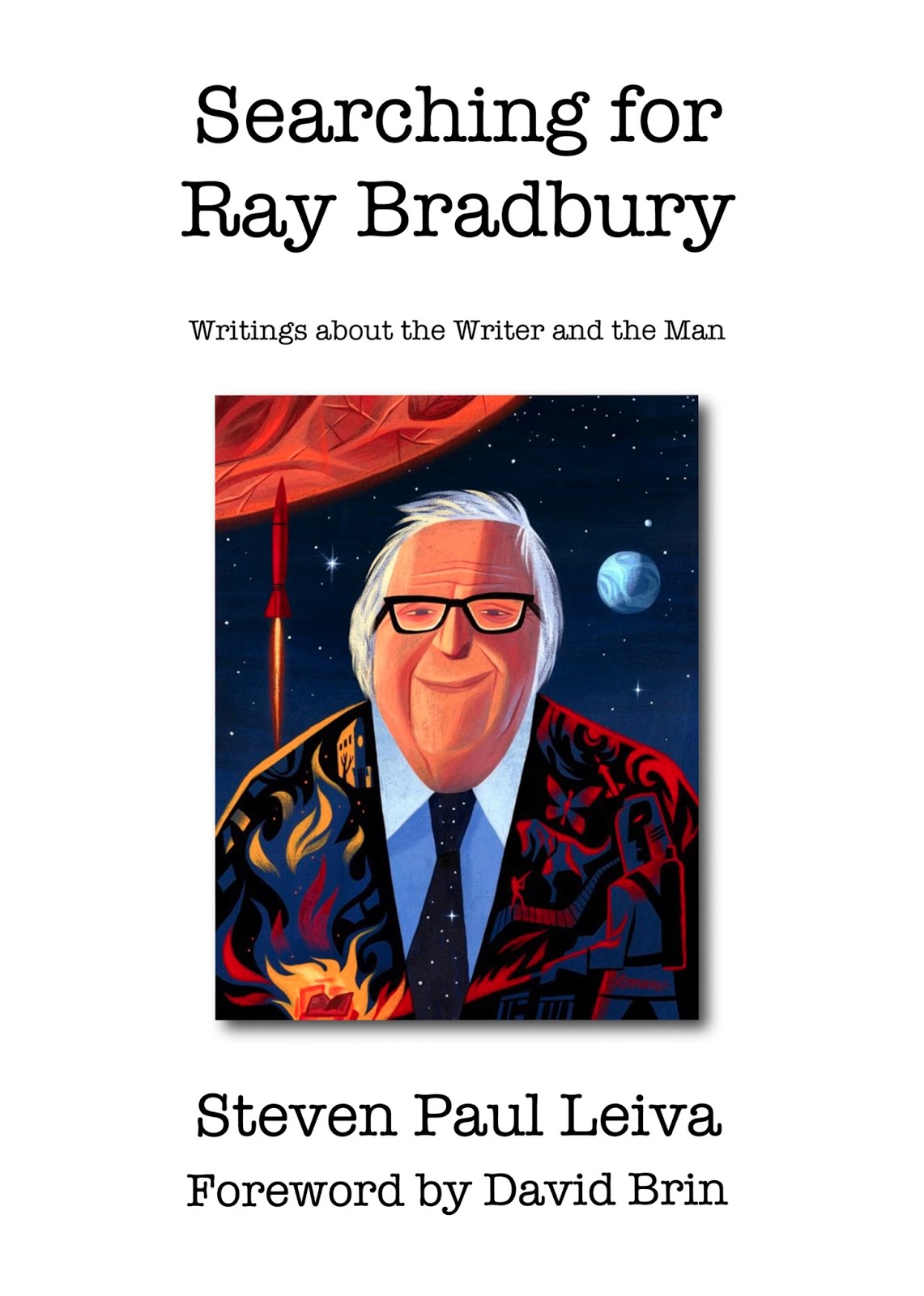
Searching for Ray Bradbury is a slim, inexpensive volume from Bradbury's friend and collaborator Steven Paul Leiva. It collects Steven's writings on Ray, previously published in various newspapers, magazines and websites. I'm currently reading this book, and will be reviewing it here in the near future. For now, I'll just say that it captures some of the spirit of celebration of the events Steven co-ordinated in recent years, such as Los Angeles' Ray Bradbury Week and the dedication of Ray Bradbury Square.
Nolan on Bradbury is William F. Nolan's return to writing about his lifelong friend. A highlight of Nolan's early career was his publication of The Ray Bradbury Review, the first study of any aspect of Bradbury's work. Nolan would soon develop a career as a creative writer which paralleled Bradbury's, with work in the fields of SF, fantasy, horror and crime fiction, and with significant excursions into screenwriting. Nolan's list of significant books includes the novel Logan's Run (written with George Clayton Johnson) and the scrapbook-style The Ray Bradbury Companion. Now Nolan on Bradbury promises to collect "sixty years of writing" about Bradbury, and is adorned with a Joe Mugnaini rendering of Bradbury's "The Pedestrian". I hope to review this book soon.
Lord Dunsany, H.P. Lovecraft, and Ray Bradbury: Spectral Journeys is William Touponce's latest study, attempting to map Lovecraft's notion of spectral literature as "literature that involves the gothic themes of the supernatural found in the past but also concerned about modern society and humanity", and showing how his tradition or mode of writing developed through the twentieth-century. Bill's previous work on Bradbury is extensive, including the study Ray Bradbury: the Life of Fiction (written with Jon Eller) and directing the Center for Ray Bradbury Studies from 2007-2011. This book is listed for publication in October... the ideal month for Bradbury.
Finally a brief note on The Collected Stories of Ray Bradbury: a Critical Edition, Volume 2. I am pleased to report that I have been appointed as a consultant on this volume, which is currently approaching it's final shape. The contents of the volume are more or less settled, with just a few items of the critical apparatus still to be completed. I'll give more details when I can. (Volume 1, of course, is already available.)
Searching for Ray Bradbury is a slim, inexpensive volume from Bradbury's friend and collaborator Steven Paul Leiva. It collects Steven's writings on Ray, previously published in various newspapers, magazines and websites. I'm currently reading this book, and will be reviewing it here in the near future. For now, I'll just say that it captures some of the spirit of celebration of the events Steven co-ordinated in recent years, such as Los Angeles' Ray Bradbury Week and the dedication of Ray Bradbury Square.
Nolan on Bradbury is William F. Nolan's return to writing about his lifelong friend. A highlight of Nolan's early career was his publication of The Ray Bradbury Review, the first study of any aspect of Bradbury's work. Nolan would soon develop a career as a creative writer which paralleled Bradbury's, with work in the fields of SF, fantasy, horror and crime fiction, and with significant excursions into screenwriting. Nolan's list of significant books includes the novel Logan's Run (written with George Clayton Johnson) and the scrapbook-style The Ray Bradbury Companion. Now Nolan on Bradbury promises to collect "sixty years of writing" about Bradbury, and is adorned with a Joe Mugnaini rendering of Bradbury's "The Pedestrian". I hope to review this book soon.
Lord Dunsany, H.P. Lovecraft, and Ray Bradbury: Spectral Journeys is William Touponce's latest study, attempting to map Lovecraft's notion of spectral literature as "literature that involves the gothic themes of the supernatural found in the past but also concerned about modern society and humanity", and showing how his tradition or mode of writing developed through the twentieth-century. Bill's previous work on Bradbury is extensive, including the study Ray Bradbury: the Life of Fiction (written with Jon Eller) and directing the Center for Ray Bradbury Studies from 2007-2011. This book is listed for publication in October... the ideal month for Bradbury.
Finally a brief note on The Collected Stories of Ray Bradbury: a Critical Edition, Volume 2. I am pleased to report that I have been appointed as a consultant on this volume, which is currently approaching it's final shape. The contents of the volume are more or less settled, with just a few items of the critical apparatus still to be completed. I'll give more details when I can. (Volume 1, of course, is already available.)
Thursday, May 02, 2013
Bradbury Poster
I recently had to produce a poster outlining my PhD research project in terms that could be understood by a non-expert. I went for a straightforward approach of a brief description and some simple illustrations drawn from book covers, film posters and DVD sleeves. As it was produced for viewing online, I opted for a landscape design.
The poster was on display for two weeks on the website of Liverpool University during the "Poster Day Online" event. The event is now over, so I can make it viewable here.
Click here, then, to view the full-size PDF of The Cinema of Lost Films: Ray Bradbury on Screen.
The poster was on display for two weeks on the website of Liverpool University during the "Poster Day Online" event. The event is now over, so I can make it viewable here.
Click here, then, to view the full-size PDF of The Cinema of Lost Films: Ray Bradbury on Screen.
Saturday, April 20, 2013
Bradbury, Ellison: Writing for the Screen
Last week I attended the Eaton Science Fiction Conference (which this year was combined with the Science Fiction Research Association conference) in Riverside, California, to present a paper on the screenwriting styles of Ray Bradbury and Harlan Ellison.
The overall conference programme was ridiculously full, with seven simultaneous panels for most of the conference's three days. This is an amazing expansion since my first Eaton in 2008, which just had a single strand of panels.
My paper was part of a panel I had proposed on screenwriting. The paper title was "Screenwriting: Spectacle, Specificity and Speculative Fiction", and my intention was to illuminate the challenge of writing a screenplay for an imagined world, using examples from the scripts of Bradbury and Ellison to show two distinct strategies.
Bradbury tended to write non-technical scripts, resulting in a style of script which looks for all the world like a modern-day "spec script" - although he developed this style as early as the mid-1950s. Ellison, on the other hand, developed his craft in television in the early 1960s, in a time when it was common practice for the scriptwriter to write more or less in a shooting-script format, a style which is generally more prescriptive and more technical in terms of camera directions.
Over time, Bradbury's style became more and more simplified, and his scripts tend to read like very clear short stories. The heavy use of metaphor we often find in his short stories is largely absent, however, as he recognised how important it was to be unambiguous in describing a fantastical world in a screenplay. Ellison, on the other hand, developed a remarkable specificity in his scripts, which makes for some stunning visual concepts which challenge the director and production team to match his vision.
Time permitting, I intend to develop the paper for journal publication.
The other contributors to the panel were Julian Hoxter of San Francisco State University, author of Write What You Don't Know: An Accessible Manual for Screenwriters (New York: Continuum, 2011) and Michael Klein of James Madison University. Julian spoke on the emergence of the "spec script" format and its impact on action in blockbuster movies. Michael spoke on the mythos of Frankenstein as it developed in both Shelley's original novel and its first film adaptation. I learned a lot from both presentations, and appreciated both speakers' contribution to the panel.
The overall conference programme was ridiculously full, with seven simultaneous panels for most of the conference's three days. This is an amazing expansion since my first Eaton in 2008, which just had a single strand of panels.
My paper was part of a panel I had proposed on screenwriting. The paper title was "Screenwriting: Spectacle, Specificity and Speculative Fiction", and my intention was to illuminate the challenge of writing a screenplay for an imagined world, using examples from the scripts of Bradbury and Ellison to show two distinct strategies.
Bradbury tended to write non-technical scripts, resulting in a style of script which looks for all the world like a modern-day "spec script" - although he developed this style as early as the mid-1950s. Ellison, on the other hand, developed his craft in television in the early 1960s, in a time when it was common practice for the scriptwriter to write more or less in a shooting-script format, a style which is generally more prescriptive and more technical in terms of camera directions.
Over time, Bradbury's style became more and more simplified, and his scripts tend to read like very clear short stories. The heavy use of metaphor we often find in his short stories is largely absent, however, as he recognised how important it was to be unambiguous in describing a fantastical world in a screenplay. Ellison, on the other hand, developed a remarkable specificity in his scripts, which makes for some stunning visual concepts which challenge the director and production team to match his vision.
Time permitting, I intend to develop the paper for journal publication.
The other contributors to the panel were Julian Hoxter of San Francisco State University, author of Write What You Don't Know: An Accessible Manual for Screenwriters (New York: Continuum, 2011) and Michael Klein of James Madison University. Julian spoke on the emergence of the "spec script" format and its impact on action in blockbuster movies. Michael spoke on the mythos of Frankenstein as it developed in both Shelley's original novel and its first film adaptation. I learned a lot from both presentations, and appreciated both speakers' contribution to the panel.
Subscribe to:
Posts (Atom)