Monday, September 09, 2013

New Book: SF Across Media

At long last, we have a publication date for a book containing one of my essays. Science Fiction Across Media: Adaptation/Novelization is due out on 16th September 2013. The book originated in the 2009 conference of the same name, which was held at the University of Leuven, Belgium.

My chapter is about Ray Bradbury's short story "A Sound of Thunder" and the ways it has been treated in difference media adaptations. I wrote it so long ago that I can barely remember what it's about (and so long ago that I will probably cringe at some of the things I say in it). I do recall that I refer to the story; to Bradbury's own TV dramatisation of the story; to Peter Hyams' disappointing film expansion of the story; and to several illustrators' treatment of the story's imagery.

Interestingly, the book's editors (Thomas Van Parys and I.Q.Hunter) or publishers (Gylphi Press) have chosen to use another Bradbury adaptation to illustrate the cover: Fahrenheit 451. It shows Cyril Cusack as Fire Chief Beatty warming his hands over some burning books while Oskar Werner looks on.

Tuesday, September 03, 2013

Frederik Pohl (1919-2013)

I just heard that Fred Pohl has passed away. He was a major figure in twentieth-century American SF, as editor, agent, novelist and short-story writer. He edited pulp-magazines before the Second World War, rubbing shoulders with other founding figures of the genre as we know it today. He wrote satirical novels and short stories in collaboration with C.M. Kornbluth in the 1950s. He edited Galaxy magazine in the 1960s. In the 1970s he had what for many people would be a late-career flourish with a string of award-winning novels such as Gateway, Man Plus (probably my favourite of his works) and Jem.

But that late-career flourish in his 50s turned out to be mid-career, as he continued working right through to his 90s. His authobiography, The Way The Future Was, consequently turns out to be a rather incomplete work as it was published in 1978 when Fred was a mere 58 years old! In recent years, he effectively extended the book by becoming a prolific blogger with his The Way The Future Blogs.

I met Fred in 2008 at the Eaton Conference in Riverside, California. He appeared on a panel with guest of honour Ray Bradbury. I had a chance to talk to him briefly about his work, telling him that I had re-read Man Plus on the flight from the UK, and found that it held up well for a thirty-year-old book. I have a few photos from the event, including one of me talking to Fred, but my favourite is this shot of him looking pensive. In the background, Larry Niven (standing) is sharing a joke with Ray Bradbury; and further back is SF scholar Eric Rabkin (seated), talking to Fred's wife Elizabeth Anne Hull.


Monday, August 26, 2013

James Gunn

One of the delights of this year's Eaton Conference in Riverside, California, was the opportunity to meet the incredible James Gunn.

(Pictured at the James Gunn panel are (from left to right) Nathaniel Williams, Michael Page, James Gunn, Chris McKitterick.)

What's so incredible about James Gunn? For starters, he's ninety years old this year, but could easily pass for twenty years younger. More importantly, though, he is what one conference speaker called "a triple threat": not only a successful author of science fiction, but a successful teacher of SF and creative writing, and a successful critic and historian of SF.

While other significant genre figures were associated with the Eaton Conference because they were to receive awards - Ray Harryhausen, Stan Lee and Ursula Le Guin all received Eaton Awards this year - Gunn was present because there was going to be a panel discussing the three strands of his career. The panel was part academic study, part reminiscence from those who have worked with Jim , and all celebration of his life and work. (The panel organisers told me they were inspired to do this by the Ray Bradbury tribute events I organised for last year's SFRA conference in Detroit.)

Apart from my ongoing interest in Bradbury and Harlan Ellison, who in any case I see as master fantasists rather than science fiction writers, I have been quite distant from the science fiction field for a number of years. But there was a time when I was fascinated by the genre, and particularly by its history as a literary genre that seemed to emerge alongside the industrial revolution. Around 1980, when I was a student (for the first time; I still am a student!) I discovered Gunn's book The Road to Science Fiction: From Gilgamesh to Wells. This was a remarkable book, which suddenly gave me that historical insight, where previously I just had a fractional and fractured knowledge of what SF was. Gunn wrote a clear history, in plain English and short chapters, and then gave the reader substantial excerpts from key texts to illustrate the points he was making about the emergence of the genre. It was, and remained, and excellent way of learning about how and why the genre came into existence. I would later learn that there are other interpretations of the emergence of the genre, but that doesn't matter.

Shortly after, I discovered there was a second volume to The Road to Science Fiction, subtitled From Wells to Heinlein; and a third, From Heinlein to Here. (And a fourth, and some time later there were yet more.) For anyone looking for a history of the genre, I still recommend this series, and they have remained in print.

One additional stroke of genius in the first volumes of the series was Gunn's inclusion of lists of recommended SF works and SF writers for further reading. I worked through these lists systematically over the next couple of years, a far more difficult task in those pre-internet days than it would be today.

I don't recall whether Gunn included any of his own works in the suggested reading category, but for some reason I was prompted to also sample his fiction. The Listeners appealed to me from its plot description as an account of scientists engaged in the search for extraterrestrial intelligence, and when I read it I was blown away by both the ease and artistry of the book, particularly its first chapter. Later I would track down as many other Gunn books as I could, and have fond memories of The Joy Makers, The Immortal, Crisis, and This Fortess World (which I was fortunate to find in a hardcover first edition from 1955).

At the Eaton Conference, Gunn explained that his career wasn't planned, but he just took opportunities as they arose. His response to each offer that came his way was, "Why not?" Thus it was that he came to be working at Kansas University by the mid-1960s, and later set up the first academic courses in SF, and the first research centre for SF (take a look at About SF for the present incarnation of what he developed at KU).

I took the opportunity of asking Jim Gunn how he came to collaborate with the legendary Jack Williamson, on the 1954 novel Starbridge. Jim explained that he attended a convention and, somewhat starstruck, recognised Williamson from a photograph on the back of a book. He pointed at Williamson and blurted, "You're Jack Williamson!" Later, he learned that Williamson was suffering a bout of writer's block, and Williamson turned over a partially complete version of Starbridge, which Gunn then completed. It was published by Gnome Press, and became Gunn's first published novel.

I couldn't resist mentioning to Jim that I had recognised him in the lift (elevator!) the day before - and that part of me had wanted to blurt, "You're James Gunn!", but I was too starstruck to say anything.

As it turns out, Jim Gunn is a charming, modest fellow, and it was exciting to meet him. It prompted me to take a look again at his books - and I still find The Listeners to be a remarkable work. Although it is fantastical, it has one of the best portrayals of scientists and scientific discovery I've ever seen in a work of fiction. Speakers on the Gunn panel also commended this as one of his best works - and both they and the audience members echoed my experience regarding The Road to Science Fiction. It seems James Gunn has been the gateway to SF not just to me, but to a couple of generations of SF fans and scholars. Jim talks about his own involvement with the genre in this recent interview in the Kansas City Star.

And now, in his 90th year, James Gunn has produced a new novel, Transcendental, and he's a Guest of Honour at the World Science Fiction Convention in San Antonio, Texas. Is this what they call a third act?


Saturday, August 24, 2013

"Onward!"


Onward!

Why "Onward!" ?

Well, it has connotations of moving forward, running ahead to meet the future head on, not giving up, not standing still... things that are echoed in Bradbury's writing, especially in his essays...

But mainly it was what he wrote when he signed books (and other items) for people, such as my only autographed Bradbury book:


Thursday, August 22, 2013

Ray Bradbury's Birthday


Today is 22nd August 2013.

93 years ago today, Ray Bradbury was born. 

60 years ago this year, one of his finest works was published: Fahrenheit 451.


Onward!


Sunday, August 18, 2013

F451 Critical Volume

Coming soon from Salem Press:


With luck, I shall be in there with a chapter on adaptations of Fahrenheit 451. More details on the volume here - and an explanation of the series concept here.

Thursday, August 15, 2013

Los Angeles Event - one week from today


From Steven Paul Leiva, the man behind Ray Bradbury Week in 2010: an event for 22 August, the 93rd anniversary of Bradbury's birth.


Tuesday, August 13, 2013

Old Cork, New Bedford

The small Irish town of Youghal, County Cork, stood in for New Bedford in the 1956 film version of Moby Dick, written by Ray Bradbury and John Huston.

When I was looking at "widow's walks" recently, it occurred to me that the rather fake looking widow's walk in the film was probably a production designer's add-on to a real house. So I thought I would go looking for that house, courtesy of Google Street View.

And what do you know, the place hasn't changed much. The widow's walk is long gone - taken down the day after shooting I expect - but the building remains. It is still happily trading on Youghal's five minutes of movie fame: it is now the Moby Dick pub.

Here's the two glimpses of the widow's walk in the movie:


Notice the old movie trick of concealing the buildings as much as possible (with ships in this case) so as to save on the amount of dressing required on the facades. Notice, too, that the closer shot clearly shows timber cladding on the walls, making the building(s) seem appropriate for New Bedford.

Here, on the other hand, is the same building today (or when Google's camera car last went past).


There are some more photos of the Moby Dick , including signs mentioning both John Huston and Gregory Peck, on this Google Plus photos page belonging to Martin Zima.

A couple of years ago, a small film-making crew recreated some of the Youghal scenes from the film. You can read the story and view some photos here. For photos from the shoot of the original film, watch this excerpt from an RTE documentary on John Huston:


Apparently, when in Youghal, you should drop in to Moby Dick's for a pint of Murphy's...


As the Pequod finally gets underway, it leaves New Bedford behind. The last we see of the place is a lighthouse and the headland across the bay. Of course, it's Youghal lighthouse we see in the film...


... as we can see from this Google Streetview image, which is almost an exact match:


Sunday, August 11, 2013

Something Fishy This Way Comes


One of the finest aspects of the 1956 film version of Moby Dick, written by Ray Bradbury and John Huston, is the art direction supervised by Ralph Brinton. The story holds off from showing Moby Dick until the final scenes, but imagery of the whale is ever-present throughout. Here are some of those fishy moments.

(And yes, I know a whale is not a fish. But try telling that to Jonah.)


Huston's main credits, backed by a painting of an upturned sperm whale. This is one of the few films to have spoilers in its title sequence...


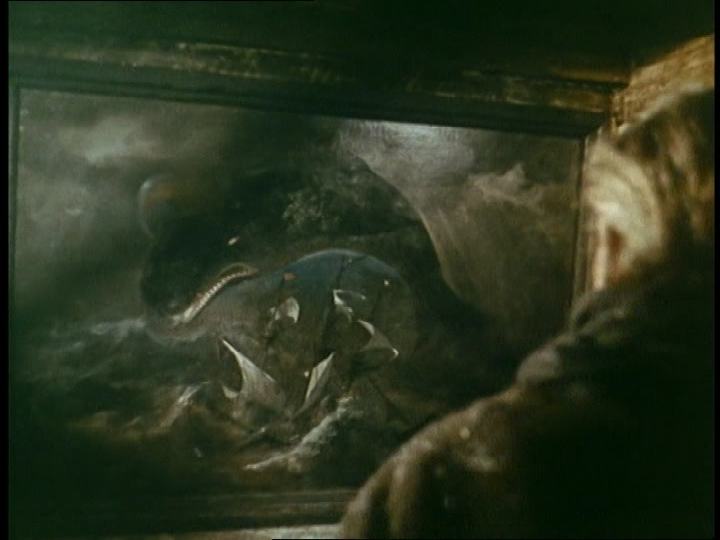
Ishmael's first glimpse of a whale, in the painting in the Spouter Inn. "Can whales do that?" he asks. He will find out later.


Queequeg enjoys the pictures in a book, but cannot read. Ishmael helps him out.


Signing on as crew of the Pequod: beneath Ishmael's signature, Queequeg's sign of the whale.


The tiller of the Pequod, made from the jaw of a sperm whale.


Here there be whales: Ahab's intricate and detailed charts obsessively chronicling the movements of Moby Dick.


Thar she blows! The white whale finally appears, and swallows up Ahab's boat.


What a fluke: Moby Dick's final actions, after ramming the Pequod, creating a mighty whirlpool which will swallow up everyone and everything except Ishmael.