I recently took a brief trip to Dublin. While I was there I dashed about with a camera trying to grab some pictures of places with a Ray Bradbury connection.
Click on any of these pictures to view larger versions.
It is an oft-told tale that Bradbury stayed in Dublin in 1953-54, when he was writing the screenplay for
Moby Dick for director John Huston. This relatively short visit - a mere few months out of Bradbury's nearly 88 years on the planet to date - provided an incredible amount of inspiration. Not only did he complete the screenplay, he left Ireland with material for a number of short plays, short stories, the play (and later novella)
Leviathan '99 and eventually the partly autobiographical novel
Green Shadows, White Whale.

My first priority in Dublin was to get to O'Connell Bridge. Not only is this the only major bridge in Europe to be wider than it is long, it was the location for Bradbury's finest Irish story, "The Beggar on O'Connell Bridge". First published as "The Beggar on the Dublin Bridge" in the
Saturday Evening Post in June 1961, the story is an account of Bradbury's experiences of being accosted by beggars whenever he left his hotel. The story can be found in Bradbury's short story collections
The Machineries of Joy and
Bradbury Stories. It can also be found, slightly modified, as a chapter in
Green Shadows, White Whale - where John Huston strangely takes the place of Bradbury's wife.

O'Connell Bridge isn't difficult to find. Nor is it difficult to find a beggar on O'Connell Bridge. There always seems to be one right in the middle, exactly where Bradbury says. Unfortunately, however, none of the real modern day beggars are as colourful or as entertaining as Bradbury's concertina playing, possibly blind (or possibly not), sweet voiced beggar:
For a moment, while we had been talking in the cold rain, the beggar had been silent. Now, as if the weather had freshened him to life, he gave his concertina a great mash. From the folding, unfolding snake box he squeezed a series of asthmatic notes which were no preparation for what followed.
He opened his mouth. He sang.
The sweet clear baritone voice which rang over O'Connell Bridge, steady and sure, was beautifully shaped and controlled, not a quiver, not a flaw, anywhere. The man just opened his mouth, which meant that all kinds of secret doors in his body gave way. He did not sing so much as let his soul free.
 When he arrived in Dublin in October 1953, Bradbury stayed in the Royal Hibernian Hotel, which can be seen in this old postcard of Dawson Street. Here is how Sam Weller describes it in The Bradbury Chronicles:
In Dublin, the Bradburys checked into the old yet opulent Royal Hibernian Hotel on Dawson Street and were given two rooms. Ray and Maggie's room - number 77 - had a fireplace, and in this room Ray would do much of his work on the screenplay. Regina [the Bradburys' nanny]and the girls were placed in a separate room, with a coin-operated heater into which Regina continually fed money to keep the room warm.
 Alas, the Royal Hibernian is no more, torn down for redevelopment in the 1970s. In its place today stands a small shopping mall, the Royal Hibernian Way.
Not far from the Royal Hibernian site is St Stephen's Green, a park where Bradbury would occasionally take his children for a walk. This gets several mentions in Green Shadows, White Whale as the narrator desperately tries to solve the mystery of the beggar-woman:

God, how that woman could race.
She put a block between her backside and me while I gathered breath to yell: "Stop, thief!"
It seemed an appropriate yell. The baby was a mystery I wished to solve. And there she vaulted off with it, a wild thief.
So I dashed after, crying. "Stop! Help! You there!"
She kept a hundred yards between us for the first half mile, up over bridges across the Liffey and finally up Grafton Street, where I jogged into St. Stephen's Green, to find it ... empty.
She had absolutely vanished.
Unless, of course, I thought, turning in all directions, letting my gaze idle, it's into The Four Provinces pub she's gone . . .
 The entrance to the park closest to Grafton Street is Fusilier's Arch, a memorial erected after the Boer War. In this photo, the arch is flanked by the St Stephen's Green Shopping Centre. Although constructed in the 1980s, this Centre looks rather Victorian with its conservatory-style domed glass roof, which was suposedly design to complement the architecture of the Gaiety Theatre opposite. (After Ray's family left for Italy in 1954, he attended the ballet season at the Gaeity.)
 Speaking of theatres, legend has it that on Bradbury's first day in Dublin he saw a newspaper ad which said "Laurel & Hardy - Live - For One Night Only". He promptly dashed down to the Olympia Theatre and bought the last remaining ticket. The Olympia still stands in the Temple Bar area of Dublin, and remains a popular venue for drama, comedy and music.
 If the legend is accurate, Ray must have arrived in Dublin on Sunday 11 October 1953, as it was on that night that Stan and Ollie had decided to give a single charity performance of a show they had been preparing for touring in Belfast and London. The picture here shows them outside the Royal Marine Hotel where they stayed throughout their time in the city. A detailed account of Laurel and Hardy in Dublin can be found in this programme for a recent Sons of the Desert convention.
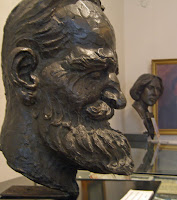
It's impossible to be in Dublin without noticing the references to the great literary figures all around, in statues, museums, public art. You can find out more than you would ever want to know at the fascinating (but small)
Writer's Museum where you will find this fellow, hero of Ray Bradbury and immortalised in the story "
GBS - Mark V" (1976).
Oh, and the wee fellow in the background? That's Oscar Wilde!

Apart from Shaw, Bradbury was also greatly influenced by another Dublin writer, W.B.Yeats. It is Yeats, of course, who provided Bradbury with the title for his short story "
The Golden Apples of the Sun." Joe Mugnaini's line art for this story is shown here.

 Good news on a definitive short story collection, courtesy of my academic colleague Bill Touponce at the Center for Ray Bradbury Studies: he and Jon Eller (pictured left) are about to embark on a five-volume series which will contain all of Bradbury's published short stories in the order in which they were written. In many cases, Bradbury stories have taken years to come into print, so this will be the first attempt to put them in chronological order.
 News, too, from Jerry Robbins of Colonial Radio Theatre. CRT's audio production of Bradbury's The Halloween Tree is moving closer to release. It will be out in time for Halloween! Jerry has kindly sent me a preview copy, so I hope to publish a review to coincide with the release. The CD is already available for pre-ordering - see Colonial's website for details.