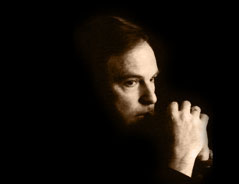
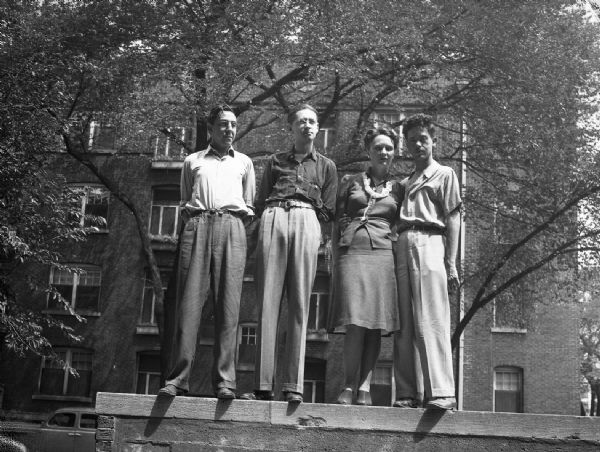
The photo on the left (click to embiggen!) is from the Harold Gauer Collection of the Wisconsin Historical Society. The one on the left is Harold Gauer himself, but he's not the reason I'm posting this.
Who are the other three people apparently standing on the wall?
None other than Ray Bradbury's writer friends Robert Bloch, C.L. Moore and Henry Kuttner. The photo was apparently taken outside Bloch's parents apartment in Milwaukee, when husband and wife Moore and Kuttner were on a visit from California. The photo is undated.
Harold Gauer was a friend of Bloch's from high school, and the two collaborated on some fiction in the 1930s. In fact, Bloch's first published fiction was a story called "The Thing", which appeared in a magazine edited by Gauer. Gauer talks about Milwaukee and his escapades with Bloch in this interview from the Unofficial Robert Bloch site.
The Wisconsin Historical Society has many more Gauer photos of Bloch, many of them funny, quirky or just bizarre. Browse the complete set here.
Thanks to jkt for alerting me to the Gauer collection.
Saturday, January 26, 2013
Wednesday, January 23, 2013
Nemo!
I recently received my copy of Nemo! It's a new hardcover from Subterranean Press, containing a complete screenplay by Ray Bradbury. I would recommend that you buy it - but it's a limited edition, and is already sold out*.
Nemo! is another one of those unfilmed Bradbury screenplays, but this one is slightly different as it's based on characters and stories by someone else, the cartoonist Winsor McCay. Bradbury was a frequent self-adaptor, but only rarely did he adapt the work of others.
Nemo! was written in the early 1980s for producer Gary Kurtz (of Star Wars fame), but the film spent years in development hell. It's based on McCay's early twentieth-century comic strip Little Nemo in Slumberland, and although it uses McCay's characters and premise, it apparently takes off into a free-flowing narrative which is as much Bradbury as it is McCay. (I say all this based on what I have heard; I haven't yet had time to read Nemo! from cover to cover, and nor have I read all of McCay's original strip!)
Eventually a film based on Little Nemo was released, ten years after Bradbury began work on the screenplay: Little Nemo: Adventures in Slumberland. Virtually nothing of Bradbury's screenplay ended up in the completed film, but he did receive a credit for the screen concept.
This convoluted production history is not mentioned in the Subterranean book. Although it is a beautifully produced volume, it is completely devoid of any of the introductions, forewords, afterwords or contextual essays I have come to expect from this publisher. Nor does it have any illustrations or any visuals from McCay's strip. Maybe that would have blown the budget. It does have a delightful cover, which gives a tempting suggestion of what a Bradbury-McCay animated feature film might have looked like.
Subterranean's page for the book is here, and if you want to explore McCay's original adventures of Nemo, you can find a collection of them at The Comic Strip Library.
*Update: it has been brought to my attention that, although Subterranean has sold out of this book, Amazon currently has stock. Details are here.
Nemo! is another one of those unfilmed Bradbury screenplays, but this one is slightly different as it's based on characters and stories by someone else, the cartoonist Winsor McCay. Bradbury was a frequent self-adaptor, but only rarely did he adapt the work of others.
Nemo! was written in the early 1980s for producer Gary Kurtz (of Star Wars fame), but the film spent years in development hell. It's based on McCay's early twentieth-century comic strip Little Nemo in Slumberland, and although it uses McCay's characters and premise, it apparently takes off into a free-flowing narrative which is as much Bradbury as it is McCay. (I say all this based on what I have heard; I haven't yet had time to read Nemo! from cover to cover, and nor have I read all of McCay's original strip!)
Eventually a film based on Little Nemo was released, ten years after Bradbury began work on the screenplay: Little Nemo: Adventures in Slumberland. Virtually nothing of Bradbury's screenplay ended up in the completed film, but he did receive a credit for the screen concept.
This convoluted production history is not mentioned in the Subterranean book. Although it is a beautifully produced volume, it is completely devoid of any of the introductions, forewords, afterwords or contextual essays I have come to expect from this publisher. Nor does it have any illustrations or any visuals from McCay's strip. Maybe that would have blown the budget. It does have a delightful cover, which gives a tempting suggestion of what a Bradbury-McCay animated feature film might have looked like.
Subterranean's page for the book is here, and if you want to explore McCay's original adventures of Nemo, you can find a collection of them at The Comic Strip Library.
*Update: it has been brought to my attention that, although Subterranean has sold out of this book, Amazon currently has stock. Details are here.
Sunday, January 13, 2013
Omni
In the 1980s and 1990s, Ray Bradbury's stories and essays would pop up from time to time in Omni, a glossy magazine which always claimed to be devoted to science fact and science fiction. (In fact, I seem to recall the magazine carrying articles on UFOs and other non-science topics, and the Bradbury fiction they published was almost entirely fantasy rather than SF.)
All four of Bradbury's fiction pieces in Omni were first appearances:
As for non-fiction, Bradbury supplied Omni with two essays:
In "The God in Science Fiction", Bradbury observes that humankind's understanding of deities has evolved over time:
An almost complete run of Omni magazine is now available online via the Internet Archive. This allows us to read Bradbury's compositions as they originally appeared, complete with the lavish illustrations that the magazine was known for. Here are direct links to the Bradbury issues, which can be viewed/downloaded in various file formats:
April 1980
October 1980
May 1981
October 1984
April 1985
Fall 1995
All four of Bradbury's fiction pieces in Omni were first appearances:
- "Colonel Stonesteel's Genuine Home-Made Truly Egyptian Mummy" (May 1981)
- "I Suppose You Are Wondering Why We Are Here?" (October 1984)
- "Trapdoor" (April 1985)
- "Once More, Legato" (Fall 1995)
As for non-fiction, Bradbury supplied Omni with two essays:
- "Beyond Eden" (April 1980)
- "The God in ScienceFiction" (October 1980)
The Space Shuttle.Of course, at this time many proponents of the Shuttle were advocating the idea of the space truck, a rather mundane delivery vehicle that would get the job done routinely, quickly and cheaply. From this quotation we can see that Bradbury took a much loftier view. As so often with his pronouncements on space, Bradbury couldn't resist ending his essay with one of his poems, this one being "They Have Not Seen The Stars".
How will it profit the men of New Bedford? How many kegs of oil can it bring to your Nantucket Market? Is there a seed farmer in the American fields, a churchwarden on his knees, an idler on Manhattan's docks who, looking up and seeing the Shuttle fly high, will be a penny richer, a half-ounce of philosophy better, less given to ill tempers, more filled with salvation?
So might Starbuck have queried Ahab re the White Whale 50,000 nights ago. My answer must imitate Ahab's, who said, touching his chest, "It will reward me here, Starbuck, here!"
For if the Space Shuttle is not as much heart and blood as it is mind and fact, then we shouldn't fly in Space at all.
In "The God in Science Fiction", Bradbury observes that humankind's understanding of deities has evolved over time:
Somewhere back in time, the Sun God Apollo became the Sun God Christ, born in the week of the winter solstice to prove that the world had not died but would rise again in the New Year that was truly that week and not January 1.From this premise, Bradbury then proposes that "Science-fiction writers will lean more and more into theology, forced by NASA's blasphemous intrusion on the Lord's-territorial imperatives to question where we have come from and just where in Heaven or Hell we are going." The remainder of the essay sees him accounting for his own handling of themes of religion in his science fiction stories, ranging from The Martian Chronicles to the then-unpublished Leviathan '99.
Somewhere further along in Time. Christ moves in Space, cargoed on missions that, for Now anyway, take the name of Apollo. So old myth and new circumnavigate the stars, rebuild old dreams, promise again better destinies on faraway worlds we cannot now imagine.
An almost complete run of Omni magazine is now available online via the Internet Archive. This allows us to read Bradbury's compositions as they originally appeared, complete with the lavish illustrations that the magazine was known for. Here are direct links to the Bradbury issues, which can be viewed/downloaded in various file formats:
April 1980
October 1980
May 1981
October 1984
April 1985
Fall 1995
Thursday, January 10, 2013
Dandelion Wine movie update
I noticed that director Rodion Nahapetov has updated his Bradbury page, saying that he hopes the long-planned Dandelion Wine film will go into production in the summer of 2013. For more details on the background to this project, see my original post here.
Monday, January 07, 2013
Becoming F451
Ray Bradbury's works have often been adapted to different media, sometimes by the author himself, and sometimes by others. Occasionally his works have inspired artists in other ways, such as the Canadian Ève K. Tremblay. Tremblay has created photographs inspired by aspects of Fahrenheit 451 and once attempted to memorise the whole novel - just like a Fahrenheit 451 book-person.
Tremblay's work is detailed in this article from Canadian Art.
Over at ArtCat, you can read the letter Tremblay sent to Bradbury which explains her intentions (scroll down to "Dear Mr Bradbury").
Tremblay's work is detailed in this article from Canadian Art.
Over at ArtCat, you can read the letter Tremblay sent to Bradbury which explains her intentions (scroll down to "Dear Mr Bradbury").
Friday, January 04, 2013
You Bet Your Life
In 1955, after completing his work on the screenplay for Moby Dick but before the film was released, a 35-year old Ray Bradbury made an appearance as a contestant on Groucho Marx's long-running game show You Bet Your Life. It seems to have been Ray's habit to go without glasses around this time, and this is how he appears in the show. Groucho must have been a complete blur to him, as Ray was severely short-sighted for all of his adult life (and even escaped conscription because his eyes were so bad).
Let's see how Ray Bradbury copes with these tough questions on movies:
Tuesday, January 01, 2013
Esquire
As Ray Bradbury's literary reputation grew, he moved from the poorly paying pulp magazines to the more financially rewarding "slicks". This was a well trodden path for successful genre authors, and a path that would typically include writing for men's magazines. In Bradbury's case this meant Playboy and Esquire, among others.
He contributed six original short stories to Esquire between 1950 and 1955:
"The Dragon", "The Gift", "The Illustrated Man", "Interval in Sunlight", "The Last Night of the World", and "A Piece of Wood".
"The Last Night of the World" appeared in February 1951 - inside the cover pictured above. Shortly afterward, the story was collected in Bradbury's book The Illustrated Man, which is in fact the only Bradbury book it has appeared in. For some reason it was never selected for either of the two big short story compendiums (Bradbury Stories and The Stories of Ray Bradbury).
Esquire's website has the full text of "The Last Night of the World", and names it as one of twelve contributions Bradbury made to the magazine. Since there were only six original short stories, I am guessing that the remainder were either reprints or non-fiction articles.
He contributed six original short stories to Esquire between 1950 and 1955:
"The Dragon", "The Gift", "The Illustrated Man", "Interval in Sunlight", "The Last Night of the World", and "A Piece of Wood".
"The Last Night of the World" appeared in February 1951 - inside the cover pictured above. Shortly afterward, the story was collected in Bradbury's book The Illustrated Man, which is in fact the only Bradbury book it has appeared in. For some reason it was never selected for either of the two big short story compendiums (Bradbury Stories and The Stories of Ray Bradbury).
Esquire's website has the full text of "The Last Night of the World", and names it as one of twelve contributions Bradbury made to the magazine. Since there were only six original short stories, I am guessing that the remainder were either reprints or non-fiction articles.
Saturday, December 29, 2012
Klaatu Barada Nikto...
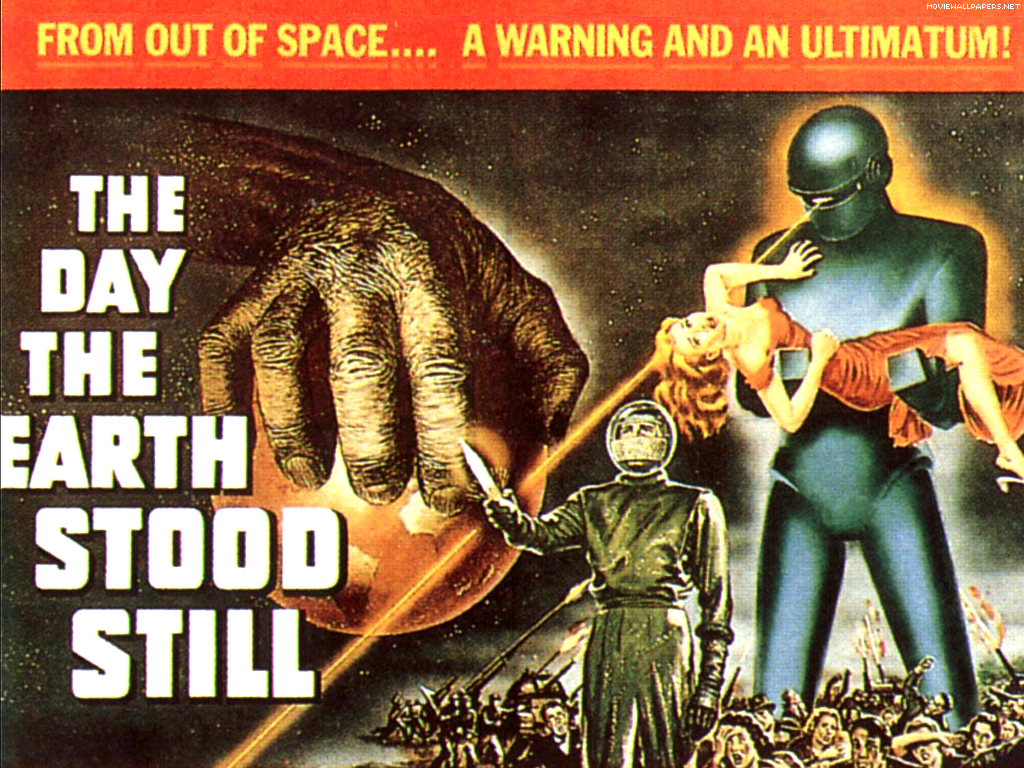
Everyone must surely know The Day The Earth Stood Still, the 1951 SF film. Directed by Robert Wise - the editor of Citizen Kane and future producer-director of both West Side Story and The Sound Of Music - it was one of the first serious Hollywood science fiction movies, and a significant contibution to that wave of near-paranoid cold war SF on the big screen. Forget the 2008 Keanu Reeves re-make; Michael Rennie remains the definitive Klaatu.
The 1951 film was scripted by Edmund H. North, and based on Harry Bates' short story "Return of the Master", a story which still reads well today.
But did you know that the early 1980s nearly saw the return of Klaatu, in a sequel written by Ray Bradbury?
Bradbury's screen treatment for Twentieth Century-Fox was entitled The Evening Of The Second Day, and was drafted in March 1981, with revisions completed in September 1981. Bradbury was initially opposed to the idea of such a sequel. According to Starlog magazine, he told the studio "Don't do it. The original film is so beautiful. Why don't you blow it up on larger film stock and re-release it, because nobody wants to see a sequel."
The studio bosses replied, "Yes, but we want you to do it."
Bradbury described his plot for the film like this:
A few days ago I remarked that Bradbury wrote little that was related to Christmas, so this film would have been a notable exception. It's certainly typical of Bradbury that he would be seduced by a strong central image, and curious that he should have chosen a Christmas setting for the return of Klaatu, especially since some critics have emphasised the Christ-like attributes and behaviour of the original character.
Would Bradbury's treatment have made a good film? It is is difficult to tell. I have no idea which director (if any) was attached to the project, nor whether this would be a "major motion picture" or just a cheap cash-in sequel. In 1981 Hollywood was still trying to come to terms with the Star Wars phenomenon, with lots of attempts to cash in on George Lucas' unexpected box-office smash. For every Blade Runner or ET, there were a dozen cheap and embarrassing Star Wars knock-offs.
In any case, Bradbury's screen treatment didn't progress to a screenplay, and the project faded away. Just another Bradbury film project that might have been.
The 1951 film was scripted by Edmund H. North, and based on Harry Bates' short story "Return of the Master", a story which still reads well today.
But did you know that the early 1980s nearly saw the return of Klaatu, in a sequel written by Ray Bradbury?
Bradbury's screen treatment for Twentieth Century-Fox was entitled The Evening Of The Second Day, and was drafted in March 1981, with revisions completed in September 1981. Bradbury was initially opposed to the idea of such a sequel. According to Starlog magazine, he told the studio "Don't do it. The original film is so beautiful. Why don't you blow it up on larger film stock and re-release it, because nobody wants to see a sequel."
The studio bosses replied, "Yes, but we want you to do it."
Bradbury described his plot for the film like this:
The return of Klaatu. He comes back under refrigeration because he has been dead, semi-dead. His body is encased in ice so you wouldn't see him very well and we wouldn't have to change characters.
Klaatu's daughter brings him back and they land on Earth at Cape Canaveral on Christmas Eve. They signify their arrival, proving how powerful they are by lighting all the towers all the way down Cape Canaveral. Oh wow! I thought it would be terrific if we could show you all the towers lit like Christmas trees on Christmas Eve. They're offering a promise, aren't they? A gift to the world. They stay around for a while and at the story's end, on New Year's Eve, they take off for the universe. Of course, that's a celebration also - and along the way, there's the usual Bradbury optimism.
I liked some of the ideas I had. They were very visual. Of course, you have to out-metaphor the other film. And what is there left to do [laughs].
Starlog magazine, Sept 1981, p23
A few days ago I remarked that Bradbury wrote little that was related to Christmas, so this film would have been a notable exception. It's certainly typical of Bradbury that he would be seduced by a strong central image, and curious that he should have chosen a Christmas setting for the return of Klaatu, especially since some critics have emphasised the Christ-like attributes and behaviour of the original character.
Would Bradbury's treatment have made a good film? It is is difficult to tell. I have no idea which director (if any) was attached to the project, nor whether this would be a "major motion picture" or just a cheap cash-in sequel. In 1981 Hollywood was still trying to come to terms with the Star Wars phenomenon, with lots of attempts to cash in on George Lucas' unexpected box-office smash. For every Blade Runner or ET, there were a dozen cheap and embarrassing Star Wars knock-offs.
In any case, Bradbury's screen treatment didn't progress to a screenplay, and the project faded away. Just another Bradbury film project that might have been.
Wednesday, December 26, 2012
Fame at last!
Whaddya know, Ray Bradbury is now a Famous Author!
Here's an interview from the series Day at Night, which was recorded in 1974. Bradbury refers to Something Wicked This Way Comes (1962) as being published "eight or nine years ago", but he was a couple of years off as the actual airdate of the interview was 21 January 1974). It has many of the familiar interview questions and Bradbury anecdotes, but one or two novelties such as the opening question about fantasy in relation to fantasising.
Incidentally, the whole aechive of Day at Night is online at CUNY-TV, and includes an amazing roster of interviewees.
Here's an interview from the series Day at Night, which was recorded in 1974. Bradbury refers to Something Wicked This Way Comes (1962) as being published "eight or nine years ago", but he was a couple of years off as the actual airdate of the interview was 21 January 1974). It has many of the familiar interview questions and Bradbury anecdotes, but one or two novelties such as the opening question about fantasy in relation to fantasising.
Incidentally, the whole aechive of Day at Night is online at CUNY-TV, and includes an amazing roster of interviewees.
Monday, December 24, 2012
Seasons Greetings!
I'm sure I've said this before, but Christmas isn't a season usually associated with Ray Bradbury. He was more of an October guy. One of the few Bradbury compositions set at Christmas was "The Gift", a TV script he wrote for the 1950s series Steve Canyon. You can read my review of this episode here.
As 2012 draws to a close and people start summing up the year, a few more Bradbury tributes have begun to appear, usually grouped with other "people we lost this year". Here are three such short tributes, from Time, the Los Angeles Times and MyDesert.com.
Subscribe to:
Posts (Atom)