 That friend of Bradburymedia, the writer Brian Sibley, has blogged about his friend Ray Bradbury once more.
If you visit Brian's blog, you can read the true history of Bradbury's The Halloween Tree, and read Brian's review of this autumnal classic.
 That friend of Bradburymedia, the writer Brian Sibley, has blogged about his friend Ray Bradbury once more.
 I haven't got my copy yet - I have to wait for it to cross the Atlantic, so I'm holding out for strong westerly winds - but Farewell Summer, Bradbury's new novel is out now.
 I've been listening to a review copy of Colonial Radio Theatre's forthcoming CD dramatisation of Dandelion Wine (which is beautifully done, by the way). That, and thinking about the imminent release of Bradbury's new book Farewell Summer, got me curious about the relationship between Bradbury's fictional Green Town - home of Ray's alter ego Doug Spaulding - and his real home town of Waukegan Illinois.
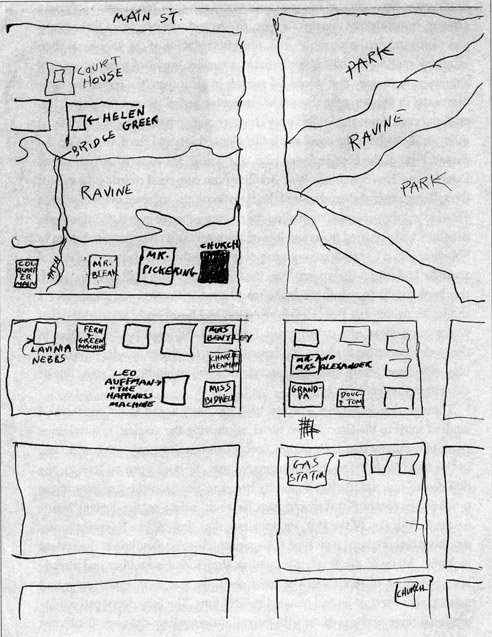 What is striking is that if you look at the real Waukegan from the air - courtesy of Google Earth - you get a very similar image (again, click on image to enlarge):

Walloon has reminded me that there is more information on Bradbury's Waukegan (with lots of excellent links) on this thread of the Bradbury Message Board.
 Bradbury's plays continue to find a home in small theaters across the US. Fahrenheit 451 - his best piece of stage writing in my view - remains a popular choice, probably because of the continuing relevance of its themes of censorship and the dangers of the decline of literacy. An Oregon production is reviewed here.
 Bradbury's own Pandemonium Theatre Company, which he founded in 1964 with director Charles Rome Smith, is the author's main outlet for premiering his plays. The company is currently presenting Ray Bradbury's Autumn People, which actually consists of two almost unrelated plays: 'Pillar of Fire' and 'Touched with Fire'. This South Pasadena production is reviewed here. Nard Kordell, who tirelessly attends many of Bradbury's productions and public appearances, has some great photos from the show.
 The quote above is from a parent, commenting on the children of Bradbury's "The Veldt" plotting and observing the death of their parents.
 This is the latest attempt to get Bradbury removed from the classroom. There is a great irony here: Bradbury has such a deep and intuitive understanding of the child mind, that his stories are ideal for the classroom - and in the US he is very widely taught. But because he writes tales of horror and suspense and often, famously, writes about a future in order to prevent it, he comes under attack from parents and occasionally librarians who would like to protect the innocents.
(Of course, anyone who thinks children are innocent should definitely be reading "The Veldt" and "The Small Assassin", among others.)
For more on the challenge to "The Veldt" (which was rejected, by the way), see this report from the Beaverton Valley Times.
By some quirk of irony, this week is also apparently Banned Books Week, an event sponsored by American Booksellers Association, American Booksellers Foundation for Free Expression, American Library Association, Association of American Publishers, American Society of Journalists and Authors, and the National Association of College Stores. Naturally, Fahrenheit 451 springs to mind whenever we think of banning books, and this report makes the customary mention.
 Bradbury, we are often told, is a storyteller at heart. Of course, people say this about many writers. There are, I think, three things that make this a particularly appropriate characterisation of Bradbury.
 This autumn, Bradbury's home town of Waukegan, Illinois, is staging a storytelling festival in Bradbury's honour. A small town, and a small event. But the emphasis on storytelling is surely correct. This format seems an ideal way to celebrate his works - and to usher in the Bradbury season of Halloween.
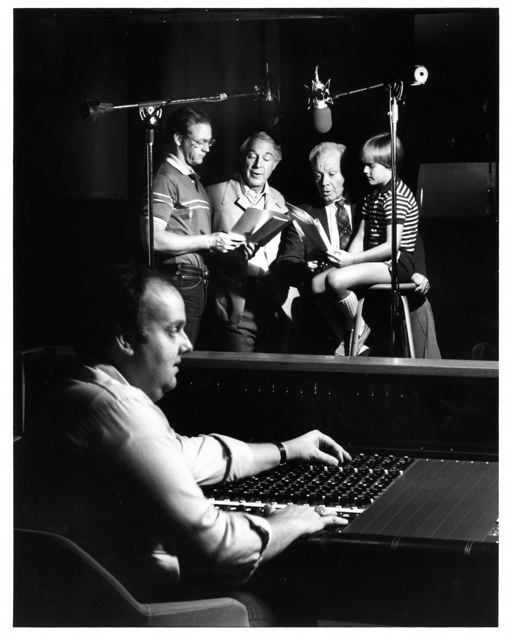 Mike McDonough, creator and producer of the classic radio series Bradbury 13 has very kindly sent me some photos from the production of the show.
 I thought I might regret it, but I paid good money for a copy of that unauthorised biography: Ray Bradbury Uncensored! The Unauthorized Biography, by Gene Beley. As I have mentioned before, I had concerns that this would not be a very solid piece of writing.
 Ray Bradbury made a brief appearance on KPCC Radio, Pasadena, yesterday for this 86th birthday interview, conducted by Patt Morrison.
 Bradbury is best known for his short stories and novels, but less well known for his poetry and plays. And yet there seems to be a Bradbury play in production somewhere in the world at almost any given moment. I have only actually seen one production, the British premiere of Fahrenheit 451, but have also read a number of other Bradbury plays. If you want to read them just for pleasure, a good starting point is On Stage: A Chrestomathy of His Plays, which combines three earlier play collections (The Anthem Sprinters and Other Antics (1963), The Wonderful Ice Cream Suit and Other Plays (1972), and Pillar of Fire and Other Plays (1975)) into a single volume. This one volume contains the following plays:


 Today is Ray Bradbury's 86th birthday. He says he is going to live forever, so he is now one year closer to achieving that aim!
 In the much earlier Dandelion Wine (1957), Douglas Spaulding and his friends sit and listen in awe of Colonel Freeleigh, an old man whose reminiscences are so vivid that they feel transported back to the American Civil War. The old man is a time machine.