Wednesday, March 21, 2007

A Piece of Wood

Several weeks ago I got to see the short film A Piece of Wood, thanks to producer Roger Lay Jr who kindly sent me a review copy. You can read my review of the film here.

Roger and director Tony Baez Milan tell me they are in negotiations for a feature film with a Bradbury connection. I know nothing else about this project, but am hopeful that they will soon be able to tell us more...

Sunday, March 18, 2007

Bradbury 13 news? And a Bradbury documentary.

A company called Strategicom have contacted me, saying that they are working with Mike McDonough on licensing of Bradbury 13. It sounds as if moves are afoot - finally - to get this classic piece of radio drama officially re-released.

As I have blogged previously, Bradbury 13 (most of it, anyway) was once released on cassette, but a CD or official download version has never appeared. I hope this is now about to happen. Watch this space!


Meanwhile, I spotted a new Bradbury documentary DVD on Amazon. Ray Bradbury: Dancing Among the Muses sounds, from a customer review, a rather cheap affair. However, the producers' web page for the DVD makes it seem rather more professional. They have a trailer online (which friend Nard also found on YouTube), which includes Ray telling the familiar Mr Electrico tale. This might be worth further investigation...

Monday, March 12, 2007

The Small Assassin - premiere screening

I can't get there myself - on account of a few thousand miles of ocean being in the way- but the short film adaptation of "The Small Assassin" is shortly to be premiered.

I have some information and links on the film here.

The film is being shown as an evening of shorts from Beverly Ridge Pictures in Chicago, Illinois.

Friday, January 12, 2007

Early Bibliography

I wonder how many Bradbury readers are familiar with William F. Nolan. A successful writer in his own right, Nolan is probably best known as the co-creator of Logan's Run, the popular SF novel (and film, and TV series, and series of books).

But Nolan (pictured left with Forry Ackerman and Ray Bradbury in 1953) was also one of the first to begin keeping detailed bibliographical records of Ray Bradbury's work. In the 1950s, he launched a fanzine/journal called The Ray Bradbury Review. Twenty-odd years later he published a collation of much of this work in a book, The Ray Bradbury Companion. For years, this was the most detailed book on Bradbury's publishing history, and in many respects it is still unsurpassed. Nolan's vast collection of Bradbury materials has been donated to Bowling Green University, Ohio, where it is is accessible to researchers.

Just the other day I stumbled across one of Nolan's earliest Bradbury biblographical pieces, onthe web. FANAC, dedicated to preserving and celebrating the history and publications of SF fandom, has uploaded a 1953 fanzine called Shangri-LA, which includes Bill Nolan's "Ray Bradbury Index".

This particular bibliography is fascinating to me because it captures Bradbury at the peak of his early success: by this time, he had broken out of genre publications and into the "slicks"; he had several books behind him; he had had works adapted for radio and early TV; and he was just breaking into movies. (For more on Bradbury's early experiences of film, see the Spaceman article here.)

"The Ray Bradbury Index" is also remarkable for its detail and accuracy. It gave me cause to cross-check the detail on my own website.

Bill Nolan is still active, and has his own website at www.williamfnolan.com. Last year he was named as Author Emeritus by the Science Fiction and Fantasy Writers of America. And he has been named a member of the Advisory Board of the proposed new Center for Ray Bradbury Studies at Indiana University.

Wednesday, January 10, 2007

Spring Clean

I've been re-arranging the Books section of my site, to make it more useful and easier to navigate. You can now browse books by decade and by type.

I've also added a section on books about Ray Bradbury. This is fairly comprehensive, and includes everything from popular non-fiction books to PhD-style learned treatises, with some High School study guides in there as well.

When time permits, I will be adding more details about some of these books.

Monday, January 08, 2007

Thomas Petitpas

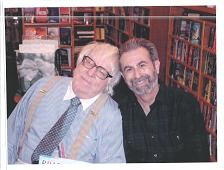
I've recently been in touch with Thomas Petitpas. Tom, pictured left with Ray, until 2004 ran Bradbury's Pandemonium Theater Company, and produced all of the plays. I hope shortly to probe Tom's knowledge of Bradbury on stage, with a view to improving my coverage of this neglected area.

Tom sells comics and assorted stuff through his eBay store. He has a nice line in Bradbury rareties, some of them related to the Pandemonium productions.

Sunday, January 07, 2007

Iconic images

A question on the official Ray Bradbury Message Board got me looking at illustrations of the short story "A Sound of Thunder" (1952). This, you may recall, is Bradbury's classic dinosaur-hunting tale: travel back in time and enjoy the thrill of hunting T.Rex. (Image is by Richard Corben, from The Ray Bradbury Chronicles.)

This is a compelling fantasy. So much so that other writers have trodden the same ground, most famously L. Sprague de Camp in "A Gun for Dinosaur".

Bradbury makes the tale slightly different, by bringing in one of those time paradoxes that the true science fiction fan will happily spend hours debating. Bradbury's twist is that one of the time-travellers steps on a butterfly and screws up the subsequent course of evolution.

Now many have criticised the story for its logical flaws - most famously the editors of Fantasy and Science Fiction who rejected the story on those grounds. (Bradbury didn't care - he sold the story to a 'slick' magazine instead, and made a whole lot more money.) However, defenders of the story, myself included, will tell you that the details of the time travel don't matter one jot. It's the symbolism that's important. Bradbury seems to be saying that little things are important: the way he sets the story up, the fate of the dinosaur is trivial; it's the butterfly that really matters.
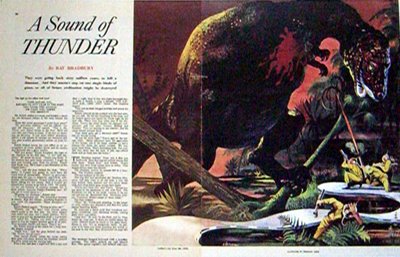

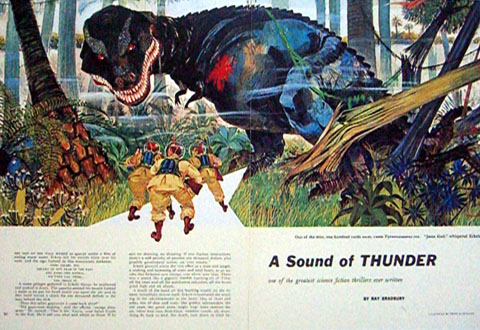
Looking at various visual interpretations of "A Sound of Thunder", I find that most illustrators have gone for the big picture. They show the T.Rex, sometimes dwarfing our time-travellers. That's certainly true of Frederick Siebel, the original illustrator of the Collier's magazine version of the story (June 1952, above). Notice that Siebel gives us the thrill of the hunt. He does also show the all-important pathway which our heroes must stick to - and one of the hunters fatally stepping off the path.
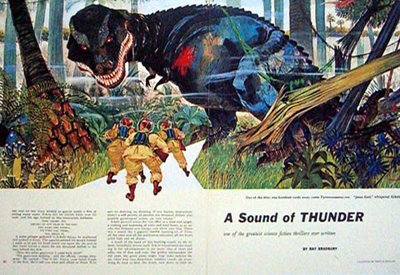


Franz Altschuler, who illustrated the story for Playboy (June 1956, above) follows the same idea, although the chrononauts don't seem quite so concerned in his vision.
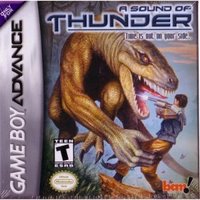


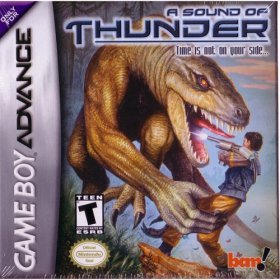
Even the Game Boy game (above) bearing the title of Bradbury's story lingers on the hunt.
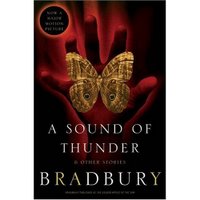


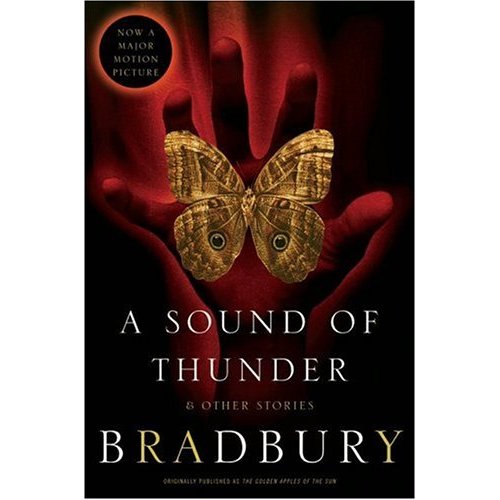
The poster and publicity for the recent film version (not a film I recommend you rush out and see) did get one thing right: emphasising the butterfly. I think this adds to the intrigue of the advertising campaign, especially when the movie trailer hints at sub-Jurassic Park dinosaur CGI. (Image shows the movie poster graphic used on a re-issue of a Bradbury short story collection.)

[For the record, I find the low budget adaptation for TV's Ray Bradbury Theatre to be vastly superior to the Peter Hyams movie. And the radio production for Bradbury 13 is pretty good as well.]
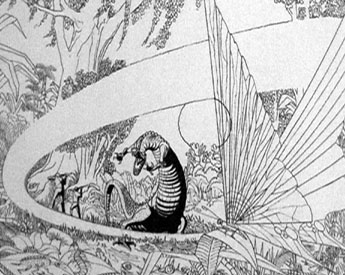


Full marks go to Joe Mugnaini, the quintessential Bradbury illustrator, for achieving such a perfect balance in his line-drawing. Created for The Golden Apples of the Sun, the short story collection that first contained "A Sound of Thunder", his illustration (above) seems to focus on the dino hunt - and his composition uses the pathway as a flourish that frames the tyrannosaur. But look again. See how the butterfly, all translucent wing, dominates the scene.

This, for me, is precisely why Mugnaini worked as Bradbury's best illustrator. He found a way of getting narrative into a single frame, and always gives a new way of looking at a story.

Saturday, January 06, 2007

More Short Films

A remarkable number of Ray Bradbury's stories have been made into short films. Many of these are independent productions, often made by film-makers who are just starting out. Examples include the recent A Piece of Wood and The Small Assassin.

But there have also been quite a few "educational" films, usually aimed at children, and presumably intended for classroom use. Examples include the Learning Corporation of America productions The Electric Grandmother and The Invisible Boy.

I thought I knew about all of these shorts, but new information keeps turning up. I recently had my attention drawn to The Flying Machine, a 16-minute short starring Blade Runner's James Hong (left), and Diane Haak's 1979 version of The Veldt (24-minutes). I haven't seen either of these, and have very little information on them. I hope to see them one day, and would welcome hearing from anyone who knows more about them.

Saturday, December 30, 2006

Old-Time Radio

The first time I ever heard an audio production of a Ray Bradbury story was back in the 1980s. It was a BBC radio dramatisation of Fahrenheit 451. I soon started collecting as many Bradbury recordings as I could lay hands on, either by off-air recording or by trading with other collectors. In those days I was collecting on audio cassette.

Sometime in the 1990s I switched to using miniDisc as my preferred recording format, despite the irritating 80-minute recording limit. (This has been overcome in recent times with the HD incarnation of miniDisc.)

Nowadays its much more convenient to keep everything on computer, so I have slooooooowwwwwwlllllyyy been moving over to MP3 for archiving.

I am reluctant to post complete MP3 recordings on the web, since all of the Bradbury source material is still in copyright. (Some of the older recordings - particularly the American productions - have slipped into the public domain, but the underlying Bradbury writings are still copyrighted.) But there are plenty of other people out there who either don't have my scruples, or who don't know much about copyright laws. Or who just don't care.

I recently came across a rather anonymous site called Acmesoundstation.com. It has no explanations on it of what it is meant to be, or who it belongs to. It carries a large amount of old audio material, including some of Wally K. Daly's BBC science fiction plays (particular favourites of mine for many years).

From trawling through, I have found one Bradbury item (which I already have on CD, as it happens): CBS Radio Workshop's production of 'Season of Disbelief' and 'Hail and Farewell'. This item is unusual in having an introduction written and recorded by Bradbury himself. You can find the MP3 file here, and browse the entire site here.

Tuesday, December 26, 2006

Bradbury for Christmas

BBC radio broadcast a little piece of Bradbury for Christmas. Late on Christmas night they broadcast a radio programme called White Nights, featuring readings of stories and poetry "to reflect the moments between waking and sleeping". One of the readings was of Bradbury's Switch on the Night. You can listen to the entire show by clicking here. To get to the Bradbury section, you may wish to fast-forward approximately 15 minutes. (BBC radio shows are usually only available online for seven days - if that link is dead, you're too late!)

Switch on the Night (1955) was written for children, as an antidote to children's fear of the dark. According to Sam Weller's biography The Bradbury Chronicles, Ray wrote it a week after the birth of his daughter Susan. The baby slept fitfully and tearfully, and reminded Ray of his own childhood fear of the dark. His original manuscript for this work was in the form of a storyboard, with Ray's own sketches to illustrate the text. The published version is professionally illustrated, originally by Madeleine Gekiere. The 1993 edition was illustrated by Leo and Diane Dillon.

Some of the Dillons' superb work can be seen by using the 'Look inside this book' feature at Amazon.com.


I was delighted to hear from Gene Beley, the author of the unauthorised biography of Ray Bradbury. Gene had seen my review comments on his book, and posted a comment on this blog. You can view our exchange of comments here.