Jon Eller's second volume on the life and writing of Ray Bradbury - Ray Bradbury Unbound - is due out in a few days. In addition to his recent blog post for Biographile, Jon has written one for Locus, the science-fiction news magazine. Here, he talks about the discoveries made in researching the book, and the creative challenge of documenting a career in a limited number of pages. The Locus blog is here.
I had the privilege of reading some of the book while Jon was finalising it, and it is a thorough piece of work which captures the whirlwind of Bradbury at his peak, following the successes of Fahrenheit 451 and his film work for Moby Dick and leading into the 1960s.
Ray Bradbury Unbound is available for pre-order in all the usual places: click here to order on Amazon (US); click here to order on Amazon (UK); click here to order from the publisher.
Friday, August 29, 2014
Wednesday, August 27, 2014
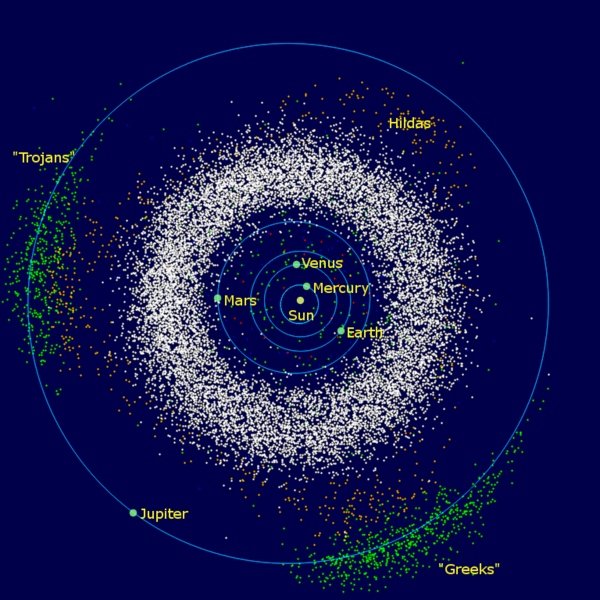
Asteroid 9766 Bradbury
On 24th February 1992, an average-sized asteroid was discovered by Spacewatch observers at the Kitt's Peak Observatory, and designated 1992 DZ2. Eight and a half years later it was given a name: 9766 Bradbury.
Dr Jeffrey Larsen of the Spacewatch Project and the University of Arizona wrote to Ray Bradbury to tell him of this astronomical re-naming. He provided technical details of the asteroid's orbit, and more graspable information such as its size (three to nine kilometres in diameter) and distance from the Sun (2.45 astronomical units). Dr Larsen also informed Ray that the asteroid had not been observed for its physical composition, and thanked Ray "for inspiring me in my youth" through his writing.
Ray immediately faxed Dr Larsen back, exclaiming "Holy Magoly!" He thanked Larsen for "this wonderful baptism" and felt sure that this would earn respect from his four daughters.
Ray Bradbury had been similarly honoured by the Apollo 15 astronauts, who named a crater on the Moon as "Dandelion Crater" in 1971. Shortly after his death, he was astronomically honoured once more, when the Curiosity landing site on Mars was named as "Bradbury Landing".
Friday, August 22, 2014
Ray Bradbury's Birthday
Ray Douglas Bradbury was born ninety-four years ago today.
Even now, two years after he passed away, the fascination with his life and work continues. In a few weeks' time, a second volume of literary biography will be published: Ray Bradbury Unbound by Jon Eller. Shortly after, the second volume of The Collected Stories of Ray Bradbury: a Critical Edition will appear. The successful tribute volume Shadow Show is being developed into a comic-book series. Film composer John Massari has developed his Ray Bradbury Theater music into a symphonic suite. Dramatic Publishing is expanding its list of Bradbury-authored theatre plays with Something Wicked This Way Comes and The Illustrated Bradbury. And this week, the Indianapolis Public Library inaugurated an annual Ray Bradbury Lecture in conjunction with Indiana University's Center for Ray Bradbury Studies.
I think that deserves a round of applause!
Sunday, August 17, 2014
Comic-Book Series: Ray Bradbury Tribute SHADOW SHOW
Comics publisher IDW has announced a five-issue series of comic books based on the Shadow Show anthology.
The original anthology, edited by Mort Castle and Ray Bradbury's biographer Sam Weller, was created as a tribute to Bradbury, and included stories from leading fantasists such as Neil Gaiman and Harlan Ellison.
The new comic will adapt a selection of the anthology's stories, including those by Gaiman, Ellison, Joe Hill and Alice Hoffman.
Full details are on IDW's web page, here.
Thursday, August 14, 2014
Bradbury Wins Retro Hugo
The problem with awards is that they don't always go to the right people. The Hugo Awards - decided on a ballot of the year's World Science Fiction Convention membership - have a way of correcting for this: the Retro Hugos, typically given for overlooked works... but many years after the event.
At this year's Loncon3 convention, the Retro Hugos have been given for the year 1939. This, of course, is long before most of the convention's members were born. But it has given Ray Bradbury a second opportunity to have his works considered for recognition.
Bradbury was on the ballot in two categories:
"Best Short Story" - his amateur story "Hollerbochen's Dilemma" lost out to Arthur C. Clarke's "How We Went To Mars". Perhaps the UK location of this year's Worldcon helped Clarke to win this category...
"Best Fan Writer" - Ray won in this category, where the award is not given for a specific named work, but for a general body of work. Of course, in the late 1930s Bradbury was contributing to a number of fan publications, and was producing his own fanzine, Futuria Fantasia.
I find it quite amusing that Ray Bradbury should win as "best fan writer", particularly since back in 1939 he attended the very first World Science Fiction Convention in New York.
Full details of the Retro Hugo ballot can be found at Tor.com.
Monday, August 04, 2014
Harlan Ellison story dedicated to Ray Bradbury
Harlan Ellison, who turned 80 just a few weeks ago, has a new short story in the online Subterranean Press Magazine. Titled "He Who Grew Up Reading Sherlock Holmes", the story alludes to both Conan Doyle's "The Red-Headed League" and Ray Bradbury's "A Sound of Thunder". The story is also dedicated to the memory of Bradbury. Read the story here.
Harlan is also one of the latest additions to the Archive of American Television's oral history programme, with a video interview conducted in early 2013, covering most of the steps in Ellison's screenwriting career. Interviews in this series are usually continuous and chronological, but for some reason this one has been broken into short, top-and-tailed segments. While this has created some fun sections, it doesn't seem quite as carefully controlled as the rest of the series, and the sense of chronology is sometimes lost - as when Harlan talks about The Twilight Zone from the 1980s in between his comments on the 1960s series Ripcord and The Flying Nun. You can watch the interview here.
Saturday, July 12, 2014
KALEIDOSCOPE returns...
Following hot on the heels of Brian Sibley's radio dramatisation of Bradbury's "Kaleidoscope" (as part of The Illustrated Man for Radio 4's Dangerous Visions season), the archive radio channel BBC Radio 4Extra is today broadcasting a 1991 production of the same story. 4Extra's web page thinks
it's a new production, but it isn't.
"Kaleidoscope" is a classic SF short story, in which a group of astronauts find themselves flung aimlessly through space when their spaceship is destroyed; each one of them faces a slow, isolated death. As I have noted elsewhere, the premise seems to have inspired part of John Carpenter's movie Dark Star and Alfonso Cuaron's recent Gravity.
This 1991 radio adaptation is unusual, because the script is by Bradbury himself. It's a modified version of his stage play, and based on his own original short story. It was only the second BBC production to have used a Bradbury script (the first was Leviathan '99, which I reviewed here.).
The 1991 "Kaleidoscope" was directed by Hamish Wilson, who later co-produced the Bradbury series Tales of the Bizarre. It was also the first BBC production to use digital sampling technology in a drama production: they used a Synclavier to create the complex soundscape.
As with most BBC Radio broadcasts, the show will be available for streaming on the web for seven days, and should be accessible from anywhere in the world. Here's a direct link to the web page: http://www.bbc.co.uk/programmes/b0499l5n
..............................................
Today is also the 91st birthday of science fiction writer, critic and historian James Gunn. I met Jim last year, as I recounted in this blog post. He's still going strong, and last year published a well-received novel, Transcendental.
Saturday, June 14, 2014
Dangerous Visions from BBC Radio 4
Today sees the start of BBC Radio 4's week-long season of science drama Dangerous Visions, which is topped and tailed with adaptations of classic Ray Bradbury books.
Today at 2.30pm UK time, Brian Sibley's dramatisation of The Illustrated Man gets its first airing. You can listen live online from the link below. Alternatively, you can listen on demand for seven days following the broadcast.
The BBC website has some interesting background material on the production, the dramatist and the cast, and the link for listening:
http://www.bbc.co.uk/programmes/b046j2jc
And if you haven't already done so, check out Brian's own blog: every day this week he has posted audio recordings of his previous Bradbury dramatisations - and very good they are, too.
Friday, June 06, 2014
BBC Bradbury
Thursday, June 05, 2014
Two Years On
It's now two years to the day since Ray Bradbury died.
Interest in his work continues, and has perhaps even intensified. Coming soon are:
Meanwhile, in Hollywood, Disney is planning its second attempt to film Something Wicked This Way Comes with Seth Grahame-Smith as writer-director. And in just over a week, BBC Radio 4 will be topping and tailing its season of SF dramas with two new productions based on The Illustrated Man and The Martian Chronicles.
In the last year we have seen academic texts about Bradbury's works:
Finally, we have seen Bradbury's office contents shipped to the Center for Ray Bradbury Studies for preservation future study, and the sale of the Bradbury house on Los Angeles' Cheviot Drive.
A time of change, to be sure.
Onward!
Interest in his work continues, and has perhaps even intensified. Coming soon are:
- the second volume of The Collected Stories of Ray Bradbury: A Critical Edition, 1943-1944;
- the second volume of Jon Eller's literary biography Ray Bradbury Unbound; and
- the fourth issue of The New Ray Bradbury Review.
Meanwhile, in Hollywood, Disney is planning its second attempt to film Something Wicked This Way Comes with Seth Grahame-Smith as writer-director. And in just over a week, BBC Radio 4 will be topping and tailing its season of SF dramas with two new productions based on The Illustrated Man and The Martian Chronicles.
In the last year we have seen academic texts about Bradbury's works:
- About the Arizona and Mars connections - Orbiting Ray Bradbury's Mars;
- About one of his most enduring novels - Critical Insights: Fahrenheit 451.
Finally, we have seen Bradbury's office contents shipped to the Center for Ray Bradbury Studies for preservation future study, and the sale of the Bradbury house on Los Angeles' Cheviot Drive.
A time of change, to be sure.
Onward!
Subscribe to:
Posts (Atom)