Wednesday, January 10, 2007

Spring Clean

I've been re-arranging the Books section of my site, to make it more useful and easier to navigate. You can now browse books by decade and by type.

I've also added a section on books about Ray Bradbury. This is fairly comprehensive, and includes everything from popular non-fiction books to PhD-style learned treatises, with some High School study guides in there as well.

When time permits, I will be adding more details about some of these books.

Monday, January 08, 2007

Thomas Petitpas

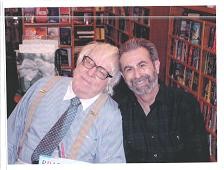
I've recently been in touch with Thomas Petitpas. Tom, pictured left with Ray, until 2004 ran Bradbury's Pandemonium Theater Company, and produced all of the plays. I hope shortly to probe Tom's knowledge of Bradbury on stage, with a view to improving my coverage of this neglected area.

Tom sells comics and assorted stuff through his eBay store. He has a nice line in Bradbury rareties, some of them related to the Pandemonium productions.

Sunday, January 07, 2007

Iconic images

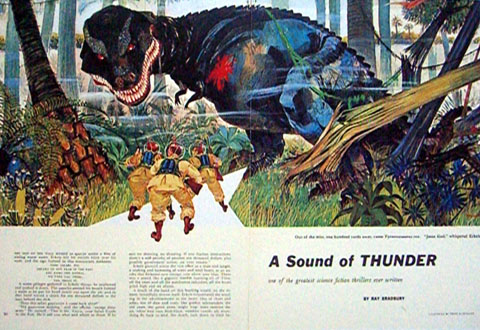
A question on the official Ray Bradbury Message Board got me looking at illustrations of the short story "A Sound of Thunder" (1952). This, you may recall, is Bradbury's classic dinosaur-hunting tale: travel back in time and enjoy the thrill of hunting T.Rex. (Image is by Richard Corben, from The Ray Bradbury Chronicles.)

This is a compelling fantasy. So much so that other writers have trodden the same ground, most famously L. Sprague de Camp in "A Gun for Dinosaur".

Bradbury makes the tale slightly different, by bringing in one of those time paradoxes that the true science fiction fan will happily spend hours debating. Bradbury's twist is that one of the time-travellers steps on a butterfly and screws up the subsequent course of evolution.

Now many have criticised the story for its logical flaws - most famously the editors of Fantasy and Science Fiction who rejected the story on those grounds. (Bradbury didn't care - he sold the story to a 'slick' magazine instead, and made a whole lot more money.) However, defenders of the story, myself included, will tell you that the details of the time travel don't matter one jot. It's the symbolism that's important. Bradbury seems to be saying that little things are important: the way he sets the story up, the fate of the dinosaur is trivial; it's the butterfly that really matters.
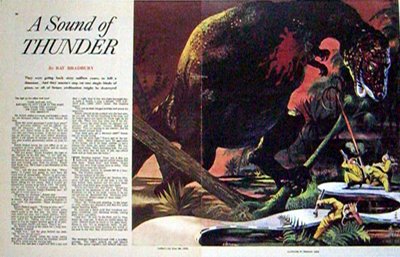

Looking at various visual interpretations of "A Sound of Thunder", I find that most illustrators have gone for the big picture. They show the T.Rex, sometimes dwarfing our time-travellers. That's certainly true of Frederick Siebel, the original illustrator of the Collier's magazine version of the story (June 1952, above). Notice that Siebel gives us the thrill of the hunt. He does also show the all-important pathway which our heroes must stick to - and one of the hunters fatally stepping off the path.
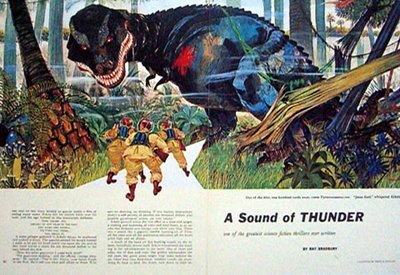


Franz Altschuler, who illustrated the story for Playboy (June 1956, above) follows the same idea, although the chrononauts don't seem quite so concerned in his vision.
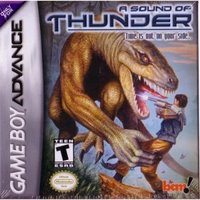


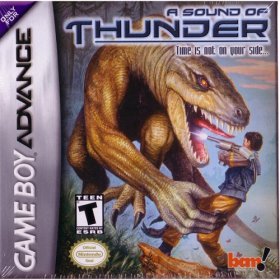
Even the Game Boy game (above) bearing the title of Bradbury's story lingers on the hunt.
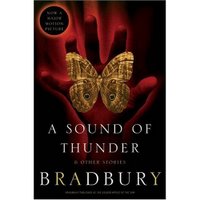


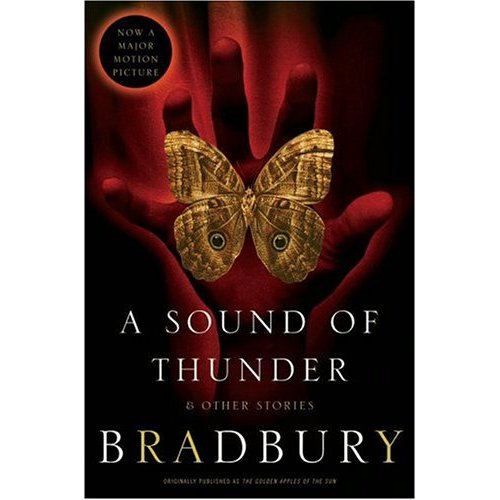
The poster and publicity for the recent film version (not a film I recommend you rush out and see) did get one thing right: emphasising the butterfly. I think this adds to the intrigue of the advertising campaign, especially when the movie trailer hints at sub-Jurassic Park dinosaur CGI. (Image shows the movie poster graphic used on a re-issue of a Bradbury short story collection.)

[For the record, I find the low budget adaptation for TV's Ray Bradbury Theatre to be vastly superior to the Peter Hyams movie. And the radio production for Bradbury 13 is pretty good as well.]
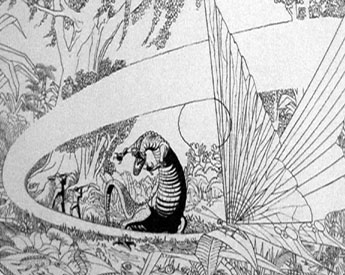


Full marks go to Joe Mugnaini, the quintessential Bradbury illustrator, for achieving such a perfect balance in his line-drawing. Created for The Golden Apples of the Sun, the short story collection that first contained "A Sound of Thunder", his illustration (above) seems to focus on the dino hunt - and his composition uses the pathway as a flourish that frames the tyrannosaur. But look again. See how the butterfly, all translucent wing, dominates the scene.

This, for me, is precisely why Mugnaini worked as Bradbury's best illustrator. He found a way of getting narrative into a single frame, and always gives a new way of looking at a story.

Saturday, January 06, 2007

More Short Films

A remarkable number of Ray Bradbury's stories have been made into short films. Many of these are independent productions, often made by film-makers who are just starting out. Examples include the recent A Piece of Wood and The Small Assassin.

But there have also been quite a few "educational" films, usually aimed at children, and presumably intended for classroom use. Examples include the Learning Corporation of America productions The Electric Grandmother and The Invisible Boy.

I thought I knew about all of these shorts, but new information keeps turning up. I recently had my attention drawn to The Flying Machine, a 16-minute short starring Blade Runner's James Hong (left), and Diane Haak's 1979 version of The Veldt (24-minutes). I haven't seen either of these, and have very little information on them. I hope to see them one day, and would welcome hearing from anyone who knows more about them.

Saturday, December 30, 2006

Old-Time Radio

The first time I ever heard an audio production of a Ray Bradbury story was back in the 1980s. It was a BBC radio dramatisation of Fahrenheit 451. I soon started collecting as many Bradbury recordings as I could lay hands on, either by off-air recording or by trading with other collectors. In those days I was collecting on audio cassette.

Sometime in the 1990s I switched to using miniDisc as my preferred recording format, despite the irritating 80-minute recording limit. (This has been overcome in recent times with the HD incarnation of miniDisc.)

Nowadays its much more convenient to keep everything on computer, so I have slooooooowwwwwwlllllyyy been moving over to MP3 for archiving.

I am reluctant to post complete MP3 recordings on the web, since all of the Bradbury source material is still in copyright. (Some of the older recordings - particularly the American productions - have slipped into the public domain, but the underlying Bradbury writings are still copyrighted.) But there are plenty of other people out there who either don't have my scruples, or who don't know much about copyright laws. Or who just don't care.

I recently came across a rather anonymous site called Acmesoundstation.com. It has no explanations on it of what it is meant to be, or who it belongs to. It carries a large amount of old audio material, including some of Wally K. Daly's BBC science fiction plays (particular favourites of mine for many years).

From trawling through, I have found one Bradbury item (which I already have on CD, as it happens): CBS Radio Workshop's production of 'Season of Disbelief' and 'Hail and Farewell'. This item is unusual in having an introduction written and recorded by Bradbury himself. You can find the MP3 file here, and browse the entire site here.

Tuesday, December 26, 2006

Bradbury for Christmas

BBC radio broadcast a little piece of Bradbury for Christmas. Late on Christmas night they broadcast a radio programme called White Nights, featuring readings of stories and poetry "to reflect the moments between waking and sleeping". One of the readings was of Bradbury's Switch on the Night. You can listen to the entire show by clicking here. To get to the Bradbury section, you may wish to fast-forward approximately 15 minutes. (BBC radio shows are usually only available online for seven days - if that link is dead, you're too late!)

Switch on the Night (1955) was written for children, as an antidote to children's fear of the dark. According to Sam Weller's biography The Bradbury Chronicles, Ray wrote it a week after the birth of his daughter Susan. The baby slept fitfully and tearfully, and reminded Ray of his own childhood fear of the dark. His original manuscript for this work was in the form of a storyboard, with Ray's own sketches to illustrate the text. The published version is professionally illustrated, originally by Madeleine Gekiere. The 1993 edition was illustrated by Leo and Diane Dillon.

Some of the Dillons' superb work can be seen by using the 'Look inside this book' feature at Amazon.com.


I was delighted to hear from Gene Beley, the author of the unauthorised biography of Ray Bradbury. Gene had seen my review comments on his book, and posted a comment on this blog. You can view our exchange of comments here.

Friday, December 08, 2006

Coming soon...

Despite the expected rapid inset of winter, here in the UK the tabloids are full of photostories about summer plants which are still in bloom. I can't say I have personally seen any roses still in flower, but I did today see some dandelion flowers (on next door's lawn).

So maybe it's not a bad time to mention that Colonial Radio Theatre's CD of Dandelion Wine is nearly ready for release. I have covered this extensively in recent months, so I'll leave you to explore the archives for the relevant stories.

Suffice it to say that Colonial have unveiled the final artwork for the CD (pictured here). Sample clips from the CD, and ordering information, can be found on Colonial's website.

Saturday, November 11, 2006

Jack Williamson 1908-2006

Jack Williamson, the science fiction writer, critic and academic, died yesterday at the age of 98.

Ray Bradbury says that Williamson was one of the first professional writers to help him in his career. In a 2000 interview he said:

"Jack is a wonderful man, a terrific man. He was very kind to me when I was 19 years old. He read my stuff long before Leigh Brackett did, and it was really bad in those days...Jack started publishing in magazines when I was about 7 or 8 years old...I couldn't afford to buy the magazines, but I borrowed copies from friends on occasion, and I read Jack Williamson first."

[Interview source: SciFi.com]

There is a good account of Jack's life and works here:
http://en.wikipedia.org/wiki/Jack_Williamson

Thursday, November 02, 2006

Nigel Kneale, 1922-2006

Nigel Kneale has died at the age of 84.

Kneale was one of the great British SF screenwriters, creator of the wonderful Quatermass series from the days of live TV (the greatest instalment of which was Quatermass and the Pit - get the beautifully restored original TV version on DVD, far superior to the Hammer movie remake of the late 1960s). Kneale also did a startlingly good adaptation of Orwell's Nineteen Eighty-Four for the BBC in the 1950s, and some remarkable, prescient single plays through the '60s and 70s: "The Year of the Sex Olympics" has some uncanny resonances with today's television; "The Stone Tape" still packs a few scares and shocks.

Kneale's influence was enormous, and to a large extent he defined the limits of acceptable/respectable SF in British TV. (It's hard to imagine that there could have been a Dr Who without his trailblazing efforts for the genre.)

Like Ray Bradbury, Kneale crossed genres without hesitation. His science fiction was filled with horror, his horror often scientifically rationalised, all of it delivered with an element of fun. In the latter part of his career he even wrote a sitcom, the unusual (and, to be honest, not very funny) Kinvig.

He will be missed.

Wikipedia has a good biography of Kneale, and this obituary from The Independent reminds me that Kneale made significant non-genre contributions to British film, with work on Look Back in Anger and The Entertainer.

Wednesday, November 01, 2006

Dandelion Wine

Just when you thought you had the seasons all figured out; just when the dandelions have died back; just when you have said Farewell Summer, celebrated autumn with The Halloween Tree and contemplated celebrating further with a re-read of Something Wicked This Way Comes...

It's summer again! When? Just after Christmas. New Year.

Confused? Then I'll explain.

On 1st January 2007, Colonial Radio Theatre releases its CD audio production of Dandelion Wine. Taken from Bradbury's stage play, rather than directly from his novel, it brings Doug Spaulding, Tom, Colonel Freeleigh and co to life in a lavish audio production. You can hear some clips from the CD on Colonial's web site.

Colonial were kind enough to send me a review copy, so I have written a review which you can read here.


Meanwhile, back in the real world of (post-) Halloween, Utah-based radio station KUER-FM has recently broadcast a live dramatic production of Bradbury's short story "Zero Hour". Staged and performed by Plan B Theatre Company, this production used Anthony Ellis' 1955 Suspense script, which can be viewed online here, courtesy of Generic Radio Workshop.

"Zero Hour" was presented as part of the RadioWest show on KUER, as second half of a double-bill with Lucille Fletcher's "The Hitch-Hiker". You can listen to/download an MP3 recording of the entire show here. (I don't know how long KUER keep their archived shows, so best to listen now while it's still there!)