Monday, June 04, 2012

Sage Advice


The website Venture Galleries has put together "Ray Bradbury's Primer for Writers", a neat summing up of typical advice Bradbury gives to would-be authors, based on his life's experience and achievements. There's not much here that's new, and most of the points can be found in Bradbury's book Zen and the Art of Writing and in the many interviews Bradbury has given over the years. Nevertheless, this is a neat encapsulation of the best points.Or, you could read an almost identical encapsulation here!

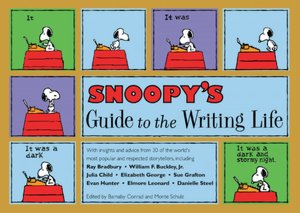
Snoopy's Guide to the Writing Life is slightly different: famous writers are asked to respond to a Snoopy Cartoon. You can read more about the book - and Ray Bradbury's contribution to it - here.

Saturday, June 02, 2012

Bradbury News

Stuart Gordon is a film director best known for Re-Animator and other horrors of a Lovercraftian variety. Somewhat incongruously, he was also responsible for a Los Angeles stage production of Ray Bradbury's play The Wonderful Ice Cream Suit, and he subsquently directed the Disney feature film from a screenplay by Bradbury himself.

Gordon answers questions about his work and life in relation to his adopted home of Los Angeles on the website of KCET.


Bradbury's hometown of Waukegan is once again celebrating the Ray Bradbury Dandelion Wine Fine Arts Festival. Now in its thirteenth year, it involves a day of creative activities in the city's Bowen Park. Details can be found here.


Website iPulpFiction.com is running a summer reading celebration on the theme of 90 stories in 90 days. Stories can be read online for a small fee (typically 50 US cents each). Two rare Ray Bradbury tales are included:

The1944 short story "The Silence"  - an uncollected story which has rarely seen print since its debut in Super Science Stories in October 1944.

The 1949 short story "The Changeling" - more familiar, this one is available in Bradbury Stories, but made its debute in Super Science Stories in July 1949.

There is a press release about this event here, and you can access the stories here.

Thursday, May 31, 2012

Good news and bad news

I've been way to busy to blog just lately, but had to break the silence to comment on two events of this past week.

The good news is that The New Yorker has just published a special science fiction issue. After decades of ignoring the genre, it has now decided that there is something worth investigating. There are items in there from Ray Bradbury, Ursula LeGuin, China Mieville and Margaret Atwood, which in a way suggests a fairly good sensibility about the genre: a couple of classic writers from within, but whose reputations have spread beyond genre boundaries; and a couple of more recent writers who have figured in a lot of debate about those boundaries.

Except...

Then they go and spoil it all, by saying something stupid like "sci-fi".

I haven't actually laid hands on the issue yet, but the table of contents (and some sample content) is available on the New Yorker website. Incidentally, the last time The New Yorker published an item with the byline "Ray Bradbury" was in 1947, when they premiered Bradbury's short story "I See You Never". The story was later selected for Best American Short Stories, and is these days familiar as a tale from The Golden Apples of the Sun.


The second event I want to comment on is the sad news of the passing of the artist Leo Dillon. Leo and his wife and collaborator Diane are best known for their illustrations for children's books and for science fiction and fantasy stories. For Bradbury, they illustrated his children's story Switch on the Night, and a number of other projects. There is a collection of Dillons/Bradbury images at the Art of Leo and Diane Dillon blog.


The Dillons are also, for me, inextricably linked to the work of Harlan Ellison: they illustrated the covers of his books quite extensively, as you can see from this collection of images on the Art of Leo and Diane Dillon blog. Leo's most recent work for an Ellison story was on the Dillons' illustration for Ellison's Nebula Award-winning short story "How Interesting, A Tiny Man":


I had often wondered about how Leo and Diane approached their collaborations, and indeed what motivated them to collaborate in the first place. Some answers are given in the New York Times obituary for Leo, which tells a fascinating story of two artists who started out as rivals, only to later find that their combined talent was greater than the sum of its parts.

Monday, April 30, 2012

Vacation in the Golden Age & New Artwork

I have mentioned before the ambitious blogging project of author Jamie Todd Rubin: to review the classic era of Astounding Science Fiction magazine, issue by issue, starting with the July 1939 edition.

Jamie has now reached July 1942, when Astounding published the first of three Bradbury stories. "Eat, Drink and Be Wary" is a very slender story, which Bradbury submitted for the "Probability Zero" section of the magazine. This section was editor John W. Campbell's place for publishing short-shorts from new writers. I believe there was no payment for appearing in this column; the reward for the writers' efforts was publication!

Jamie's review includes the Bradbury piece, and detailed reviews of all the longer pieces in the magazine, which include efforts from such SF luminaries as A.E. Van Vogt and L. Sprague de Camp.


Patrick Leger is the artist responsible for the artwork on the recent Simon & Schuster editions of Bradbury's The Illustrated Man and The Martian Chronicles. What I hadn't realised was that Leger's design decisions were consciously influenced by Joe Mugnaini. Mugnaini's artwork is inextricably linked to Bradbury's fiction through the iconic cover of Fahrenheit 451 and over books, and through the line drawings he produced for Golden Apples of the Sun.

Leger talks about his new designs in his blog, and includes some of his preliminary sketches.

Thursday, April 26, 2012

After the rain, the sun!

Bradbury's well known story "All Summer in a Day", in which the sun only appears for a very short time (just like a typical British summer), is the inspiration for a full-length dance by the Red Bucket Dance Company. If I have read the story correctly, this group is based in Sacramento, California. More information, including dates and times of performances are in this story from Newsreview.com.

Meanwhile, in West Hollywood poets are performing Bradbury at an event which is part of the Big Read programme. Details are here.

Elsewhere (I don't know exactly where, because the web page gives absolutely no details!) somebody is rehearsing Bradbury's play Kaleidoscope, based on his short story of the same name. How do I know this? Because there are thirty-six photos here!

[Update: I have now realised that those Kaleidscope photos have captions! The first one tells us the following: Actors run a dress rehearsal of "Kaleidoscope", an adaptation of two Ray Bradbury radio plays, Wednesday night in Lafayette. The show will run April 26-29 and May 3-6 at 7 p.m. each night at Theatre 810 in downtown Lafayette. By Leslie Westbrook April 18, 2012.  I don't know where Lafayette is, but I'm guessing California.]

Wednesday, April 25, 2012

Rain!

This is England, and so rain is hardly unexpected. Especially in April, the month traditionally associated with showers.

However, we haven't had very much rain - statistically and historically speaking - in the last two years, and so the Authorities (with a capital A) have declared an official drought. This must be laughable to those who live in, say, Ethiopia. All it means is that the UK water table is at a low level for the time of year, and if the dry spell keeps on we will faced with water shortages very soon. Several areas of the UK are under a hosepipe ban right now, meaning it is against the law to use a hosepipe or sprinkler to water that front lawn.

And, right on cue, it started raining about a week ago and has barely stopped. Today especially there has been an almost endless torrent where I am. It reminds me, of course, of the Bradbury story "The Long Rain".

"The Long Rain" first appeared in Planet Stories magazine in1950. Today you can find it in Bradbury's collections R is for Rocket and The Illustrated Man. It's set on the planet Venus, and is built on the science fiction conception of Venus as some kind of lush rain forest. The story deals with an astronaut who has to travel through the endless rains of Venus to reach the safe haven of a Sun Dome.

If you are stuck indoors, staring out at the rain and wondering what to do, you could always try a bit of homework. Here's a lesson-plan found online which should prompt you to start writing your own story in the style of Bradbury!

Thursday, April 19, 2012

Bradbury news

Sam Weller, Bradbury's biographer, was quoted recently as saying that Bradbury is the most important writer of the last one hundred years. I'm not going to argue with that. Full details can be found in this report from the Lake County News-Sun, the newspaper that serves Waukegan, Illinois and the surrounding areas.

- - - - - - -

There's been a video of a 2001 Bradbury lecture on YouTube for a very long time, but just lately I've seen dozens of new places linking to it - as if it were a new lecture or a new find.  I'm not going to re-link to it directly, but I will link to two web pages which have condensed some of Bradbury's content. Here you will find, derived from the lecture, Bradbury's twelve pieces of advice to young writers. And here, Bradbury's recommended reading. I confess to having read just a few of the authors he mentions (Collier, Welty and Wharton, since you asked).

- - - - - - -  

From Monsters from the Vault magazine, a bit of free reading: Terry Pace's article entitled "Ray Bradbury's Earliest Influences" discusses Bradbury's early childhood experiences watching Lon Chaney.

- - - - - - -


Monday, April 16, 2012

Searching for Bradbury's "The Crowd"

Although Ray Bradbury is a fantasist, occasionally you hear of one of his works of fiction being inspired by real-life events. One classic example is the short story "The Crowd", which deals with a ghoulish, apparently supernatural crowd of people who gather at car crashes.


The story is supposedly inspired by an incident Bradbury witnessed in Los Angeles in his teens. Bradbury's biographer Sam Weller, writing in The Bradbury Chronicles, describes it like this:


[...] in 1935 Ray was visiting Eddie Barrera at his house on Washington Boulevard when they heard a terrific crash outside. The boys bounded out the front door and saw a smoldering car about a hundred yards up the street, in front of a cemetery. The car had hit a telephone pole head-on and the passengers had been catapulted onto the pavement. [...] Three people had already died; another - a woman - was barely alive.


It was the sight of this woman that created a vivid memory that compelled Bradbury to think about the event over and over until, some eight years later, he was inspired to produce "The Crowd", which was first published in Weird Tales in May 1943. Today, you can find the story in The Stories of Ray Bradbury.

In The Complete Stories of Ray Bradbury: a Critical Edition, Jon Eller gives a little bit more information: that Bradbury was  located at Washington Boulevard [Eller says Avenue, but there is no Washington Avenue in LA] and Berendo Street. Armed with this information, and Google Maps, this allows us to work out where the crash must have taken place: outside Rosedale Cemetary. The nearest part of the cemetery is about a hundred yards from the corner of Berendo and Washington.


View Larger Map


I thought I would try to locate detailed information about this car crash. Such an incident must surely have made the local press, I thought.

Searching through the online archives of the Los Angeles Times for 1935, I found just one news story that contained details of a car crash and a reference to Berendo/Washington, reported on 1 May 1935.

Unfortunately, none of the content ties in with Bradbury's recollection. The headline, "AUTOS TAKE TWO LIVES", gave me hope that this was indeed the account of the source of "The Crowd". But alas this one brief news story tells of two separate road traffic accidents happening the day before, both being incidents where pedestrians were hit by cars... and reports a conviction for manslaughter due to dangerous driving in another incident... and reports on a police officer being struck by a motorcycle and sidecar... and reports on a court appearance by a man arrested for drunk driving... and on and on.

I was forgetting. This is Los Angeles. The home of the road traffic accident, even in 1935.

No wonder Bradbury was always afraid to drive, and became a champion of public transport!

Friday, April 13, 2012

Live Forever... again!

I blogged recently about Michael O'Kelly's submission of a short film Live Forever! to a festival. Well, now there's more to add to the story. According to the Ventura County Star, there's a full-length documentary in the works, based around the interviews O'Kelly and his son have been conducting with Ray Bradbury over the last five years or so. Joe Mantegna is to narrate, and in fact recorded for the film on Wednesday of this week. Also featured is Malcolm McDowell. The full story is here.

O'Kelly's fifteen minute teaser film is now on Youtube, and for you convenience I am embedding it here.


Wednesday, April 11, 2012

Destino Galaxia

Other than the odd phrase that I can figure out due to a resemblance to French or Latin, I speak no Spanish. I therefore offer no explanation for the following other than this: I found it on the web. Enjoy!

Destino Galaxia!


Hannes Bok was an artist and writer, and friend of Bradbury when they were both trying to establish themselves professionally, back in the late 1930s. This brief article from Antique Trader discusses Bok's art and career, and identifies Bradbury as a critical component in Bok's getting started.


Occasionally, I stumble across a reference to a published work about Bradbury which turns out to be a phantom: something that was never existed, or was perhaps scheduled for publication but never actually made it. I was amused to see author David Kubicek briefly explain that something he wrote in college has become such a phantom. It probably exists in physical form somewhere, but certainly has never seen publication, but this doesn't stop Amazon tantalisingly cataloguing it as if it were an out-of-print book.