Saturday, August 24, 2013

"Onward!"


Onward!

Why "Onward!" ?

Well, it has connotations of moving forward, running ahead to meet the future head on, not giving up, not standing still... things that are echoed in Bradbury's writing, especially in his essays...

But mainly it was what he wrote when he signed books (and other items) for people, such as my only autographed Bradbury book:


Thursday, August 22, 2013

Ray Bradbury's Birthday


Today is 22nd August 2013.

93 years ago today, Ray Bradbury was born. 

60 years ago this year, one of his finest works was published: Fahrenheit 451.


Onward!


Sunday, August 18, 2013

F451 Critical Volume

Coming soon from Salem Press:


With luck, I shall be in there with a chapter on adaptations of Fahrenheit 451. More details on the volume here - and an explanation of the series concept here.

Thursday, August 15, 2013

Los Angeles Event - one week from today


From Steven Paul Leiva, the man behind Ray Bradbury Week in 2010: an event for 22 August, the 93rd anniversary of Bradbury's birth.


Tuesday, August 13, 2013

Old Cork, New Bedford

The small Irish town of Youghal, County Cork, stood in for New Bedford in the 1956 film version of Moby Dick, written by Ray Bradbury and John Huston.

When I was looking at "widow's walks" recently, it occurred to me that the rather fake looking widow's walk in the film was probably a production designer's add-on to a real house. So I thought I would go looking for that house, courtesy of Google Street View.

And what do you know, the place hasn't changed much. The widow's walk is long gone - taken down the day after shooting I expect - but the building remains. It is still happily trading on Youghal's five minutes of movie fame: it is now the Moby Dick pub.

Here's the two glimpses of the widow's walk in the movie:


Notice the old movie trick of concealing the buildings as much as possible (with ships in this case) so as to save on the amount of dressing required on the facades. Notice, too, that the closer shot clearly shows timber cladding on the walls, making the building(s) seem appropriate for New Bedford.

Here, on the other hand, is the same building today (or when Google's camera car last went past).


There are some more photos of the Moby Dick , including signs mentioning both John Huston and Gregory Peck, on this Google Plus photos page belonging to Martin Zima.

A couple of years ago, a small film-making crew recreated some of the Youghal scenes from the film. You can read the story and view some photos here. For photos from the shoot of the original film, watch this excerpt from an RTE documentary on John Huston:


Apparently, when in Youghal, you should drop in to Moby Dick's for a pint of Murphy's...


As the Pequod finally gets underway, it leaves New Bedford behind. The last we see of the place is a lighthouse and the headland across the bay. Of course, it's Youghal lighthouse we see in the film...


... as we can see from this Google Streetview image, which is almost an exact match:


Sunday, August 11, 2013

Something Fishy This Way Comes


One of the finest aspects of the 1956 film version of Moby Dick, written by Ray Bradbury and John Huston, is the art direction supervised by Ralph Brinton. The story holds off from showing Moby Dick until the final scenes, but imagery of the whale is ever-present throughout. Here are some of those fishy moments.

(And yes, I know a whale is not a fish. But try telling that to Jonah.)


Huston's main credits, backed by a painting of an upturned sperm whale. This is one of the few films to have spoilers in its title sequence...


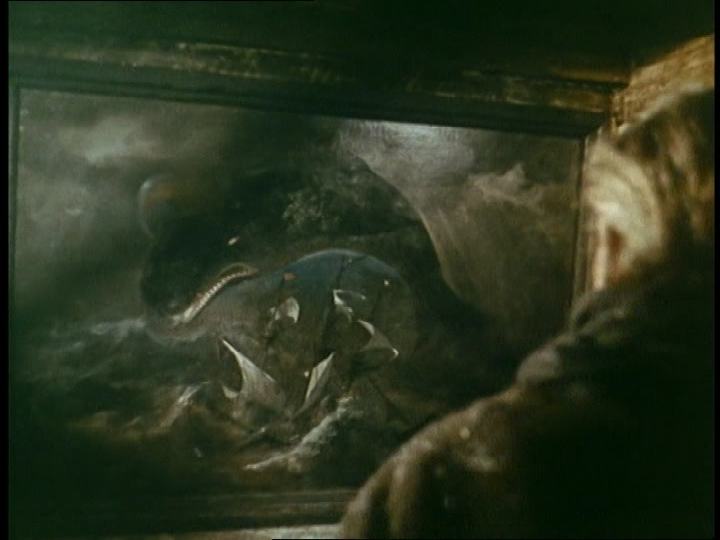
Ishmael's first glimpse of a whale, in the painting in the Spouter Inn. "Can whales do that?" he asks. He will find out later.


Queequeg enjoys the pictures in a book, but cannot read. Ishmael helps him out.


Signing on as crew of the Pequod: beneath Ishmael's signature, Queequeg's sign of the whale.


The tiller of the Pequod, made from the jaw of a sperm whale.


Here there be whales: Ahab's intricate and detailed charts obsessively chronicling the movements of Moby Dick.


Thar she blows! The white whale finally appears, and swallows up Ahab's boat.


What a fluke: Moby Dick's final actions, after ramming the Pequod, creating a mighty whirlpool which will swallow up everyone and everything except Ishmael.


Friday, August 09, 2013

Where Does A Widow Walk?

In Ray Bradbury's screenplay for Moby Dick (1956), there are some elaborate camera "leaps" when the Pequod is setting sail. First mate Starbuck looks across the harbour, and then we take a series of jumps - just cuts really, but Bradbury describes them as "steps" - to get closer to Starbuck's wife.

First we see her as a figure standing on a "widow's walk". Then, closer, as a solitary figure dressed in black, her dress fluttering in the wind. Then, closer still, we are looking over her shoulder out to sea. In the far distance is Starbuck aboard the Pequod.

Then the camera reverses its series of steps, back to Starbuck's point-of-view.

The sequence helps to humanise Starbuck, which is part of Bradbury's grand plan for the screenplay. It serves to set him apart from the rest of the crew - whose wives, mothers and significant others hang around on the quayside. And it acts as an ill omen: she's dressed funereally,and stands on a widow's walk.

Director John Huston found no use for this sequence, and so in the finished film we just get a shot of Starbuck looking up and off, a cut to a distant shot of his wife and family, and then a cut back to Starbuck.

In fact, the shot is so brief - and the figures quite indistinct when viewed on DVD, and the shot slightly cluttered by the mast and rigging in the foreground - that I have never really registered what we are looking at.

It's only when reading Bradbury's screenplay that I realised that the strange fenced-off area we see sitting on top of that distant roof is a "widow's walk".  Apparently, they are a common feature of coastal architecture in North America, although the idea that they are primarily for looking out to sea maybe a myth: as John Ciardi reported on NPR in 2006, they were usually constructed around chimneys, and were more likely used to help put out chimney fires.

The widow's walk shown in Moby Dick doesn't seem to be built around a chimney, unless it's a tiny chimney. It looks as if it was added to a building specifically to give Mrs Starbuck and kids somewhere to stand while they wave daddy Starbuck off.

Even without using Bradbury's conception for this scene, Huston still managed to get a sense of foreboding and dread, by making the other wives look as miserable as sin:


Wednesday, August 07, 2013

Sometimes Ohio is not Mars

I've never been to Ohio, but I have a couple of mental images of what it must be like. One mental image is based on fragmentary images I have seen in film and TV, probably of Cleveland and Cincinatti. The other is from Bradbury's The Martian Chronicles - where our main glimpse of Ohio is a fantasy: made real by  Martians, out of memories of the crew of the third expedition to Mars.

Admittedly, that is going to be one very distorted image...

In the Cape Gazette, Denis Forney tells of his recent "Ray Bradbury ride across Ohio", a cycle journey through the heartland of the state. What he saw is a combination of stunning scenery and post-industrial landscape. He mentions that some of the buildings still evoke the old Bradbury image of the state, but the photographic evidence suggests that it has moved on somewhat - if indeed it ever did look anything like Bradbury's characters recalled.

You can read Forney's photo essay here.

Monday, August 05, 2013

Bradburyesque... 3

The band in Heaven's album Caught in a Summer Swell, coming soon from Decades Records, shows a clear influence from Ray Bradbury... at least in the titles of the opening and closing tracks on the album.

The opening track is "Dandelion Wine", and the closer is "Farewell Summer". The former, of course, is named after Bradbury's 1957 novel. The latter is named after its 2006 sequel.

"Dandelion Wine" is out now, and has a video to accompany it, although it must be said that the imagery of the video owes more to the "summer of love" and pagan ritual (and maybe even The Wicker Man!) than it does to Bradbury. See for yourself...


Saturday, August 03, 2013

Bradburyesque... 2

Some current and forthcoming books with a touch of Bradbury about them:


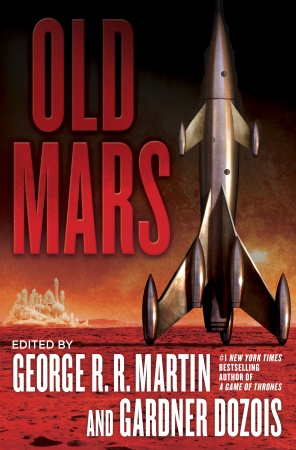
Old Mars, edited by George R.R. Martin and Garner Dozois, is an anthology of new stories set on the old red planet. Not, Martin says, the pre-Mariner real Mars, but the pre-space age, science-fictional Mars. The book is released in October from Bantam... and a sequel, Old Venus is already in the works.

Contributors include Phyllis Eisenstein, Joe R. Lansdale, Ian McDonald, Michael Moorcock, Melinda Snodgrass and Howard Waldrop.

On her Facebook page, Melinda Snodgrass wrote "It's a very retro book. It's Mars as it was imagined by the pulp writers. Oddly, I ended up writing the Bradburyesque story." So there you have it: while some of the stories might be more aligned with Edgar Rice Burroughs or even H.G. Wells, at least one of them is officially Bradburyesque!


Another book with some Bradbury content is "50 Girls 50" and Other Stories from Fantagraphics. This collects a number of comic strips by Al Williamson, originally published in the old EC Comics. The contents include Williamson's adaptations of  Bradbury's “I, Rocket” and “A Sound of Thunder”. It's not the first time these have been published in book form, but it's good to see them being made available again.