Monday, April 27, 2020

Lockdown Choices - Issue #8: Dandelion Wine

This is the eighth in a new series of posts, my Lockdown Choices, where I seek to entertain you while in coronavirus-isolation, and remind you of Bradbury's great works in this, his centenary year.

In these posts, I cover each of Ray Bradbury's books, say something about the contents, then pick the best stories and adaptations.

Lockdown Choice #8: Dandelion Wine
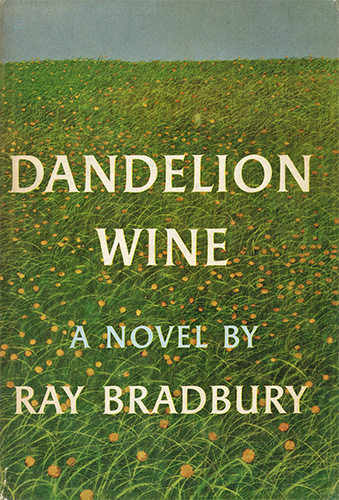
First edition, Doubleday 1957. Cover design by Robert Vickrey.


The Book

Dandelion Wine was Ray Bradbury's first book for Doubleday in four years, the last being 1953's The Golden Apples of the Sun. In the interim, he had published a children's book through a specialist publisher and two books with Ballantine. Although it may look like he had gone away from Doubleday and then come back, in reality it was a case of Dandelion Wine being delayed because he was having trouble finishing it.

Bradbury's original concept for what became Dandelion Wine dates back to the mid-1940s. He drafted various brief outlines - often just a list of short story titles - called The Small Assassins, The Wind of Time, The Blue Remembered Hills and Summer Morning, Summer Night. The project evolved from being a set of stories about children and childhood, to including a conflict between children and the elderly. As with The Martian Chronicles, various short stories would be written and published first, as the book gradually came together as another of Bradbury's "composite novels" or "novelised story-cycles. (See my blog post on The Martian Chronicles for more on this concept.) The end result is a partly-biographical story of one summer in the life of young Douglas Spaulding.

By the 1950s, Bradbury had published a number of the short stories, but still had very little of the linking material that could tie everything together into anything resembling an overall narrative. We can only assume that, once again, he was being driven to create a "proper" novel either from his sense of what consititutes the true output of an author, or that he was being steered to the novel form by his editor. That editor, Walter Bradbury (no relation), was in fact convinced that Summer Morning, Summer Night would be a breakthrough book for Ray, his big opportunity to escape from the genre ghetto(es) that had both started and restricted his career.

Since the Dandelion Wine stories were mainly "realist" (rather than science fiction or fantasy), Bradbury was able to place them in all kinds of magazines. The short story called "Dandelion Wine" appeared first in this issue of Gourmet: the Magazine of Good Living!


Through all this time Bradbury referred to his novel-in-progress, with its fluctuating title, as "the Illinois novel", a shorthand reference to the setting of this semi-autobiographical work. The specific setting was, of course, the fictitious Green Town, a thinly disguised portrayal of Ray's real hometown of Waukegan.

By 1954, Ray had a mass of story material, with way too many characters and plot threads for a single novel. Where he been able to get away with this in The Martian Chronicles because of the enormous spatial and temporal dimensions of that book (it tells the story of two whole planets over a span of thirty years), it would just be confusing with only the small scale of Green Town and one summer as a setting.

Things began to focus in a New York meeting between Ray, Walter Bradbury, and Ray's agent Don Congdon. The three discussed various ways forward, with a proposed three-pronged assault on the overlong text: Ray should trim out some of the characters (and merge some others); he should make the book less episodic, by spreading some of the stories out throughout the book; and he should develop and enrich the secondary child characters, the ones who the central characters Tom and Doug interact with. But even with these three resolutions, Ray struggled to make the book work.

"Summer in the Air" first appeared in Saturday Evening Post in February 1956. Artwork by Amos Sewell.
Reader responses to "Summer in the Air". Bradbury's little story of buying new sneakers clearly struck a chord with Post readers.


The breakthrough came when both Bradburys - Ray and Walter - came to the realisation that there might actually be two books here. There was the beautifully developing narrative of Douglas Spaulding during the year that he realised "I'm alive!" - and there was a set of sketches of the town and the people of Green Town. Ray wasted no time in rearranging the contents, arriving quite rapidly at Dandelion Wine as we now know it, and the set of other stories which would many decades later finally emerge as Farewell Summer (2006).

Oh yes, when you see Farewell Summer advertised as a "sequel" to Dandelion Wine, you are being slightly misled. They genuinely were conceived as two parts of a single work.

Tracking the exact development of the contents of Dandelion Wine as it evolved is far too complex for me to attempt here. Fortunately, however, those super-scholars Eller and Touponce have already done it. In their 2004 book Ray Bradbury: the Life of Fiction they include the following table which shows three stages of development. And since Dandelion Wine is usually published without chapter titles or chapter numbers, this table is also a handy indicator of which parts were originally short stories and which parts were written as bridging material.

Three stages in Ray's development of Dandelion Wine, from Eller & Touponce's Ray Bradbury: the Life of Fiction, p. 231 (Kent State University Press, 2004). Click to embiggen.

Incidentally, there is a Bradbury book called Summer Morning, Summer Night - but this is one of those instances of Bradbury re-deploying a title. The 2008 book with that title is a rag-bag collection of left-overs from the Dandelion Wine/Farewell Summer project.


The Stories

Dandelion Wine is a bit tricky to navigate. Although the bulk of the content is made up of short stories which were originally published separately, there are no chapter headings. If I refer you to "Statues", could you find it in the book?

Unfortunately, there's no way to deal with this issue, so I'll have to leave you to find the stories within the book for yourself...


"Illumination" - OK, this is the easy one. It's the introductory passage. We are introduced to Douglas Spaulding, who introduces his world to us. In fact, he magics the world to life, or at least he thinks he does. Given that Doug is really Ray Bradbury fictionalised, it seems appropriate that Doug is able to awaken the town so that it can play out his story:

He stood at the open window in the dark, took a deep breath and exhaled.

The street lights, like candles on a black cake, went out. He exhaled again and again and the stars began to vanish.

Douglas smiled. He pointed a finger.

There, and there. Now over here, and here . . .

Yellow squares were cut in the dim morning earth as houselights winked slowly on. A sprinkle of windows came suddenly alight miles off in dawn country.

"Everyone yawn. Everyone up."


"The Happiness Machine" - the one about Leo Auffman, inventor, who wants to make a machine that will bring, well, happiness. Eventually, he discovers that such a machine already exists. He takes Doug and Tom to the side of the house to look at the machine. It's nothing more nor less than - a window, through which he can see his family, going about their business. What I find curious about this story is that it represents one of the few moments in the book which has any resemblance at all to Ray's science fiction stories. Of course, here the story denies technology, relying instead on a shift of perspective, a dawning moment for Leo. But then again, isn't all of Bradbury's technology, in all of his stories, just a form of magic?

"The Happiness Machine", Saturday Evening Post, September 1957. Artwork by Fritz Willis.

"Statues" - the one about John Huff leaving town. The whole of Dandelion Wine is about change, discovery and learning - all during what we imagine to be one long, hot summer. One of the things I like about the book is how it captures that childhood feeling that everything goes on forever. Summer holidays did used to last forever, didn't they? But now that you're all grown up, they're over in the blink of an eye. When John Huff, Doug's friend, announces that his family are leaving town, it comes as a devastating blow to Doug, who declares, "You been here in Green Town all my life. You don't just pick up and leave!" I wouldn't exactly say that this is a plotted story - it's more a collection of moments, a series of emotional beats. But that's what makes it ring true.


"The Whole Town's Sleeping" - the one about The Lonely One and the Ravine. If one story sums up Bradbury's fictional Green Town, it's this one. We go with Lavinia Nebbs across town to the theatre, and we travel back with her as she takes a short cut aross the ravine. Which she knows she shouldn't do. And we know it, too. It's a classic tale of suspense. Even if you only ever read one story from Dandelion Wine, please make sure it's this one. Sure, the tone of the story is very different from much of the rest of the book, but it's the fear factor in this story that makes the sugary-sweetness of the rest of the book bearable.


"Good-by, Grandma" - spoiler alert: as the title suggests, this one is about the death of Doug's grandmother. The family can't let her go because, well, who will fix the roof next spring? Although grandma is "just" an old woman, she is clearly the centre of the family's life, depended on for everything. But she wants to go on her terms, not on anybody else's:
 "I don't want any Halloween parties here tomorrow. Don't want anyone saying anything sweet about me; I said it all in my time and my pride. I've tasted every victual and danced every dance; now there's one last tart I haven't bit on, one tune I haven't whistled. But I'm not afraid. I'm truly curious. Death won't get a crumb by my mouth I won't keep and savour. So don't you worry over me. Now, all of you go, and let me find my sleep..."
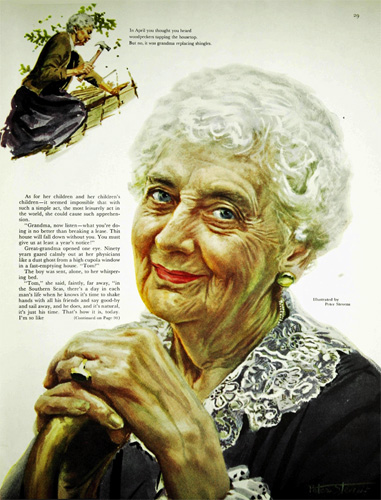
"Good-by, Grandma" in its first appearance. Saturday Evening Post, May 1957. Artwork by Peter Stevens.


The Adaptations

Dandelion Wine is the only one of Bradbury's "classic period" novels to remain unfilmed - in English, that is. There was a Russian adaptation in 1997 which, as far as I can tell as a non-Russian-speaker, looks like it was pretty good. Over the years, there have been several announcements about an English-language film, but nothing has ever come of them. I suspect that, like The Martian Chronicles, there isn't enough of an overarching story for the book to be directly filmable. Although, like Chronicles, it might be suitable for a TV miniseries.

Bradbury himself adapted Dandelion Wine for the stage, in a version which has been presented as straight drama and as a musical. But even he had to invent a whole new storyline to tie everything together: it centers on the mystery of Bill Forrester, a man who returns to Green Town after many years. Bradbury's theatrical script was used for the full-cast audio production of Dandelion Wine made by Colonial Radio Theatre.

A number of stories from the book have been adapted on their own. The out-and-out winner here has to be "The Whole Town's Sleeping", which pre-dates the book by nearly a decade. In fact, the very first public outing of the story was on radio, a good two years before the story ever saw print.

Back in 1948, Ray submitted the story to the radio series Suspense, where it was aired under the title "Summer Night". The story appeared in print in 1950 (in McCall's), then appeared on TV (Suspense, 1952, again as "Summer Night"), and then saw a whole series of repeat radio dramatisations on Suspense and ABC Radio Workshop. The story is also one of Bradbury's most anthologised stories, having appeared in dozens of books and textbooks.

For his TV series The Ray Bradbury Theater, Ray dramatised "The Happiness Machine", "Exorcism" and "The Whole Town's Sleeping".


Find Out More...

  • Read about the Russian film of Dandelion Wine on my page for the film, here.
  • Read about the real-life Lonely One, in my blog post about this petty criminal, here. 
  • Compare the fictional Green Town to the real-life Waukegan in my blog post, here.
  • Read about Ray's stage play version of Dandelion Wine, which was also the basis for the Colonial Radio Theatre audio production, in my review here.


Read...


You can read "Illumination" as it originally appeared in The Reporter, here.

And you can read "Summer in the Air" as it originally appeared in Saturday Evening Post, here.


Listen...

"The Whole Town's Sleeping" - the story of Lavinia Nebbs and her fearful crossing of the ravine alone at night - has been adapted for radio countless times. Listen to a version from Suspense, here.


Watch...

View the Russian film Vino iz oduvanchikov here. What's that? You don't understand Russian? Then just watch and try to figure out which stories are being adapted!


Next Up...

The next of my Lockdown Choices will be Bradbury's ninth book: A Medicine for Melancholy. Or should that be The Day it Rained Forever?

Friday, April 24, 2020

Best Reference Sources

If you've been following my Lockdown series of posts, you'll know that I like to give background information on Ray's books: how they came to be written and edited. And you might be wondering where I get my information from. Well, here are the answers...

Actually, most of it is in my head, and I simply type it out - and then go fact-checking to make sure I haven't made any mistakes. But how did it get in my head in the first place? I have a number of go-to books, and these are where I have learned most about Bradbury over the years.

The first of these is the magnificent Ray Bradbury: the Life of Fiction, written by the masterful Bradbury scholars Jon Eller and the late Bill Touponce. It's really two books in one, reflecting the authorship of the book, and the specialisms of Jon and Bill. They go through each of Ray's major works and give you (a) a history of how the book was originally composed, including roads-not-travelled; and (b) a lit.-crit. analysis of each of those works. The history sections are generally the work of Jon Eller, and the lit.-crit. sections are generally by Bill Touponce - although the two did help each other with the revisions of their respective sections.


The reason I find this book so fascinating is that it really uncovers Bradbury's writing process. It's a process of writing, re-writing, and more re-writing. And this is precisely why Bradbury's books tend to be a bit fluid over time, with (for example) various editions of The Martian Chronicles having slightly different contents. And why you will often see the same idea popping up in different works over many years.

My own original research into Bradbury has usually focused on Ray's writing and re-writing in media (film scripts, plays, radio plays etc), and it was amazing to find that Eller & Touponce had uncovered similar quirks in Bradbury's prose fiction as I was finding in his screenwriting. Over the last decade or so, I've had the good fortune of working quite closely with Jon Eller, and there's no doubt that his understanding of Bradbury has rubbed off on me. We both have a fascination with archive materials, and how we can re-construct a sequence of events from a set of archival clues. I was also lucky enough to meet and work with Bill Touponce on a couple of projects, but his approach and mine are very different. Although I admire Bill's analytical and theory-infused writing, it's a form and style that I would struggle to achieve (and usually seek to avoid) in my own writing.

My second go-to book is the profusely illustrated Ray Bradbury: an Illustrated Life by the late Jerry Weist. This is a glorious coffee-table book full of cover art and interior art from nearly all of Ray's career. But it also includes draft artwork, both from the cover artists (especially Joe Mugnaini) and from Ray himself. I'll bet you didn't know that many of Ray's book covers were from Ray's own concepts.


Third is Sam Weller's authorised biography of Ray, The Bradbury Chronicles. It's quite well researched and written in a breezy style. You'll be amazed how quickly Ray's long life flies by as you work through this volume. My only real problem with it as a reference book is that the index is quite inaccurate. Many a time I've looked something up in the index and found that the page references are wrong. I'm not sure what went wrong here. (The ebook version has an obvious advantage, in that you can ignore the index and just do a straight text search.) There are also a couple of instances where Weller reports something that Ray has told him, but hasn't done the follow-up fact-checking that I would expect in a book which generally appears to be well-researched. The case of "the Lonely One" is a particular example which I have discussed before.


Finally, not a book but a whole series of books. Starting with Becoming Ray Bradbury, Jon Eller has produced a trilogy of biographical volumes about Ray and his work. It's sometimes been referred to as a biography of a mind, since it focuses on Ray's developing intellect throughout his career. And since Eller is a meticulous researcher (and the series is published by an academic press), everything is thoroughly referenced and cross-referenced. The third volume, Bradbury Beyond Apollo, is due out later this year, and it traces Ray's evolution through the "space age" and beyond. You'll get to find out how Ray went from being something of an outsider to the science-fiction field to being a spokesman for the genre - and a lauded consultant on anything to do with space and planetary research.


What you won't find a book on is Bradbury's media work - and that's precisely why this Bradburymedia website exists. It was always my aim to focus on this much un-researched area of Ray's activities. So if you're wondering where I get all my film, radio and television-related information from, the answer is: my own research. I've had to dig into archives and find primary sources to track Ray's development as a screenwriter. And I've had a lot of fun doing it!

Wednesday, April 22, 2020

Lockdown Choices - Issue #7: The October Country

This is the seventh in a new series of posts, my Lockdown Choices, where I seek to entertain you while in coronavirus-isolation, and remind you of Bradbury's great works in this, his centenary year.
In these posts, I cover each of Ray Bradbury's books, say something about the contents, then pick the best stories and adaptations.


Lockdown Choice #7: The October Country

First edition, Ballantine 1955. Cover art by Joe Mugnaini. Note the pseudo-gothic houses, the implied wind... and the inexplicable lizard creature...


The Book

The October Country was Ray Bradbury's seventh book, published by Ballantine in (appropriately enough) October of 1955. It contained nineteen stories, fifteen of them reprinted from his earlier book  Dark Carnival (1947). In fact, the project originated as a simple re-packaging and re-arrangement of Dark Carnival, once Arkham house had relinquished rights to the book. It was Bradbury's Ballantine editor Stanley Kaufmann who realised the revised contents of the book were drifting a long way from the original, and suggested a new title would be in order (see Eller & Touponce, Ray Bradbury: the Life of Fiction, pp. 77-79).

This was the first of many re-shuffled playlists of Bradbury's short-story-collection career, and so it's worth just spelling out how it compares to Dark Carnival:


The stories in black are carried over, and the ones in red are new to The October Country. Also new is the "the" in front of "Cistern", perhaps stolen from "The Homecoming", which no longer has a "the"!

And missing from the original Dark Carnival line-up are: "The Maiden", "The Tombstone", "The Smiling People", "The Traveler", "Reunion", "The Handler", "The Coffin", "Interim", "Let's Play Poison", "The Night", "The Dead Man", and "The Night Sets". But most of these would re-surface in future collections, so Bradbury was presumably still happy with them. (Four of them would never re-appear in a Bradbury collection, though: "The Maiden", "Reunion", "Interim", and "The Night Sets". My thanks to Piet Nel for pointing this out.)

As with his earlier book The Ilustrated Man, Bradbury initially considered something of a framing narrative to tie the disparate short stories together, but went instead for a two-page scene presenting a dialogue between a grandfather and grandson. He later trimmed this down to his simple "definition" of the concept as it appears in the finished book:

...that country where it is always turning late in the year. That country where the hills are fog and the rivers are mist; where noons go quickly, dusks and twilights linger, and mid-nights stay. That country composed in the main of cellars, sub-cellars, coal-bins, closets, attics, and pantries faced away from the sun. That country whose people are autumn people, thinking only autumn thoughts. Whose people passing at night on the empty walks sound like rain...
This passage reminds me very much of an introduction to a TV anthology series, and it's surprising in a way that nobody ever developed such a concept from the book - especially since The October Country contains some of Bradbury's most frequently-adapted stories.

Mugnaini illustration for "Skeleton", helping to define the story before the reader even begins to read. Note the man's shadow...


As with another earlier book The Golden Apples of the Sun, Bradbury wanted to include illustrations by Joe Mugnaini, and so some (but not all of the stories) appeared with Mugnaini's by now familiar line drawings. In Golden Apples, the drawings were half-page images at the head of each story, and became inextricably linked to the story for the reader. In The October Country, however, the illustrations were allowed a full page each, sometimes before the story, and sometimes within the story; almost randomly distributed, and with some stories remaining completely unillustrated.


Mugnaini illustration for "The Scythe", planted within the story.  


The October Country picked up some good reviews. The UK edition won approval from The Guardian reviewer Norman Shrapnel, who declared that Bradbury's stories had "the subtlety of a hypodermic syringe". (I'm still trying to figure out whether that's a good thing or a bad thing.) Meanwhile another British reviewer for The Observer lamented that Bradbury had been "classed with the science fiction writers". Because, you know, he was good, unlike those sci-fi fellows...


Mugnaini illustration for "The Wind", again preceding the story. Note the echo of the tree shown on the book's cover.

I made a Bradbury 101 video about The October Country, in which I give an overview of how Dark Carnival was re-worked, demonstrating that part of Bradbury's method was his tendency to re-write:


The Stories

When I covered Dark Carnival, I singled out a few stories which re-appear here - namely "Skeleton", "The Crowd", "The Scythe", "The Lake". So here I will pick just from those which are new to The October Country.


"The Dwarf" - this was one of my early favourite Bradbury stories, The October Country being only the second Bradbury book I ever read. The story is simultaneously funny, sad and frightening. The basic premise is about a little man (the dwarf of the title) who goes into a hall of mirrors to see himself distorted to full stature. It's not exactly politically correct when stated like that, and in truth the story might find difficulty getting published today. But what makes the story so terrific is that the dwarf is also a writer who has written a story about being both a dwarf and a murderer; and he is effectively tortured by the main characters in the story. I'm not doing it justice here - you really need to read it. But it's an effective series of twists and distortions, and through Bradbury's skill you will by turns be horrified by the dwarf and feel sorry for him.


"Touched with Fire" - this story has a simple premise: "More murders are committed at ninety-two degrees Fahrenheit than at any other temperature." Any warmer, and it's too hot to move; any cooler, and cooler heads prevail. What makes this story so charming is the way it's framed. The main action involves the hotheaded Mrs Shrike:
The woman [...] stood at a wall phone, saliva flying from her mouth at an incredible rate. She showed off all of her large white teeth, chunking off her monologue, nostrils flared, a vein in her wet forehead ridged up, pumping, her free hand flexing and unflexing itself. Her eyes were clenched shut as she yelled [...]
But the story is told through the frame of Mr Foxe and Mr Shaw, who set out to verify the hypothesis of 92-degree murders. They have targeted Mrs Shrike as she seems a likely murderer...

"Touched with Fire" originally appeared in Maclean's magazine as "Shopping for Death" in June 1954. Bruce Johnson's illustration masterfully captures the key scenes from the story, and with an effective colour scheme for Mrs Shrike.


I decided when I started this series of blog posts that I would talk about my favourite stories. And of the four new stories in this volume, these are the only two that I could count as favourites. There are some elements of "Dudley Stone" which impress me, but overall I have little time for that story. And I'm afraid "The Watchful Poker Chip" remains one of my least favourite Bradbury stories. So I'll say no more about them.


The Adaptations

The October Country, being just a collection of short stories with no linking narrative, doesn't lend itself to being adapted as a whole book. But it has been done - as radio drama - twice. Sort of.

ABC Radio's Halloween 1984: The October Country was a ninety-minute live broadcast from the Directors' Guild Theater in Los Angeles, performed before an audience. It wove together four of the book's stories ("Emissary", "There Was An Old Woman", "The Next in Line" and "The Wonderful Death of Dudley Stone") into a, er, strange assemblage. Most of the individual stories were told reasonably well, and with a decent cast which included June Lockhart, Lynn Redgrave, and voice-acting legends Casey Kasem and Gary Owens. But "The Next in Line" - set by Bradbury in the Mexican town of Guanajuato, famous for its mummies and catacombs - is inexplicably relocated to Jamaica. And "Dudley Stone" for some reason becomes the author of all these stories, as the production makes "solving the mystery of Dudley Stone" into the overarching plot of the whole thing. I feel sorry for Bradbury, who had to sit in the audience through this whole production, and was then hurried into an unplanned interview when the show ran short. Bradbury explains the origin of each of the stories, politely pointing out that "The Next in Line" was based on a real experience he had in Mexico, not Jamaica...

In 2009, Peggy Webber's California Artists Radio Theatre did a better job, with a cast including Beverley Garland and William Windom. No framing or linking story, just a single ninety-minute production which tackled several of the best stories from the book: "Skeleton", "There Was an Old Woman" (again), "Uncle Einar", and "The Man Upstairs". The adaptation here was straightforward, with the narration of the stories turned directly into voice narration, and the dialogue brought to life by performers and sound effects.

Better work was done on adapting individual stories from The October Country. "The Dwarf" turned up on The Ray Bradbury Theater, in an episode which Ray considered to be one of the worst, but that was one of the few week adaptations of October Country stories. "The Next in Line" has been done well for radio on several occasions, perhaps the best being Brian Sibley's Tales of the Bizarre adaptation for the BBC. And then there is a whole string of stories which, in adaptational terms, are among Bradbury's star turns, all of them having been adapted multiple times: "Skeleton", "The Jar", "The Lake", "Emissary", "Touched With Fire", "The Small Assassin", "The Crowd".


Find Out More...

You can read "Touched with Fire" (in its original magazine form "Shopping for Death") at the Maclean's archive, here.


Watch...

Watch part of Ray's own 1956 TV adaptation of "Touched with Fire" ("Shopping for Death") for Alfred Hitchcock Presents here.


Listen...

Listen to ABC Radio's Halloween 1984: The October Country, here.

Better still, listen to how "The Next in Line" should be done, in Brian Sibley's dramatisation for BBC Radio's Tales of the Bizarre, here.


Next Up...

The next of my Lockdown Choices will be Bradbury's eighth book: Dandelion Wine.

Monday, April 20, 2020

Reading, Short and Deep - podcast series

Reading, Short and Deep is a long-running podcast about short fiction. It's co-hosted by Jesse Willis and the noted science fiction scholar Eric Rabkin, and in each episode they pick a single short story to discuss. They usually also provide an online link, so that you can read the story under discussion.

I met Eric at a couple of conferences in the last decade, and had the honour of writing a chapter for a book he co-edited, Visions of Mars (McFarland, 2011).

Given Eric's background, its perhaps no surprise that a good number of episodes discuss works of fantasy and SF, including stories by Jack London, Clark Ashton Smith, Shirley Jackson and Robert Sheckley.

And, of course, Ray Bradbury.

Here are direct links to the Bradbury episodes (although you can also subscribe to the podcast on any podcast app):

Zero Hour

The Wind

Morgue Ship

The Pendulum (Bradbury with Henry Hasse)

I, Mars (aka Night Call, Collect)

Friday, April 17, 2020

Lockdown Choices - Issue #6: Switch on the Night

This is the sixth in my series of Lockdown Choices, where I seek to entertain you while in coronavirus-isolation, and remind you of Bradbury's great works in this, his centenary year.

In these posts, I cover each of Ray Bradbury's books, say something about the contents, then pick the best stories and adaptations.


Lockdown Choice #6: Switch on the Night

First edition, illustrated by Madeleine Gekiere. Pantheon, 1955.


The Book

Switch on the Night (1955) was Ray Bradbury's shortest book to date. It contains just a single story, and runs to about fifty pages. This is because it is an illustrated book for children. Yes, the author who started out in Weird Tales scaring the bejeezus out of us with visceral horrors such as "Skeleton" and existential angst in "The Crowd" and "The Wind", has by now turned into a children's author! Well, if it's good enough for Roald Dahl...

From a biographical point of view, there is a clue as to how this shift occurred, right there on the dedication page:

Dedication to Switch on the Night.


Susan and Ramona were Ray's first two daughters, and Susan happened to be scared of the dark. And so Bradbury devised a story to counter this fear. According to Sam Weller's The Bradbury Chronicles (p.236), Bradbury shipped the book around various publishers for six years before, finally, Pantheon (Random House) picked it up. And I have seen a colour photocopy of the original 1949 manuscript (in the Center for Ray Bradbury Studies, Indianapolis) which shows that Ray always intended it to be an illustrated book. The manuscript has primitive colour images, presumably created by Bradbury himself.

The book was illustrated throughout by Madeleine Gekiere, the Swiss-born American artist, writer and filmmaker, whose previous work for children's books had been recognised by the New York Times. According to an obituary in the New York Post (July 2, 2014), Bradbury shared the royalties from the book with Gekiere - something that she said was unheard of: "I never got any royalties on my other books [...b]ut Ray Bradbury, no problem, he shared the profits . . . Just a very nice man.” Gekiere alas commited suicide in 2014.

The Gekiere version of the book stayed in print for a number of years, with the last reissue being a library edition issued in 1963.

Perhaps more familiar today, though, is the version first published in 1993, with illustrations by the phenomenal Diane and Leo Dillon. 

Bradbury/Dillons version. Knopf, 1993.


What's curious about this is to see two different visual interpretations of the same text - although Bradbury's text has also been published a number of times with minimal illustration, such as in the 1990 Oxford Book of Story Poems.

Last page of the story/poem's appearance in the Oxford Book of Story Poems, with illustrations (just three of them) by Robina Green. Oxford University Press, 1990.


The Stories

There's just a single story here: of a little boy who likes light and hates darkness. He dislikes switches, we are told, because they turn off the light. He won't go out in the dark, but stays lonely in his room surrounded by candles and torches.


One night, wandering around the house, the boy spies a curious figure: a little girl who introduces herself as "Dark". She explains the wonders of darkness, and how switches actually work differently to how the boy sees it. When you flick a lightswitch off, you are turning on the night; you can switch on the stars, the crickets, and the frogs.


With this new understanding, the boy can now marvel at the darkness.

Naturally, this is a very slight tale, and designed to be read to (or with) a small child. But we can still see some Bradbury hallmarks here. The most obvious, perhaps, is the poetic way with words. From the layout of the words on the page, you may even wonder if this is a story or a poem. (Who can say? Which is why it was included in the Oxford Book of Story Poems, I imagine...)

Then there is the twist: that reversal of point of view, which allows the boy (and the reader) to see a single phenomenon from a totally different angle. This is characteristic of early and middle Bradbury. Remember "The Million-Year Picnic", where the humans are the Martians now?

And finally there is "Dark". She reminds me of Clarisse in Fahrenheit 451: a young but worldly-wise catalyst who brings about a change in another character. (Except for her name, dark hair, dark eyes, dark clothes and dark shoes. All of those remind me of Mr Dark from Something Wicked This Way Comes - but oh look, I've jumped the timeline; that book hasn't been written yet...)

The Adaptations

As far as I'm aware (and believe me, I do a lot of digging for this sort of thing), there has only ever been one official media adaptation of Switch on the Night. And that was simply a reading with some atmospheric sounds and music, as part of a BBC radio series called White Nights (July 2006).


Find Out More...

Read about the remarkable career of artist Madeleine Gekiere, here.

Learn about the extraordinary range of titles illustrated by the Dillons, here.


Listen...

Switch on the Night is a lovely piece of writing to be read aloud, and so you will find some (usually unauthorised) readings online. There's a charming one here.


Next Up...

The next of my Lockdown Choices will be Bradbury's seventh book: The October Country.

Wednesday, April 15, 2020

Introducing Fahrenheit 451 (1966)

Another short break from my Lockdown Choices series, to bring you a short slideshow introduction ot the 1966 film of Fahrenheit 451. I originally created the slideshow for a presentation I gave at Wolverhampton's Light House Cinema in 2016. This version has a "temp" narration (apologies for the sound quality...)

For best results, click the little square in the bottom-right corner, and go fullscreen.


Monday, April 13, 2020

Lockdown Choices - Issue #5: Fahrenheit 451

This is the fifth in my series of Lockdown Choices, where I seek to entertain you while in coronavirus-isolation, and remind you of Bradbury's great works in this, his centenary year.

In these posts, I cover each of Ray Bradbury's books, say something about the contents, then pick the best stories and adaptations.


Lockdown Choice #5: Fahrenheit 451


First edition. Ballantine books, 1953. Cover art by Joe Mugnaini.

The Book

Fahrenheit 451 is legendary. A presentation of a dystopian future, it is sometimes considered alongside other classic dystopias such as Nineteen Eighty-Four and Brave New World. Its central conceit - that those in charge have banned all books because of the dangerous ideas found in some of them - has great resonance, since censorship has so many times been a defining characteristic of real-life oppressive regimes. That one central idea, providing a great "what if...?", would be enough for most novelists, but Bradbury ties it to other ideas which continue to fascinate us, such as our willingness to be manipulated by the media, and our tendency to turn to addictive substances. Every time you think Fahrenheit must be rendered obsolete because its world has become impossible in real life, real life has a way of making the book all too relevant again.

And yet the book you can buy today is not the same as the original Fahrenheit 451.

The original volume in hardcover from Ballantine, published in October 1953, contained three stories: Fahrenheit itself, plus "The Playground" and "And the Rock Cried Out". It was a story collection, rather than a novel.  And you can see why this might be: Fahrenheit 451 is a mere 46,000 words long, and barely counts as a novel; it is really a novella, longer than a short story but shorter than a novel. But Ballantine's paperback edition published that same year (which is technically the second edition) dropped the other two stories, leaving Fahrenheit to stand alone. And this is mostly how you will find Fahrenheit 451 today.

Find out how Fahrenheit 451 mutated from a story collection into a standalone novel in myBradbury 101 video below. And scroll further down the page for more on the evolution of the book.


The Stories


If you've been following these blog posts, you'll know by now that Bradbury's four previous books were all short story collections (The Martian Chronicles looks like a novel, but is made up from a bunch of short stories). And so it should come as no surprise that his first "novel", Fahrenheit, is an expansion of a shorter work, "The Fireman".

"The Fireman" - the first appearance of Montag's story. Galaxy magazine, 1951.


"The Fireman" sure reads a lot like Fahrenheit 451, and that's because Bradbury ported nearly all of it over into the longer work. But he also added some material - a lot of really good material. The whole business of Mildred and her substance abuse is new to the longer work, and so is the implied critique of television. In other words, two of the three thematic strands which have given Fahrenheit its longevity and ongoing relevance come from Bradbury's re-writing of his earlier short story.

When I worked on my PhD a couple of years ago, this was one of the features of Bradbury's writing that fascinated me: his tendency to re-write and re-visit earlier works, and to uncover (or generate, I suppose) gold in those re-writings. My own fascination is with how he does this in his adaptations between media - how he re-works a story when he adapts it for film - but his re-writing of prose works follows a similar pattern.

Bradbury's view on re-writing was somewhat mixed, in his public utterances at least. On the one hand he strongly advocated a two-stage process to writing, which he sometimes described vividly as "throw up in the morning, clean up at noon". The first stage of writing should be completely unrestrained, letting the imagination and the typing fingers run wild. But then there should be a second stage, where the intellect is engaged. It is here that the writer can apply some analysis to what has emerged during the first stage, and impose structure and order on what might otherwise have been random verbiage.

But on the other hand, Bradbury claimed that he didn't believe in re-writing his younger self. He let his works stand as first published, warts and all. Except... The October Country was a re-written and re-edited Dark Carnival... and he pulled stories out of collections that he didn't think fit any more, and added new ones in... and he really enjoyed taking an earlier short story and turning it into a play, or taking one of his film scripts and turning it into a novel...

The roots of Fahrenheit go back even further than 1951's "The Fireman". Jon Eller, in the book Match to Flame: the Fictional Paths to Fahrenheit 451 (ed. by Donn Albright, Gauntlet Press 2006) traces the genes of the story all the way back to 1942, and a short story called "Reincarnate". Bradbury worked through all sorts of variations of book-burning, finally arriving at this theme's finest expression in "The Fireman".

Match to Flame (Gauntlet 2006) was a limited edition volume tracing the history of Fahrenheit 451, and included all the precursor stories. The stories were re-packaged without the historical explanation as a mainstream book, A Pleasure to Burn: Fahrenheit 451 Stories (HarperCollins, 2010). Match has cover art by the editor, Donn Albright. Pleasure has a Joe Mugnaini variation of the original F451 cover art.

Ray Bradbury was aware that Fahrenheit 451 was his masterpiece, at least as far as novels were concerned. His gravestone, which he had carved several years before he died, reads simply "Ray Bradbury - author of Fahrenheit 451."


The Stories

In this section I usually write about individual stories making up a collection, but in the case of Fahrenheit 451 that doesn't really work. I suppose I could write about the three stories in the first edition of the book, but who has access to the first edition?

Instead, I thought I would write about the best scenes in the book. So let's see how this turns out...


Meeting Clarisse - Clarisse is the most charming character in the book. She's a bit kooky, a bit flaky, very naive, and yet very wise beyond her years. She says she's seventeen and crazy. When the thoroughly institutionalised fireman Montag meets her, his outlook is transformed:
They walked in the warm-cool blowing night on the silvered pavement and there was the faintest breath of fresh apricots and strawberries in the air, and he looked around and realized this was quite impossible, so late in the year.
Soon, Montag is brought to a point of self-awareness. He is triggered to question what he does, and is totally floored by Clarisse's last utterance:
She started up her walk. Then she seemed to remember something and came back to look at him with wonder and curiosity.

"Are you happy?" she said.

"Am I what?" he cried.

But she was gone running in the moonlight. Her front door shut gently.

"Happy! Of all the nonsense."

He stopped laughing.

The old woman - The best sequence in the book, in my view, is when Montag and colleagues go on a book burning. An old woman has been found hoarding books, and the instructions are to torch the lot. In gathering the books together, Montag inadvertently finds himself reading brief passages of texts - he has already by this point been shown as being curious about the books that he is forced to burn.

The firemen try to remove the woman from her house, but she refuses to go, causing Montag to wonder why anyone would become so attached to their books. And then comes the flashpoint.

Standing amid piles her books, scattered all around, all of them now soaked in kerosene, the woman pulls out... a match. I've waxed lyrical about the structure of this scene many times before. I marvel at how like a screenplay it is:
Montag placed his hand on the woman's elbow. "You can come with me."
"No," she said. "Thank you, anyway."
"I'm counting to ten," said Beatty. "One. Two."
"Please," said Montag.
"Go on," said the woman.
"Three. Four."
"Here." Montag pulled at the woman.
The woman replied quietly, "I want to stay here."
"Five. Six."
"You can stop counting," she said. She opened the fingers of one hand
slightly and in the palm of the hand was a single slender object.
An ordinary kitchen match.
The sight of it rushed the men out and down away from the house. Captain
Beatty, keeping his dignity, backed slowly through the front door, his pink face
burnt and shiny from a thousand fires and night excitements.

I love the way Bradbury's word choices focus the mind's eye like a film camera. Going from the woman; to the opening of her fingers; to the kitchen match; is like a camera going into ever-tighter close-up. And that single-sentence-fragment paragraph, "An ordinary kitchen match" sits alone on the page allowing the eye to absorb its implications, before the helter-skelter reaction of the firemen dashing from the tinderbox house.


The bomb - An ever-present threat in the book, an atomic war finally breaks out near the end. It is the destruction of the city that will, eventually, allow the "book people" to return and re-establish civilisation. But in typical Bradbury fashion, the dropping of the first bomb is focused entirely through Montag's perceptions.
Montag held the bombs in the sky for a single moment, with his mind and his
hands reaching helplessly up at them. "Run!" he cried to Faber. To Clarisse,
"Run!" To Mildred, "Get out, get out of there! " But Clarisse, he remembered,
was dead. And Faber was out; there in the deep valleys of the country somewhere
the five a.m. bus was on its way from one desolation to another. Though the
desolation had not yet arrived, was still in the air, it was certain as man
could make it. Before the bus had run another fifty yards on the highway, its
destination would be meaningless, and its point of departure changed from
metropolis to junkyard.
And Mildred... 
Get out, run!
One of the things that has been bugging Montag is that he can't remember where he met Mildred, his wife. This seems to be a characteristic of Montag's world: in the absence of books and literature, everything has become so ephemeral. People go about their lives without thinking or reflecting. But now, in the climactic destruction of the city, Montag's memory is jolted: 
I remember. Montag clung to the earth. I remember. Chicago. Chicago, a long time ago. Millie and I. That's where we met! I remember now. Chicago. A long time ago.

If you ever suggest to me that Bradbury can't write characters, I will tear the pages from Fahrenheit 451 and stuff them into your eyes!


The Adaptations

Fahrenheit 451 has been adapted for radio several times, with two dramatisations by BBC radio. The best of these was by David Calcutt, adding some British flavouring to the story by referencing John Bunyan's The Pilgrim's Progress - which turns out to be a pretty good parallel to aspects of Montag's journey. Calcutt also adds to the "oral tradition" elements of Bradbury's story by including a number of nursery rhymes and playground games, the kind of thing we all learn by rote as children.

And of course Fahrenheit has twice made it to the screen. In 1966, François Truffaut directed his own adaptation (co-written with Jean-Louis Richard), starring a multinational cast. Truffaut was by far the biggest-name filmmaker to have so far directed a Bradbury adaptation, and in many ways was an unlikely choice. Except that Truffaut was a bibliophile even more than he was a cinephile, and the concept of Bradbury's novel appealed to him. Truffaut invited Bradbury to write the screenplay, but Ray was burned out from a succession of bad experiences in Hollywood, and declined.

Truffaut originally planned to make Fahrenheit 451 in French, in black and white, with Charles Aznavour (the star of his earlier Shoot the Pianist), but the film was delayed. Eventually American money was secured, and Truffaut instead filmed in England, in English, in colour, and with Austrian actor Oskar Werner in the lead.

Just one problem: Truffaut spoke no English, and had failed repeatedly in his efforts to learn it. And so it was that Truffaut directed through an interpreter. Fortunately co-star Julie Christie and cinematographer Nicolas Roeg both spoke fluent French, and this gave Truffaut an easier ride than he might otherwise have had.

Truffaut film poster.

At the time of release, Bradbury was very much in love with Truffaut's film, and wrote of the film and the book being reflections of each other. And while Truffaut made a number of changes (eliminating the atomic war, for one thing), there were whole sections where Truffaut brought Bradbury's sequences to detailed life. The "old woman" sequence I discussed above is filmed almost exactly as written, and remains the high point of the movie. Over time, however, Bradbury became publicly critical of the film - despite having lifted a few ideas from Truffaut when writing his own stage play version of Fahrenheit.

Despite decades of talk of new film adaptations from the likes of Mel Gibson and Frank Darabont, Bradbury passed away in 2012 without ever seeing another screen version. When one finally reached the screen in 2018 for HBO, it was something of a curate's egg: good in parts.

Ramin Bahrani, director and co-writer of the 2018 version, came with a solid reputation, but had never worked on anything remotely science fictional. His script smartly updated certain aspects of Fahrenheit's world - managing to make it broadly plausible that books might continue to be important in a world of ebooks and emojis. But a bit of hokey SF (storing books in the DNA of a pigeon) really spoiled Bradbury's practical and philosophical ending.

DVD of the HBO film. Note the empty space to the left of Montag - which could thematically have been easily filled by Montag's wife (oops, the film forgot to give him a wife) or by Clarisse (oops, the film downplayed any significance of that character).


Find Out More...

I wrote about the interplay between Bradbury and FrançoisTruffaut in a journal article, based on my PhD research in the Bradbury archives. You can read it on my Academia page, here.

I wrote about adaptations of Fahrenheit  and other Bradbury works in a book chapter. You can read that on my Academia page, too, here.


Listen...

I took part in two lively discussions of Fahrenheit and its movie adaptations on the Take Me To Your Reader podcast. Listen to them here... and here.

Listen to David Calcutt's BBC radio adaptation of Fahrenheit 451, here.


Next Up...

The next of my Lockdown Choices will be Bradbury's sixth book: Switch on the Night.

Friday, April 10, 2020

A Lockdown Pause: Images in Ray Bradbury Stories

Something a little different today, as I take a brief pause from my Lockdown Choices series...

Some years ago, I presented a paper on images in Bradbury's fiction, at a conference in France. Note the term "images", rather than "imagery". The point being: I talked about how characters within Bradbury stories experience images such as photographs, paintings and tattoos.

As is my wont, I made a Powerpoint slide show to illustrate my talk. And now, these many years later, I've glued the slide show to a recording of me reading the paper. Here it is, for your delectation and delight. (Click the little square in the corner to make it fill the screen.)

By the way, my pronunciation of "Peirce" is correct. I say this to forestall a load of comments from those who assume it is pronounced the same as "pierce"...

If you'd prefer to read the paper, you can find it on my Academia page, here.


Wednesday, April 08, 2020

Lockdown Choices - Issue #4: The Golden Apples of the Sun

This is the fourth in my series of Lockdown Choices, where I seek to entertain you while in coronavirus-isolation, and remind you of Bradbury's great works in this, his centenary year.

In these posts, I cover each of Ray Bradbury's books, say something about the contents, then pick the best stories and adaptations.


Lockdown Choice #4: The Golden Apples of the Sun

First edition. Doubleday, 1953.


The Book

The Golden Apples of the Sun was Ray Bradbury's fourth book, a collection of science-fictional, fantasy, and "realistic" tales. With Bradbury, of course, "realism" can be very far from our everyday reality, but what I mean here is the type of story which does not hinge upon a science-fictional or fantastical premise.

The book collected twenty-two stories, most of which had previously been published in various magazines between 1944 and 1953. Like Bradbury's first book, Dark Carnival, the stories are presented as is, without any attempt to connect them through a linking narrative. It is therefore the first of Bradbury's Doubleday books to be allowed the luxury of being an undisguised short story collection. (Remember that editor Walter Bradbury (no relation) had asked of Ray, "We've disguised The Martian Chronicles as a novel, do you think we can somehow do the same thing with The Illustrated Man?")

As well as being "just" a collection of short stories, Golden Apples has the distinction of collecting a number of stories which had won awards or had been published in venues of some prestige. "Power House", for example, had won an O. Henry Prize; "The Big Black and White Game" had been selected for Best American Short Stories 1946; and "I See You Never" for Best American Short Stories 1948. And by now, Bradbury's short stories were being collected not just from pulp magazines, but from major-market publications such as American Mercury, Saturday Evening Post and The New Yorker. Appearing in these majors brought more than just prestige: they brought better income.

Another distinctive feature of Golden Apples is the art direction. For the first time, Bradbury's work was surrounded by the work of artist Joe Mugnaini. Mugnaini provided both the cover art (see above) and a uniform series of line drawings, one for each story. Mugnaini and Bradbury became good friends, and collaborated repeatedly over the year, to the extent that many readers find the two inextricably linked. Where else might you recognise that Mugnaini style from? For a start, there's that iconic newspaper-fireman from the cover of Fahrenheit 451.

For some reason, the first UK edition of Golden Apples deleted one story, "The Big Black and White Game" - perhaps on the grounds that the baseball theme might be meaningless to British readers. Subsequent UK editions restored the full table of contents, however.


Unfortunately, Golden Apples has become somewhat confusing in more recent times. Somewhere along the line, it became part of a set of editorial mash-ups which resulted in The Golden Apples of the Sun disappearing, and being effectively supplanted by The Golden Apples of the Sun AND OTHER STORIES. This latter title (which usually has "and other stories" written as a whispering footnote) scrambles the order of the stories and mixes in others from elsewhere. And - blasphemy! - removes the Mugnaini illustrations.

For some readers, there's no problem here. It's just a collection of short stories. But to others (i.e. me), the art direction and the running order is all part of "the book". If you're a person who puts their MP3s on shuffle, you probably don't care about this. But if you like to hear, say, Sergeant Pepper's Lonely Hearts Club Band with all the tracks in the right order, then this is a very big deal indeed.

In fact, according to Eller and Touponce, the visual theme of the original book was Bradbury's concept, and was his alternative way of having a consistent authorial thread running throughout the book (Ray Bradbury: the Life of Fiction, p. 367). So taking away the Mugnaini artwork would be the equivalent of removing the linking material from The Martian Chronicles.

Check the small print to see whether you have an actual Golden Apples, or an ...and other stories edition. Current paperback, HarperCollins.

Find out how The Golden Apples of the Sun finally allowed Bradbury to break out of the fantasy/science fiction "ghetto" and gain respect in the mainstream in myBradbury 101 video below. And scroll further down the page for my pick of the best stories from the book.


The Stories

Because of its eclectic nature, pulling in science fiction, fantasy and realistic stories, Golden Apples feels less coherent than any of Bradbury's previous books. But that does set a pattern which would continue through most of his subsequent short-story collections. Here are my personal story picks, perhaps heavily influenced by the fact that this is the first Bradbury book I ever read.


"The Pedestrian" - a really simple concept, and strangely appropriate for the COVID-19 lockdown: in some unspecified future, it is illegal to walk anywhere. Instead, everyone is supposed to stay home and watch TV. Mr Leonard Mead, however, breaks the rules. He goes out (gasp!) for a solitary stroll. Of course, it being the future and everything, he is stopped by what turns out to be... Well, read it for yourself.

According to Bradbury, one day he took his pedestrian out for another stroll - and found himself writing a new story, "The Fireman", which he would later expand into Fahrenheit 451.

Mugnaini illustration for "The Pedestrian".


"The Fruit at the Bottom of the Bowl" - I think this is truly the first piece of fiction I ever read which amazed me, and convinced me that words on a page could be magical and insightful. This when I was, I suppose, twelve years old. It's a simple story of a murder, except that the murderer becomes obsessed with the fingerprints he has left behind. Or probably left behind. Or must have, or possibly left behind. His gradual descent into obsession is masterfully written, and is another fine example of Bradbury constructing a character, even though that's something he is alleged not to be able to do. It's also full of beautifully poetic writing which is also narratively purposeful.

He has forgotten to wash the fourth wall of the room! And while he was gone the little spiders had popped from the fourth unwashed wall and swarmed over the already clean walls, dirtying them again! On the ceilings, from the chandelier, in the corners, on the floor, a million little whorled webs hung billowing at his scream! Tiny, tiny little webs, no bigger than, ironically, your - finger!
As he watched, the webs were woven over the picture frame, the fruit bowl, the body, the floor. Prints wielded the paper knife, pulled out drawers, touched the table top, touched, touched, touched everything everywhere.
 "The Fruit..." was originally published with Bradbury's punning title "Touch and Go!", but he wisely switched to the title the story is now better known by. The significance of the fruit? Our murderous protagonist becomes so obsessed with fingerprints that he cleans even things he knows he didn't ever touch...


"The Fruit at the Bottom of the Bowl" first appeared as "Touch and Go" in Detective Book Magazine, November 1948.


" A Sound of Thunder" - how could I not pick this story? It's one of the most anthologised short stories of all time, and one of the best known science fiction shorts. In case you don't recall this one, it's the one where people go back in time to hunt dinosaurs. Bradbury didn't originate that concept of course, and there are numerous other variations on the theme from other authors. But what Bradbury does so much better than, say, L. Sprague de Camp's "A Gun for Dinosaur", is create a clear connection and contrast between small, selfish actions, and large-scale consequences. And this is why I could also have said, "in case you don't recall this one, it's the one with the butterfly".

"Thunder" was rejected by The Magazine of Fantasy of Science Fiction, whose editor declared it was unbelievable because of the way it handles the time-travel paradox. But Bradbury stuck with his story, believing that the powerful imagery far outweighed any appeal to logic. The story was published instead by the mainstream magazine Collier's. 

"A Sound of Thunder" first appearance. Collier's, 1952.


"The Great Wide World Over There" -  proof if it were needed that Bradbury can write stories without a science-fictional or fantastical premise. This tale is of Cora, who longs to be like her neighbour and receive letters from far and wide - except that Cora can't read or write. She gets Benjy to send off for things for her. All sorts of things: a free muscle chart, a free health map, information from a detective school, anything that she can eagerly anticipate arriving.

There's a neat little plot within the story, and again a demonstration that Bradbury can craft characters who are tightly bound to his narrative and theme.


Mugnaini illustration for "The Great Wide World Over There".


"Hail and Farewell" - an often overlooked story of a boy who cannot grow up, this is an exquisite example of Bradbury taking a simple fantasy concept (Peter Pan anyone?) and finding the tragedy within it, just as he had done with the earlier story "The Martian" in The Martian Chronicles. The tragedy here comes from the fact that every time the boy (outwardly stuck at the age of twelve, but actually born forty-three years ago) finds himself a family to adopt, he must eventually walk away from them. The reason: they will eventually discover his secret, and will no longer be able to love him: "after three years, or five years, they guessed, or a travelling man came through, or a carnival man saw me, and it was over. It always had to end."

Mugnaini illustration for "Hail and Farewell".


The Adaptations

"The Pedestrian" was adapted for the stage, and later for TV, by Bradbury himself. In both of these adaptations, he was faced with a slight problem: Mr Leonard Mead does most of his walking alone among empty streets, and therefore doesn't have much to say or anyone to interact with; not exactly the most riveting of stories to perform with actors on a stage or on screen. His solution? He gives Mead a walking companion. It's not a bad piece of theatre - see for yourself in the Ray Bradbury Theatre adaptation, here - but it really turns it into a very different story, and I think I prefer the original tale.

"The Fruit at the Bottom of the Bowl" was adapted by Ilona Ference for a British  series, Television Playhouse, in 1963 with Leonard Rossiter in the role of the nervous killer, and adapted by Bradbury himself for an early episode of Ray Bradbury Theater, with Michael Ironside and Robert Vaughn.

"The Meadow" is something of a reverse adaptation: Bradbury wrote the short story first, then adapted it for radio for World Security Workshop. But the radio adaptation appeared in 1947, and the short story in 1953, giving the impression that the story is an adaptation of the play.

"Hail and Farewell" was also adapted for Ray Bradbury Theatre, albeit as a rather non-memorable instalment.

But Golden Apples' biggest stories are the two creature features. Both "The Fog Horn" and "A Sound of Thunder" feature prehistoric creatures, and both have had a long afterlife in media adaptation. "The Fog Horn" was originally published in the Saturday Evening Post under the title "The Beast from 20,000 Fathoms", and served as the inspiration for Ray Harryhausen's first solo animation feature under that name, and arguably inspired the similarly themed original Godzilla. "Thunder" was not quite so lucky.

"A Sound of Thunder" has been adapted for radio quite successfully, as in the NPR series Bradbury Thirteen, and even the Ray Bradbury Theater version scripted by Ray was OK (apart from the pre-Jurassic Park rubber monster). But it was also the basis of a dodgy feature film directed by Peter Hyams in 2005; Hyams got the job after Bradbury allegedly had an earlier director fired from the project for trying to remove the butterfly from the story. The story also inspired a segment of The Simpsons!


Find Out More...

See my page for Golden Apples, here.

Read about a little-known educational short film adaptation of "The Flying Machine" by Bernard Selling, here.


Listen and Watch...

I took part in a lively discussion of "A Sound of Thunder" and its movie adaptation on the Take Me To Your Reader podcast. Listen to it here.

Watch Tyne Daly bring Cora to life in Ray's dramatisation of "The Great Wide World Over There" for Ray Bradbury Theatre, here.


Next Up...

The next of my Lockdown Choices will be Bradbury's fifth book: Fahrenheit 451.