Friday, September 22, 2006

"This isn't a good way of problem-solving"

The quote above is from a parent, commenting on the children of Bradbury's "The Veldt" plotting and observing the death of their parents.

This is the latest attempt to get Bradbury removed from the classroom. There is a great irony here: Bradbury has such a deep and intuitive understanding of the child mind, that his stories are ideal for the classroom - and in the US he is very widely taught. But because he writes tales of horror and suspense and often, famously, writes about a future in order to prevent it, he comes under attack from parents and occasionally librarians who would like to protect the innocents.

(Of course, anyone who thinks children are innocent should definitely be reading "The Veldt" and "The Small Assassin", among others.)

For more on the challenge to "The Veldt" (which was rejected, by the way), see this report from the Beaverton Valley Times.

By some quirk of irony, this week is also apparently Banned Books Week, an event sponsored by American Booksellers Association, American Booksellers Foundation for Free Expression, American Library Association, Association of American Publishers, American Society of Journalists and Authors, and the National Association of College Stores. Naturally, Fahrenheit 451 springs to mind whenever we think of banning books, and this report makes the customary mention.

Wednesday, September 13, 2006

Storyteller

Bradbury, we are often told, is a storyteller at heart. Of course, people say this about many writers. There are, I think, three things that make this a particularly appropriate characterisation of Bradbury.

First is that Bradbury's writings are mostly in the short form. Like the storytellers of old, seated around the camp fire, he keeps things short and to the point. He favours short stories. Short poems. One-act plays. Thirty-minute TV dramas. Yes, he has written plenty of novels, some poetry of epic length, and many full-length screenplays. But even his longest works are really quite short, and nearly all are highly episodic.

Second is that Bradbury likes to re-tell his stories. All good camp-fire stories are ones that have been refined, embellished and enhanced through repeated telling to different audiences. All the great stand-up comedians do this, and some of them keep the same comic tales spinning for years, always adjusting the narrative, delivery and timing for optimum delivery. Bradbury re-tells his stories in many ways. He constantly adapts and re-adapts from one medium to another: short story, play, TV script, novel chapter. And in his interviews and public-speaking engagements, he invariably re-tells familiar anecdotes, like the one about Mr Electrico, or the one about how he remembers being born.

Third is that Bradbury is (or has been until recent years, when his health has got the better of him) a great performer of his own stories. He has recorded audio books of The Martian Chronicles, Fahrenheit 451 and many others of his works. Although he's not one of the world's greatest actors, he has been one of the best performing writers.

This autumn, Bradbury's home town of Waukegan, Illinois, is staging a storytelling festival in Bradbury's honour. A small town, and a small event. But the emphasis on storytelling is surely correct. This format seems an ideal way to celebrate his works - and to usher in the Bradbury season of Halloween.

Bradbury won't be attending in person, but he is filming a contribution in California.

Sunday, September 10, 2006

Bradbury 13 exclusive!

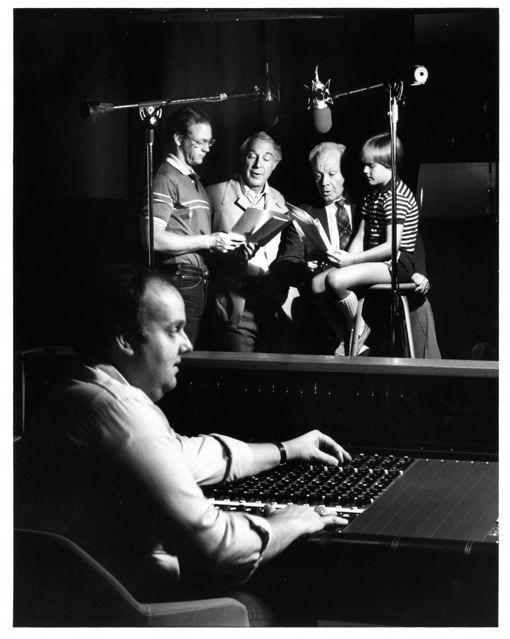
Mike McDonough, creator and producer of the classic radio series Bradbury 13 has very kindly sent me some photos from the production of the show.

I have added Mike's photo album to my Bradbury 13 page: click here to take a look.

As far as I know, many of these pictures are published here for the first time. Many thanks to Mike for his generosity, and for taking the time to scan them for me.

Tuesday, September 05, 2006

That UNauthorised biography again...

I thought I might regret it, but I paid good money for a copy of that unauthorised biography: Ray Bradbury Uncensored! The Unauthorized Biography, by Gene Beley. As I have mentioned before, I had concerns that this would not be a very solid piece of writing.

At some point, I will do a complete review of the book, but I wanted here to record my first responses, having speed-read the whole book, and having read a couple of chapters very closely.

My overall impression is of a book that very much needs a strong editorial hand. It needs some fact-checking (example: it reports events of Bradbury's 86th birthday, even though it was published
before that event). It needs some copy-editing (example: names of people spelled inconsistenly, sometimes within a single paragraph).

It also needs systematically revising to make it a 2006 book, rather than a slowly-accreted collection of items written over a period of years. It is rather disturbing to read that Beley had "last heard of" Charles Rome Smith in a particular place - giving the impression that the author has lost track of the theatre director - and then to read an end-of-chapter note reporting Smith's death. Many of the chapters of the book take the form of an article written ten, twenty or thirty years ago, with an "author's note" tacked on the end to bring it up to date. In chapters where Beley is reporting a specific event, such as a particular speech Bradbury delivered, this would appropriately give us a sense of being at the event, and provide important historical context. However, when the chapter is an interview that has no particular point-in-time value, this seems odd. George Clayton Johnson and Harlan Ellison, both very much alive today and (judging from interviews elsewhere) both highly accessible to interviewers, are quoted extensively on their views of Bradbury's writing and character - but the interview quotes are from the 1980s. Ellison is quoted as saying that Bradbury has done nothing of value for thirty years - but this quote pre-dates Bradbury's flurry of writing activity that would include Death is a Lonely Business, Green Shadow White Whale, Ray Bradbury Theater, The Toynbee Convector...

Apart from these editorial weaknesses, does the book have anything to offer? Well, it has a biography of Bradbury, but necessarily with less detail than Sam Weller's The Bradbury Chroniclesoffers. It reports on some of Bradbury's public speaking, quite successfully giving a sense of what it is/was like to be present at such events. It covers Bradbury's legal action against CBS over copyright infringement of Fahrenheit 451, in more detail than I have read elsewhere. It gives some insights into Bradbury's forays into theatre, revealing/claiming clashes between Bradbury and Smith, and between Bradbury and Shank.

It has some charming quotes from "ordinary people" who knew Ray at various points in his life, and some negative comments about Bradbury from various people who have had dealings with him.

And it sounds slightly unkind when discussing Bradbury's disabilities and his current state of health.

And quite a few photos, rather randomly arranged.

Overall, it's a real mixed bag. Probably essential reading for the Bradbury completist, but for anyone else I would say: buy Weller instead.

My top tip is to buy the ebook version, which is a lot cheaper than the printed edition!

Wednesday, August 23, 2006

Birthday interview; theatrical productions

Ray Bradbury made a brief appearance on KPCC Radio, Pasadena, yesterday for this 86th birthday interview, conducted by Patt Morrison.

Bradbury is best known for his short stories and novels, but less well known for his poetry and plays. And yet there seems to be a Bradbury play in production somewhere in the world at almost any given moment. I have only actually seen one production, the British premiere of Fahrenheit 451, but have also read a number of other Bradbury plays. If you want to read them just for pleasure, a good starting point is On Stage: A Chrestomathy of His Plays, which combines three earlier play collections (The Anthem Sprinters and Other Antics (1963), The Wonderful Ice Cream Suit and Other Plays (1972), and Pillar of Fire and Other Plays (1975)) into a single volume. This one volume contains the following plays:
  • The Great Collision of Monday Last
  • The First Night of Lent
  • A Clear View of an Irish Mist
  • The Anthem Sprinters
  • The Wonderful Ice Cream Suit
  • The Veldt
  • To the Chicago Abyss
  • Pillar of Fire
  • Kaleidoscope
  • The Foghorn
There are also useful introductions and afterwords to each section.

Some of the plays are remarkable for their economy of staging. "Kaleidoscope", for example, dramatises the last minutes of a crew of astronauts after theirship has been destroyed and they find themselves flung apart in empty space. Bradbury's stage directions call for no scenery. The play begins in darkness, and each astronaut appears, one by one, in a single spotlight against the dark stage. There is no need to show anything else.

Anyone interested in staging a Bradbury production would be well advised to visit the website of Dramatic Publishing. They supply single plays at reasonable prices, and will also manage the licensing arrangements, and publicise productions on their site.

They currently list the following current and imminent productions (to which I have have added links to the theatres or companies staging the shows):


Dandelion Wine
(Chicago, November to January)


Fahrenheit 451
(Talent, Oregon, October to November)
(Civic Theatre of San Juan, Puerto Rico, October to November)


The Martian Chronicles

(Seattle, until 26th August)


The Wonderful Ice Cream Suit
(Albuquerque , New Mexico, August to September).

Tuesday, August 22, 2006

Ray Bradbury at 86

Today is Ray Bradbury's 86th birthday. He says he is going to live forever, so he is now one year closer to achieving that aim!

Bradbury has, on many occasions, written of time machines. Some of these are more or less literal transports, such as the device that takes Eckels and Travis back to the Jurassic for a touch of dino hunting. Others are more metaphorical. In "The Toynbee Convector" (1984), a man in an ice-cream white suit claims to have travelled to a glorious future world, and by so preaching of it causes such a world to come into existence. This man sounds very much like Ray Bradbury.

In the much earlier Dandelion Wine (1957), Douglas Spaulding and his friends sit and listen in awe of Colonel Freeleigh, an old man whose reminiscences are so vivid that they feel transported back to the American Civil War. The old man is a time machine.

In this recent interview, Bradbury is conscious that, at eighty-six, he is now such a time machine. It is remarkable to think, as you read Dandelion Wine, that the book's author (thirty-seven years old at the time it was published) is able to project himself into the characters of young Doug and old Freeleigh, is capable of simultaneously being the child and the time machine.

Birthday greetings for Ray are being gathered on his official message board. Brian Sibley offers a birthday tribute to Ray on his ex libris blog.

Monday, August 21, 2006

Bradbury 13

I have recently been in contact with Mike McDonough, the award-winning sound designer and writer-producer of the classic radio series Bradbury 13. Mike was kind enough to answer some of my questions, which has enabled me to expand my page on the series.

Although episodes of the series were once available on audio cassette, there has never been a CD release of the show. Aficionados have had to make do with relatively poor quality recordings, many of them unauthorised. The good news is that Mike is still in possession of the original studio master recordings (and the copyright on the series), and has recently transferred them to a digital format to preserve them for posterity. He still hopes that he can one day secure a commercial release on CD, or as high-quality, official MP3 downloads.

Saturday, August 19, 2006

Farewell Summer, video odds and ends

Advanced reviews have started to appear for Ray Bradbury's forthcoming book Farewell Summer. This, you may recall, is his sequel to Dandelion Wine (1957), although most of it was written at the same time as the original novel, and both books were originally conceived by Bradbury as a single novel.

Publisher's Review's text is posted on the Amazon page for the book. Kirkus Review's text is available on their site, but only to paying subscribers. However, over at the Ray Bradbury Message Board, Walloon has posted the Kirkus text. Many thanks, Walloon.

There are some interesting Bradbury-related video clips on YouTube these days. Nard has alerted me to Exposure Three: a short behind-the-scenes feature on the making of The Small Assassin. And then there is this quirky little piece: The Adventures of Ray Bradbury. This is a little comedy that parodies the persona of Bradbury - not so much his fiction or writing style, but his Ray Bradbury Theater persona. Until I saw this, it had never occurred to me that Bradbury was a celebrity capable of being parodied, but I guess he is!

Other Bradbury-related material on YouTube can be found here.

Friday, August 18, 2006

"The Burning Man"

One of the best Bradbury adaptations in the visual media was a modest entry in the 1980s version of The Twilight Zone. "The Burning Man" is only eleven minutes long, and is based on Bradbury's short story of the same name. The writer and director of the adaptation was J.D.Feigelson.

Feigelson took Bradbury's story, looked at the central metaphors - the idea of evil being perpetually reborn, like locusts that return every seventeen years; and the idea that we all go a little crazy in the heat - and ran with them. This is by far the best way to capture the spirit of Bradbury; instead of slavishly keeping the plot but losing the imagery, you cling to the imagery and let the plot slide where necessary.

As it happens, Feigelson made very few changes to the story, just enough to vary the pace and, more importantly, to emphasise the drama in the dialogue.

Bradbury's story may be flawed (is it locusts that rise up out of the earth, or is it cicadas?), but Feigelson has captured the look and the feel of Bradbury's original. It has marvellous performances, particularly from Roberts Blossom as the crazy old guy.

"The Burning Man" features characters called Aunt Neva and Doug (probably Douglas Spaulding, although this isn't specified). Both names are familiar from other Bradbury stories. Bradbury really did have an aunt called Neva - there is a picture in Nard's gallery ("Ray Bradbury Personal Photos #2").

Monday, August 14, 2006

Bradbury audio (again)

I now have a page about the BBC Radio 4 series Fear on Four, which explains the origin of the Bradbury episode "The Next in Line", and how it came to inspire Ray's BBC Radio series Tales of the Bizarre. I hope to develop a page about the latter series in the next few weeks.